
Most companies have a code of conduct document. Far fewer have a code of conduct employees can actually recall or apply when a real situation comes up. Consider a common scenario: a hiring manager is reviewing candidates for an open role, and one of them is a close friend's relative. Nothing in that situation is explicitly illegal. But how the manager handles it — disclosing the relationship, recusing themselves from the final decision, or quietly proceeding as normal — is exactly the kind of judgment call that a well-designed ethics program shapes, and a policy document alone rarely does.
That gap, between "we have a policy" and "our people know how to act on it," is where workplace ethics training either earns its place or becomes another checkbox nobody remembers past onboarding week.
Why Workplace Ethics Training Matters Beyond Compliance
It shapes culture, not just risk exposure. A well-run ethics program signals what the organization actually values in ambiguous, gray-area situations, not just what's explicitly illegal or immediately punishable.
It protects against a wider range of issues than people expect. Workplace ethics training typically covers conflicts of interest, gift and hospitality policies, confidentiality, fair treatment, and anti-discrimination — areas where a single bad judgment call can create real reputational and legal exposure for the organization.
It's increasingly expected by clients and investors. Enterprise clients and investors doing due diligence routinely ask about code of conduct training as part of vendor and portfolio company assessments. A credible program is becoming a commercial requirement, not just an HR nicety.
Employees genuinely want clarity, not just rules. Most employees want to know what's expected of them in ambiguous situations. Vague or purely legalistic training leaves that gap unfilled, and employees default to guessing.
Three Scenarios That Show Why This Matters
Scenario 1 — The vendor gift. A vendor sends an employee an expensive gift during festival season. Is it acceptable to keep? Does it need to be disclosed? A policy stating "avoid conflicts of interest" doesn't answer this in the moment — a scenario-based training module that walks through exactly this situation does.
Scenario 2 — The confidential information slip. An employee mentions unreleased product details in a casual conversation with a friend who works at a competitor. They didn't intend harm — but did they violate confidentiality policy, and what should they have done differently? Training that presents this as a discussion scenario builds the judgment that a rule list alone doesn't.
Scenario 3 — The uncomfortable joke in a team meeting. A colleague makes a comment that could be read as discriminatory. Nobody says anything. What should a bystander do? This is exactly the kind of moment effective ethics training prepares employees to navigate — not just the policy against discrimination itself, but the practical, social difficulty of acting on it.
What Effective Ethics Training Actually Covers
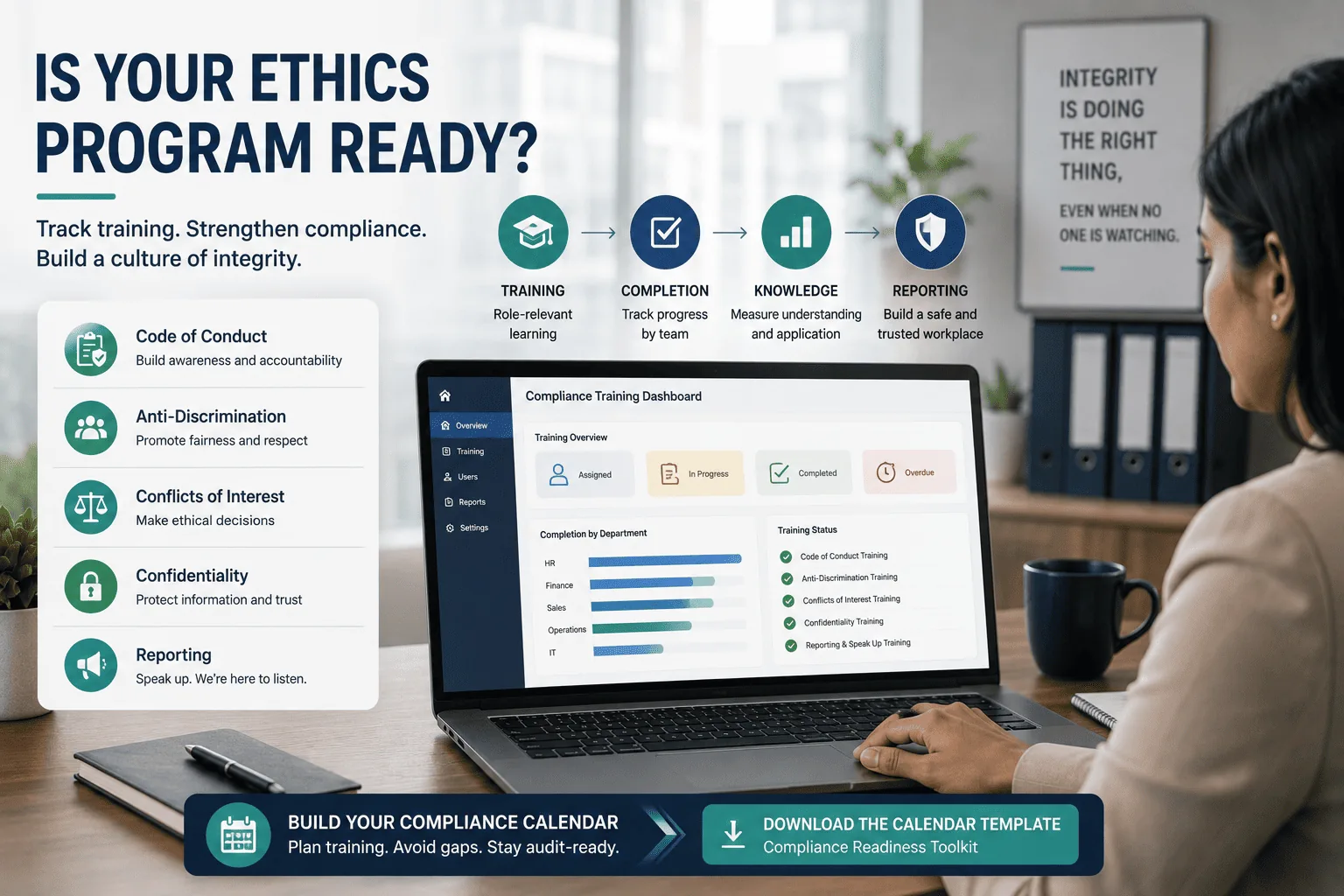
Core code of conduct principles, explained in plain language rather than legal phrasing — what the organization expects around honesty, respect, and professional conduct.
Conflict of interest scenarios specific to your industry — vendor relationships, personal relationships affecting hiring or promotion decisions, outside business activities.
Anti-discrimination and fair treatment principles, covering hiring, promotion, and day-to-day workplace interactions — often paired with, but distinct from, POSH-specific training.
Confidentiality and information handling, especially relevant for teams handling client data, financial information, or proprietary business information.
Reporting mechanisms, making sure every employee knows exactly how and where to raise a concern, and understands they're protected from retaliation for doing so in good faith.
Why Scenario-Based Training Outperforms Policy Recitation
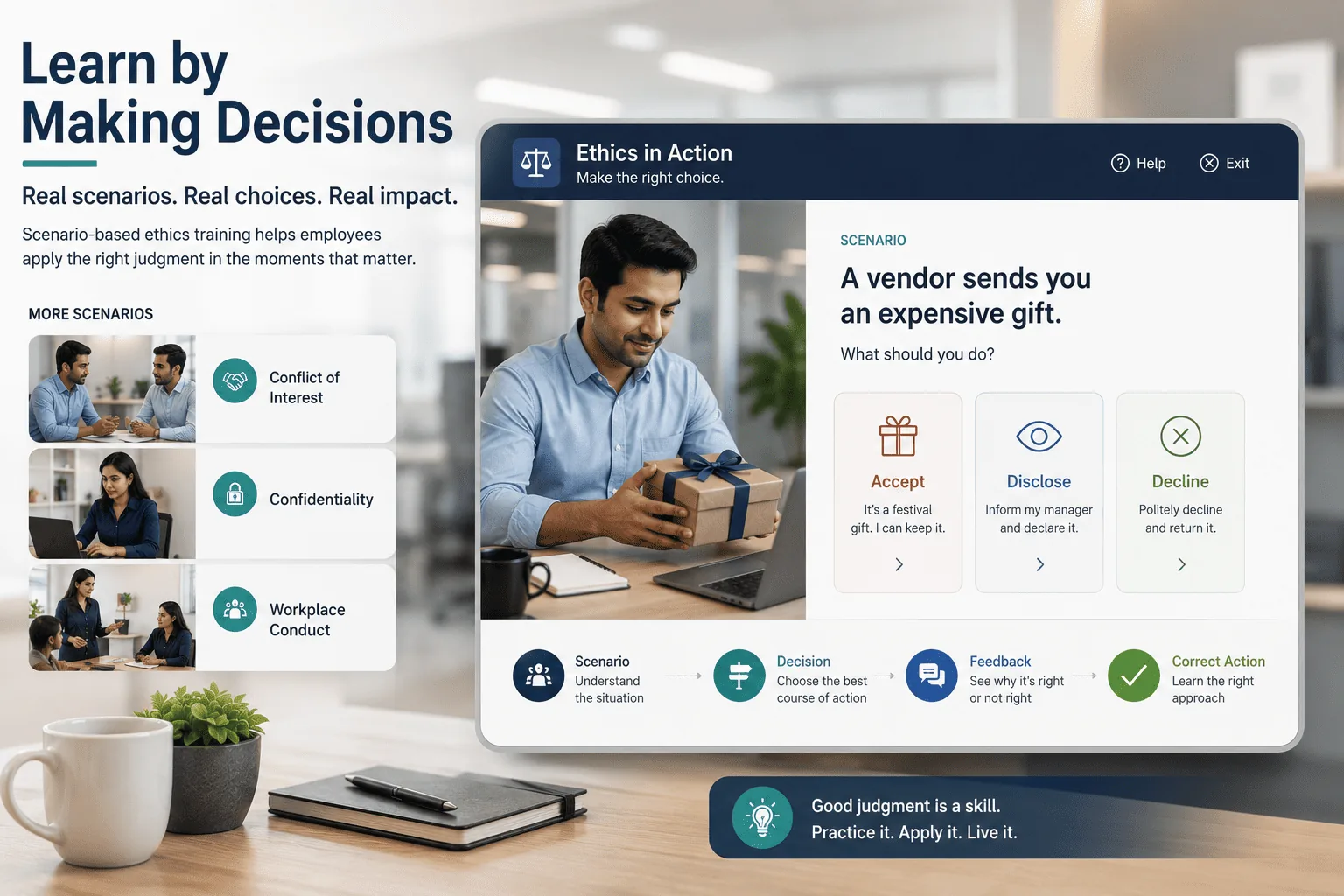
Reading a code of conduct document rarely changes behavior in the actual moment an employee faces an ethical gray area. Scenario-based training — presenting realistic situations like the three above and asking employees to work through the right response — builds the judgment that a rule list alone can't. The three scenarios above aren't hypothetical exercises; they're the actual format effective ethics training should use throughout, not just as occasional examples.
Building a Program That Actually Changes Behavior
Make it role-relevant, not one-size-fits-all. A finance team's conflict-of-interest risks differ from a sales team's. Generic training that ignores this feels irrelevant, and employees mentally check out of it quickly.
Repeat it, don't just deliver it once at onboarding. Annual refreshers, ideally with updated or rotating scenarios, keep the content from becoming background noise new hires vaguely remember from their first week.
Get visible leadership participation. Ethics training that leadership visibly completes and references sends a different signal than training that's clearly positioned as "something HR makes everyone else do."
Track completion by department and level. Gaps in completion — especially among senior leadership, where accountability matters most — are exactly what surfaces during an investigation or audit if training records aren't actively maintained.
Build a clear, genuinely accessible reporting path. A strong training program paired with an unclear or intimidating reporting process still fails. Employees need to know precisely how to raise a concern and trust that doing so is safe.
Frequently Asked Questions
What's the difference between code of conduct training and POSH training? Code of conduct training covers a broader range of ethical topics — conflicts of interest, confidentiality, fair treatment, anti-discrimination generally. POSH training specifically addresses prevention of sexual harassment and is legally mandated in India under a distinct, specific framework. Most organizations run both, often coordinated on the same annual calendar.
How often should workplace ethics training be repeated? At minimum annually, ideally with updated or rotated scenarios so the content doesn't become repetitive background noise that employees stop genuinely engaging with over time.
Why does scenario-based training work better than a policy document? Reading a rule rarely builds the judgment needed to apply it correctly in an ambiguous real situation. Working through a realistic scenario — like a vendor gift or a confidentiality gray area — builds decision-making skill in a way passive policy reading doesn't.
Should ethics training be mandatory for leadership too? Yes, and visibly so. Leadership completing the same training — and referencing it — signals that the program reflects genuine organizational values rather than a rule applied only to junior staff.
What should happen after an employee reports an ethics concern? This should be clearly documented in your policy and communicated during training: a defined investigation process, confidentiality protections, and explicit non-retaliation guarantees, so employees trust that reporting is safe before an issue ever arises.
Planning your annual compliance training calendar? Our Compliance Readiness Toolkit includes a training calendar template to help you sequence ethics, POSH, and other mandatory programs without creating training fatigue — download it to get started.
Primary sources
- The Sexual Harassment of Women at Workplace (Prevention, Prohibition and Redressal) Act, 2013 (India Code, Government of India)
About the author
4Edge Compliance TeamCompliance Training Specialist
Designs compliance training programs at 4Edge IT Solutions covering POSH, the DPDP Act, cybersecurity awareness, ISO and SOC 2 readiness, and workplace ethics for Indian organisations.