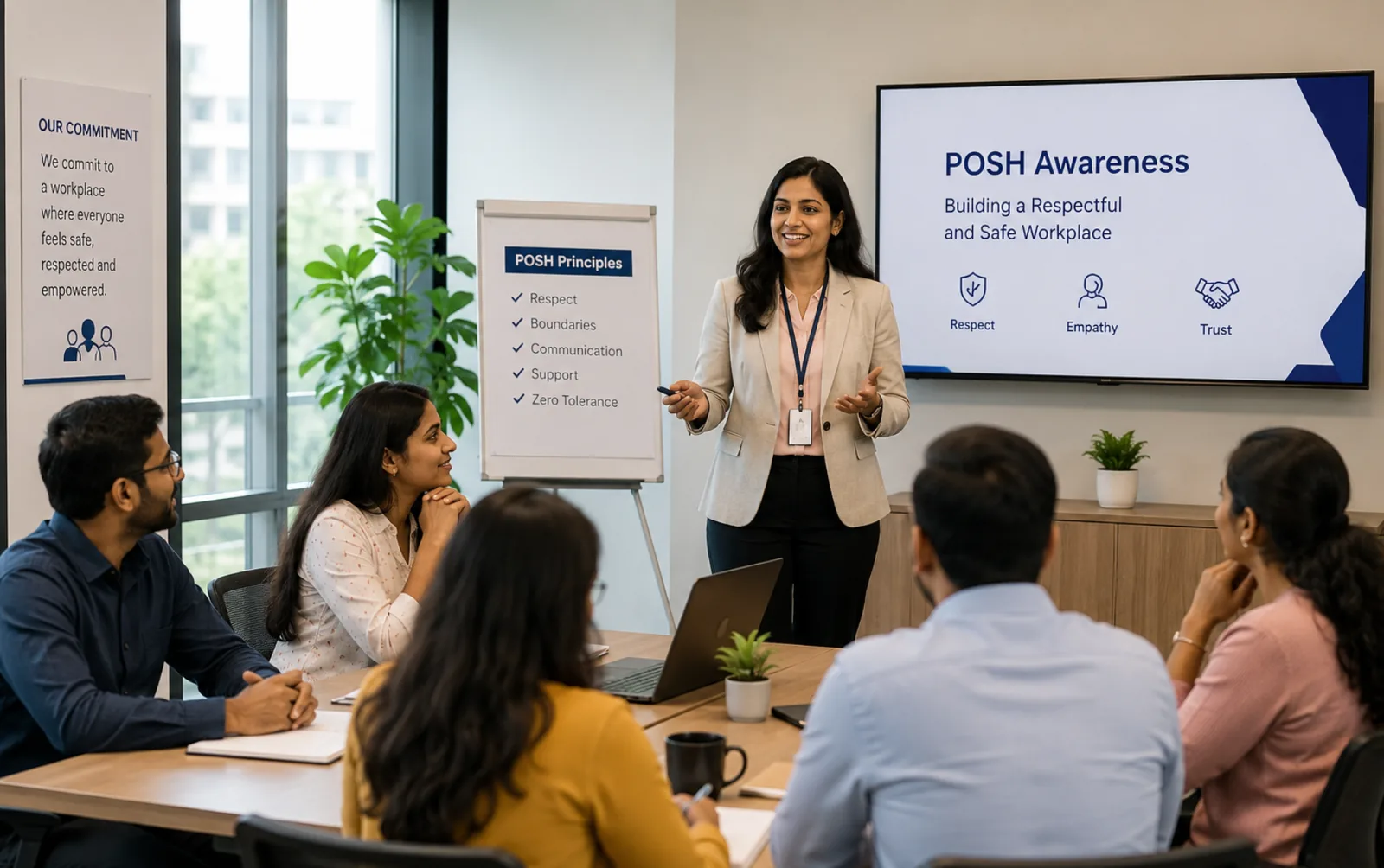
What should HR leaders know about POSH training in 2026?
POSH awareness programs are most effective when they move beyond annual presentations and focus on ongoing reinforcement, practical scenarios, manager preparedness, and employee understanding. Building respectful workplaces requires continuous communication rather than one-time awareness sessions.
Expert Perspective from 4Edge IT Solutions
Many organisations measure awareness through attendance and certificates.
However, meaningful POSH initiatives help employees understand expected behaviours, build manager confidence, improve reporting clarity, and strengthen workplace culture over time.
The organisations that see the greatest impact treat awareness as an ongoing commitment rather than an annual activity.
The discussion around safety in the workplace has shifted.
Only a few years ago POSH training was often seen as an annual compliance activity – something organisations did to tick a box.
Today, HR leaders view it differently.
They know that dealing with harassment at work is not just about complying with the law.
It’s about protecting employees, protecting organisational culture, reducing reputational risk and creating environments where people feel safe and respected.
Yet many organisations continue to ask questions like:
- "Is our annual session enough?"
- "Who actually needs to be trained?"
- "Are employees aware of their responsibilities?"
- "Is our Internal Committee prepared?"
The challenge isn't always the intent.
It’s about understanding what meaningful POSH awareness looks like in the workplace today.
If you are an HR Head, Compliance Officer or a Business Head overseeing employee wellbeing here is what you should know about POSH awareness programs in 2026.
Why POSH Awareness Matters More Than Ever
Every organization wants to foster a respectful workplace.
But policy does not determine behavior.
Employees need clarity.
Managers need to be confident.
Internal Committees must be prepared.
And organisations need to have a consistent message about expected behaviour.
Uncertainty grows when employees do not understand what inappropriate behaviour is, how concerns can be raised or where support exists.
That uncertainty can impact:
- Employee trust,
- Workplace culture,
- Reporting confidence,
- Team dynamics,
- Employer reputation.
POSH awareness programs help bridge these gaps through education and dialogue.
What Is POSH?
POSH stands for the Prevention of Sexual Harassment at the workplace.
The legislation provides a framework intended to support safer workplaces and outlines responsibilities related to awareness, reporting mechanisms, and organisational preparedness.
However, effective POSH initiatives extend beyond explaining definitions.
Employees need practical understanding of:
- Appropriate workplace conduct,
- Respectful communication,
- Boundaries and behaviours,
- Available support mechanisms,
- Their role in maintaining a positive work environment.
Awareness becomes meaningful when employees can connect concepts to everyday situations.
The Biggest Mistake Organisations Make
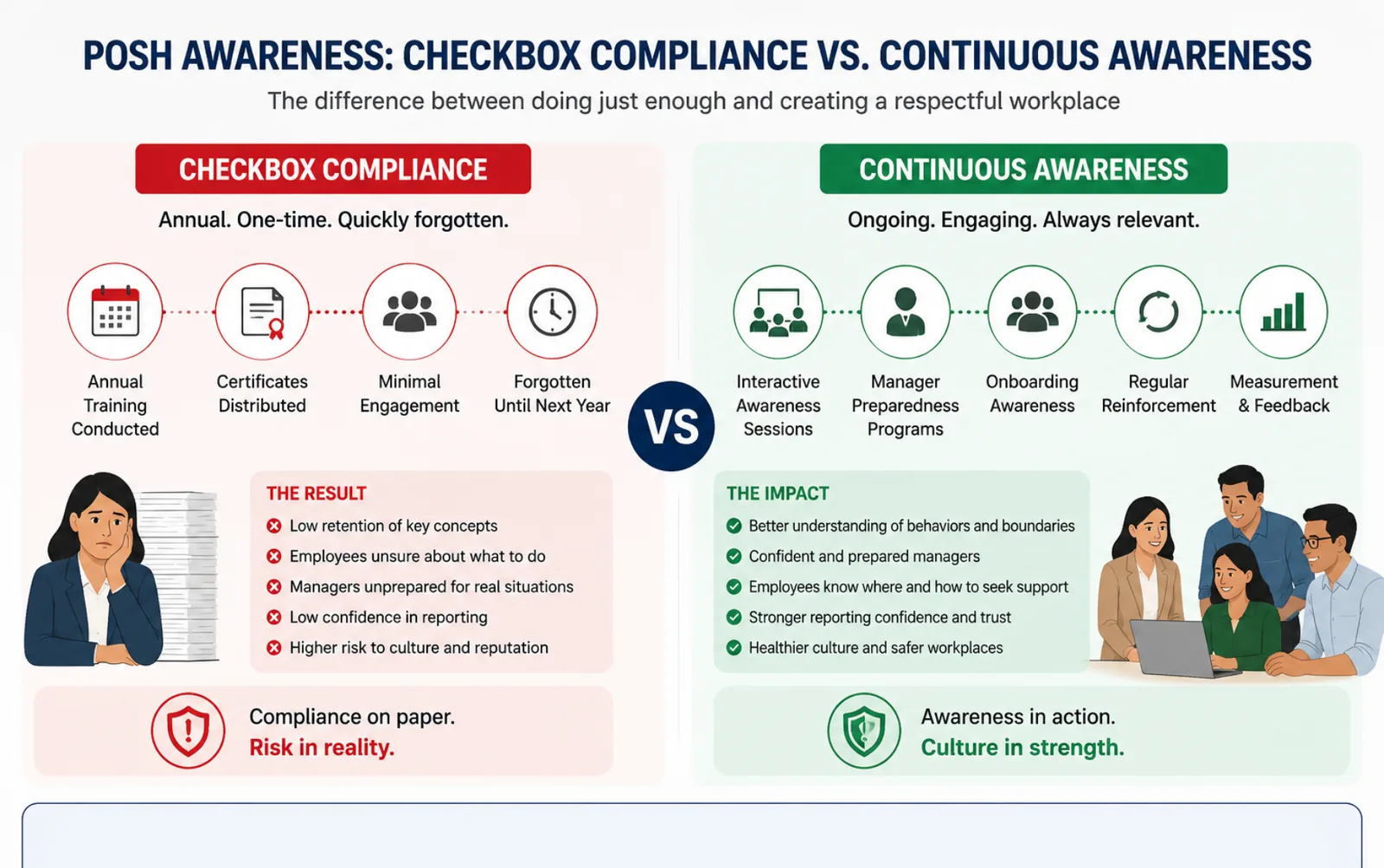
Many organisations approach POSH awareness as a once-a-year presentation.
Employees attend.
Certificates are distributed.
The program concludes.
Until the following year.
The issue?
- Awareness fades.
- New employees join.
- Managers change.
- Hybrid work introduces new challenges.
- Cultural expectations evolve.
A single awareness session rarely creates lasting understanding.
POSH awareness should be viewed as an ongoing workplace conversation—not a one-time event.
5 Questions HR Leaders Should Ask in 2026
Instead of asking whether training happened, ask whether it achieved its purpose.
1. Do Employees Understand What Appropriate Behaviour Looks Like?
Policies explain expectations.
Scenarios build understanding.
Employees should be able to recognise behaviours that contribute to respectful workplaces.
2. Are Managers Prepared to Respond Appropriately?
Managers often become the first point of contact.
They need awareness around:
| Managers Should Know | Why It Matters |
|---|---|
| Listening without judgment | Encourages trust |
| Escalation pathways | Prevents confusion |
| Maintaining confidentiality | Protects employees |
| Appropriate communication | Supports fair processes |
Prepared managers contribute to stronger workplace confidence.
3. Are New Employees Receiving Awareness Early?
Onboarding provides an important opportunity.
Introducing workplace expectations early helps employees understand organisational values from day one.
| Timing | Awareness Opportunity |
|---|---|
| During onboarding | Establish expectations |
| Annual refreshers | Reinforce understanding |
| Manager transitions | Address leadership responsibilities |
| Policy updates | Maintain relevance |
4. Is Awareness Relevant to Today's Workplace?
Modern workplaces extend beyond office walls.
Awareness programs should consider:
- Hybrid work environments,
- Virtual interactions,
- Messaging platforms,
- Team collaboration tools,
- Offsite engagements.
Employees need examples that reflect contemporary work experiences.
5. Can HR Demonstrate Ongoing Commitment?
Employees notice consistency.
Regular communication, visible leadership support, and accessible awareness initiatives reinforce organisational commitment.
Workplace culture is shaped through repeated signals—not isolated events.
Scenario: The Organisation That Thought It Had Done Enough
A growing organisation conducted annual awareness sessions consistently.
Completion rates exceeded expectations.
However, an internal employee survey revealed uncertainty.
Employees weren't confident about:
- How concerns could be raised,
- Who to approach,
- Whether virtual interactions were included,
- What behaviours crossed professional boundaries.
The issue wasn't a lack of training.
It was a lack of clarity.
By introducing practical scenarios, periodic reminders, onboarding awareness, and manager-focused sessions, the organisation strengthened employee confidence significantly.
The takeaway?
Awareness effectiveness isn't measured by attendance alone.
It's measured by understanding.
What Effective POSH Awareness Programs Look Like
Effective programs balance sensitivity with practicality.
They create space for learning without fear.
They encourage dialogue while reinforcing expectations.
Key characteristics include:
| Effective Programs | Less Effective Programs |
|---|---|
| Scenario-based discussions | Policy-heavy presentations |
| Relevant workplace examples | Generic examples |
| Inclusive participation | Passive attendance |
| Periodic reinforcement | Once-a-year activity |
| Manager involvement | HR-only ownership |
| Practical guidance | Legal jargon |
Employees remember experiences they can relate to.
The Hidden Cost of Treating POSH as a Checkbox
The true cost isn't measured through awareness budgets.
It appears elsewhere.
| Hidden Cost | Potential Impact |
|---|---|
| Employee uncertainty | Reduced trust |
| Lack of awareness | Confusion around expectations |
| Inconsistent messaging | Cultural gaps |
| Limited manager preparedness | Delayed responses |
| Low reporting confidence | Employee discomfort |
| Reactive approaches | Increased organisational stress |
Creating respectful workplaces supports both employee wellbeing and organisational resilience.
How 4Edge Supports Workplace Awareness
At 4Edge, we help organisations deliver practical awareness experiences designed around employee understanding and engagement.
Our programs focus on:
Workplace Awareness
Helping employees understand expected behaviours and responsibilities.
Scenario-Based Learning
Using relatable situations to improve comprehension.
Digital Learning Delivery
Supporting awareness initiatives through scalable learning experiences.
K-Nest LMS Integration
Enabling enrolments, tracking, certificates, and reporting.
Reinforcement Opportunities
Helping organisations sustain awareness beyond a single session.
Our objective isn't simply to complete training.
It's to support workplaces where employees understand expectations and contribute positively to organisational culture.
Before Your Next Awareness Initiative…
Ask yourself:
- Would employees know what to do if they witnessed inappropriate behaviour?
- Would managers respond confidently?
- Would new employees understand expectations?
If the answer feels uncertain, now is a good time to review your current approach.
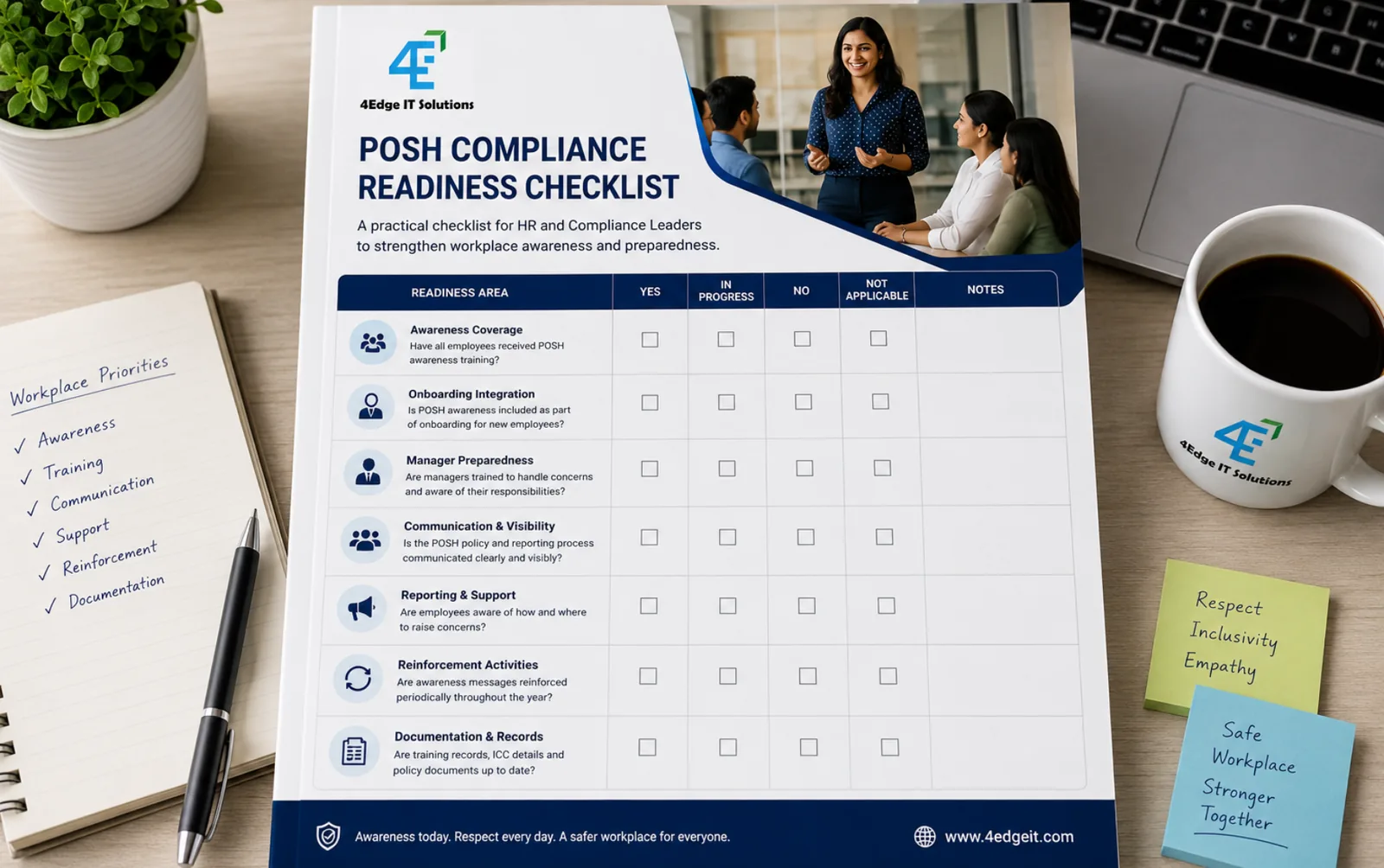
Free Download: POSH Compliance Readiness Checklist
Evaluate whether your organisation's awareness initiatives support employee understanding and ongoing reinforcement.
Inside the Toolkit
| The Checklist Helps You Review | Why It Matters |
|---|---|
| Awareness coverage | Identify participation gaps |
| Onboarding integration | Support new employees |
| Manager preparedness | Improve confidence |
| Communication practices | Reinforce expectations |
| Reinforcement activities | Sustain awareness |
| Documentation practices | Improve consistency |
Take a practical first step toward strengthening workplace awareness and supporting a respectful organisational culture.
Frequently Asked Questions
Who should participate in POSH awareness programs?
Awareness initiatives are most effective when they include employees across levels and functions, helping create a shared understanding of workplace expectations.
How often should organisations conduct awareness programs?
Many organisations schedule annual initiatives while reinforcing awareness through onboarding activities and periodic reminders throughout the year.
Why are scenarios important in awareness programs?
Scenarios help employees connect concepts to real-life situations, improving understanding and recall.
Should managers receive separate awareness sessions?
Managers often benefit from focused discussions that help them understand their responsibilities and communication approaches.
Can digital learning support awareness initiatives?
Yes. Digital learning enables organisations to scale awareness efforts, support distributed teams, track participation, and reinforce key messages over time.
Respectful workplaces don't emerge from policies alone.
They are built through shared understanding, consistent communication, and ongoing reinforcement.
The most effective organisations recognise that awareness isn't simply an annual obligation.
It's part of how culture is shaped.
Because the real question isn't:
"Did we conduct a session?"
It's:
"Do our employees understand what it means to create a respectful workplace?"
Primary sources
- The Sexual Harassment of Women at Workplace (Prevention, Prohibition and Redressal) Act, 2013 (India Code, Government of India)
- SHe-Box: Sexual Harassment Electronic Box (Ministry of Women and Child Development)
About the author
4Edge Compliance TeamCompliance Training Specialist
Designs compliance training programs at 4Edge IT Solutions covering POSH, the DPDP Act, cybersecurity awareness, ISO and SOC 2 readiness, and workplace ethics for Indian organisations.