
India's data privacy landscape is changing. Here's what every business should know to prepare for DPDP compliance in 2026.
Data Privacy Is No Longer Just an IT Concern
A customer requests that your company delete their personal data.
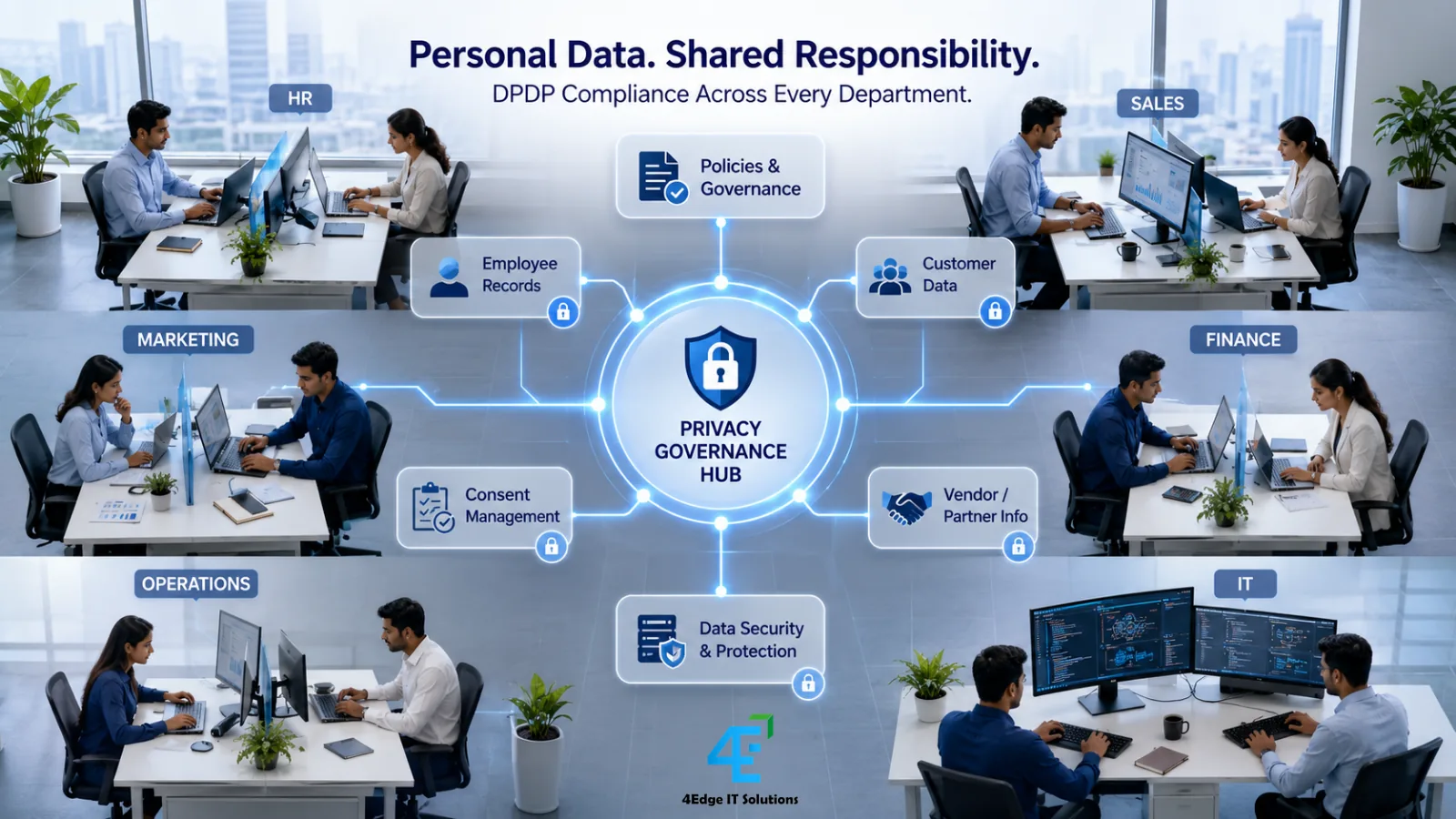
Your HR team stores employee records in an app. Marketing has customer data in a CRM. Sales keeps spreadsheets of prospects and Finance keeps another system with vendor info.
The request sounds simple enough — until you realize that nobody knows precisely where all that personal data resides.
This is becoming increasingly common as organizations deal with more and more digital information across multiple departments and platforms.
The Digital Personal Data Protection (DPDP) Act, 2023 is a milestone in India’s data privacy journey. It encourages organisations to move beyond treating personal data as an operational asset and to manage it with greater accountability, transparency and governance.
For business leaders, compliance is no longer just about implementing security controls. It requires rethinking how personal data is collected, processed, shared, retained, and protected throughout its lifecycle.
The organizations that prepare early won't simply reduce regulatory risk—they'll build stronger customer trust, improve governance, and establish more resilient business processes.
Why DPDP Matters to Every Business
One of the biggest misconceptions surrounding the DPDP Act is that it only affects technology companies or large enterprises.
In reality, if your organization collects or processes digital personal data, the principles of the Act are likely to be relevant to your operations.
This includes businesses that handle:
- Employee information
- Customer records
- Vendor and supplier data
- Website enquiries
- Marketing databases
- Mobile application users
- Recruitment information
Whether you're a manufacturing company, healthcare provider, educational institution, professional services firm, retailer, or software company, personal data is now part of everyday business operations.
The question is no longer "Do we collect personal data?"
It's "Can we demonstrate that we're managing it responsibly?"
DPDP Is About Governance—Not Just Technology
Many organizations begin their compliance journey by evaluating cybersecurity tools.
While security remains essential, privacy compliance extends well beyond firewalls, antivirus software, and access controls.
The DPDP framework encourages businesses to establish governance across people, processes, and technology.
| Traditional Approach | DPDP-Oriented Approach |
|---|---|
| IT manages data security | Every department shares responsibility |
| Focus on preventing cyber attacks | Focus on responsible data handling |
| Policies created once | Continuous governance and improvement |
| Compliance driven by audits | Compliance embedded into daily operations |
| Technology-first thinking | People, process, and technology working together |
Privacy is no longer an isolated compliance activity.
It becomes part of how an organization operates.
A Simple DPDP Readiness Check
Before considering new tools or technologies, assess your current practices.
| Question | Status |
|---|---|
| Do you know what personal data your organization collects? | ☐ |
| Is there a documented privacy policy? | ☐ |
| Are employees trained on handling personal information? | ☐ |
| Is consent managed consistently across systems? | ☐ |
| Can you identify where sensitive data is stored? | ☐ |
| Is there a process for responding to privacy requests? | ☐ |
| Do you have an incident response procedure? | ☐ |
If several of these questions remain unanswered, it's a strong indication that your organization should begin reviewing its privacy governance framework.
Where Most Organizations Struggle
Businesses rarely struggle because they lack technology.
They struggle because personal data is scattered across departments, applications, spreadsheets, and shared drives.
Consider a typical organization.
Human Resources manages employee records.
Marketing collects newsletter subscribers.
Sales maintains customer information.
Finance stores vendor details.
Operations receive customer documents through email.
Each department follows its own process.
Without clear governance, answering even a simple privacy request becomes time-consuming and inconsistent.
This fragmentation creates operational challenges long before it creates compliance challenges.
Privacy Is Becoming Everyone's Responsibility
One of the most significant shifts introduced by modern privacy regulations is the shared responsibility model.
Compliance cannot sit exclusively with Legal or IT.
Every department that handles personal data has a role to play.
| Department | Primary Responsibility |
|---|---|
| Leadership | Governance, accountability and decision-making |
| HR | Employee data management |
| IT | Security controls and access management |
| Legal & Compliance | Policies, contracts and regulatory oversight |
| Marketing | Consent and communication preferences |
| Sales | Responsible customer data handling |
| Operations | Process compliance and documentation |
Organizations that succeed in privacy management create a culture where employees understand not only what the policies are, but why they matter.
4Edge Insight
Technology can secure data, but only people can protect trust.
Many privacy incidents don't happen because systems fail. They happen because employees unknowingly share information, respond to phishing emails, or follow inconsistent processes. Building awareness across the workforce is just as important as implementing technical safeguards.
Privacy Begins With Understanding Your Data
Before implementing new policies or software, organizations should answer a fundamental question:
What personal data do we actually have?
A structured data discovery exercise helps organizations understand:
- What personal data is collected
- Why it is collected
- Where it is stored
- Who has access
- How long it is retained
- When it should be deleted
Without this visibility, privacy governance becomes reactive rather than proactive.
Think of it as creating an inventory before managing a warehouse.
You cannot protect information you don't know exists.
Compliance Is a Journey, Not a One-Time Project
Many businesses approach compliance as a checklist exercise.
Complete the documentation.
Publish the policies.
Conduct one awareness session.
Move on.
In reality, privacy compliance requires continuous review as businesses introduce new applications, collect additional data, onboard employees, and expand operations.
Organizations should think about compliance as an ongoing governance program rather than a single implementation project.
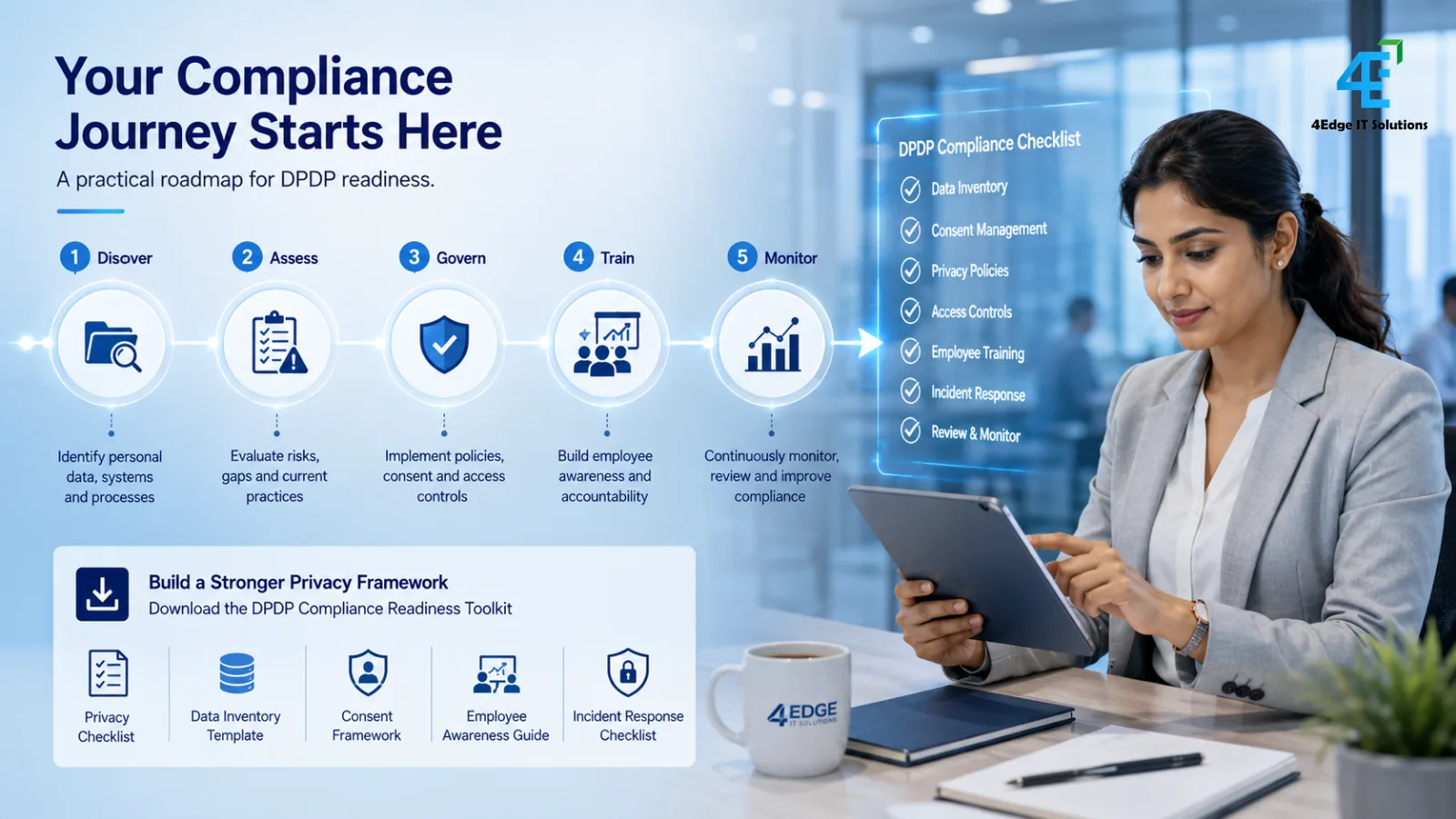
A practical roadmap includes four stages:
| Phase | Objective |
|---|---|
| Discover | Identify personal data, systems and business processes |
| Assess | Review current policies, risks and gaps |
| Implement | Improve governance, awareness and operational controls |
| Monitor | Regularly review, audit and refine processes |
This phased approach makes implementation more manageable while encouraging continuous improvement.
Why Employee Awareness Is the Foundation of DPDP Compliance
Technology alone cannot ensure compliance.
In fact, many privacy incidents occur not because security systems fail, but because employees unknowingly make mistakes—sharing personal information with the wrong recipient, clicking phishing links, storing sensitive files in unsecured locations, or collecting customer data without understanding the purpose.
That's why employee awareness is one of the most important components of a successful DPDP compliance program.
Every employee who interacts with personal data should understand:
- What qualifies as personal data
- How personal data should be collected and used
- Why consent matters
- How to identify potential privacy risks
- What to do if a data incident occurs
Privacy shouldn't be treated as an annual compliance session. It should become part of everyday workplace behaviour.
A Practical Example
Imagine a growing manufacturing company with operations across multiple cities.
The HR team maintains employee records in one system. Sales captures customer information through a CRM, while Finance stores vendor details separately. Marketing manages email subscribers using another platform, and service requests arrive through multiple channels.
Each department follows its own process for collecting and storing personal information.
Now imagine a customer requests access to their personal data or asks for it to be deleted.
Without a centralized governance framework, teams spend days identifying where the information exists, who owns it, and whether it has already been shared elsewhere.
After introducing standardized privacy policies, role-based access controls, employee awareness training, and a clear data governance process, the same request can be managed efficiently and consistently.
The difference isn't just better technology—it's better governance.
Common Mistakes Businesses Make
Organizations often delay compliance because they believe it requires a major technology investment.
In reality, many challenges stem from poor processes rather than missing software.
| Common Mistake | Better Approach |
|---|---|
| Treating DPDP as an IT project | Make privacy a business-wide responsibility |
| Waiting until enforcement begins | Build readiness proactively |
| Focusing only on policies | Combine policies with employee awareness |
| Collecting unnecessary personal data | Collect only what is required |
| One-time compliance exercise | Continuously review and improve processes |
The organizations that succeed are those that integrate privacy into daily operations rather than treating it as a separate compliance activity.
Building a Culture of Privacy
Strong privacy practices don't happen because employees memorize regulations.
They happen because employees understand the impact of their decisions.
Creating a privacy-first culture means encouraging people to ask simple questions before handling personal data:
- Do I really need this information?
- Have we obtained the appropriate consent?
- Is this the correct place to store it?
- Who should have access to it?
- How long should we retain it?
- What happens if this information is shared accidentally?
When these questions become part of everyday work, compliance becomes much easier to sustain.
Your DPDP Readiness Checklist
Use this checklist as a starting point to evaluate your organization's current preparedness.
| Readiness Area | Status |
|---|---|
| Personal data inventory completed | ☐ |
| Privacy policies reviewed and updated | ☐ |
| Roles and responsibilities clearly defined | ☐ |
| Consent management process documented | ☐ |
| Employee awareness training completed | ☐ |
| Data retention and deletion procedures established | ☐ |
| Incident response plan documented | ☐ |
| Regular compliance reviews scheduled | ☐ |
A completed checklist doesn't guarantee compliance, but it provides a strong foundation for building a mature privacy program.
Download the DPDP Compliance Readiness Toolkit
Preparing for DPDP compliance becomes easier with the right resources.
Our Compliance Readiness Toolkit includes practical templates and checklists to help organizations begin their privacy journey with confidence.
Inside the toolkit you'll find:
- DPDP Awareness Guide
- Privacy Readiness Checklist
- Data Inventory Template
- Consent Management Worksheet
- Employee Awareness Planner
- Incident Response Checklist
Download the DPDP Guide and use it to evaluate your organization's current privacy practices.
Frequently Asked Questions
Does the DPDP Act apply only to large enterprises?
No. Any organization that processes digital personal data should understand how the Act applies to its operations, regardless of size or industry.
Is cybersecurity enough for DPDP compliance?
Cybersecurity is an important part of compliance, but it must be supported by governance, documented processes, employee awareness, and responsible data handling practices.
Why is employee awareness so important?
Employees handle personal data every day. Awareness helps reduce accidental disclosures, phishing incidents, and poor data handling practices that technology alone cannot prevent.
Where should organizations begin?
Start by identifying the personal data you collect, understanding where it is stored, reviewing existing processes, and educating employees about their responsibilities.
Is DPDP compliance a one-time project?
No. Privacy governance is an ongoing process that requires regular reviews, updates, awareness programs, and continuous improvement as business processes evolve.
The DPDP Act represents more than a regulatory milestone—it reflects a broader shift toward responsible data governance in India's digital economy.
Organizations that approach compliance as an opportunity rather than an obligation will be better positioned to strengthen customer trust, improve operational transparency, and reduce long-term business risk.
The journey doesn't begin with buying new software or creating lengthy policy documents.
It begins with understanding your data, establishing clear governance, and building a workforce that knows how to handle personal information responsibly.
In an increasingly digital world, trust has become one of the most valuable business assets—and effective data privacy practices are essential to earning and maintaining that trust.
Primary sources
- Digital Personal Data Protection Act, 2023 and DPDP Rules, 2025 (Ministry of Electronics and Information Technology (MeitY))
About the author
4Edge Compliance TeamCompliance Training Specialist
Designs compliance training programs at 4Edge IT Solutions covering POSH, the DPDP Act, cybersecurity awareness, ISO and SOC 2 readiness, and workplace ethics for Indian organisations.