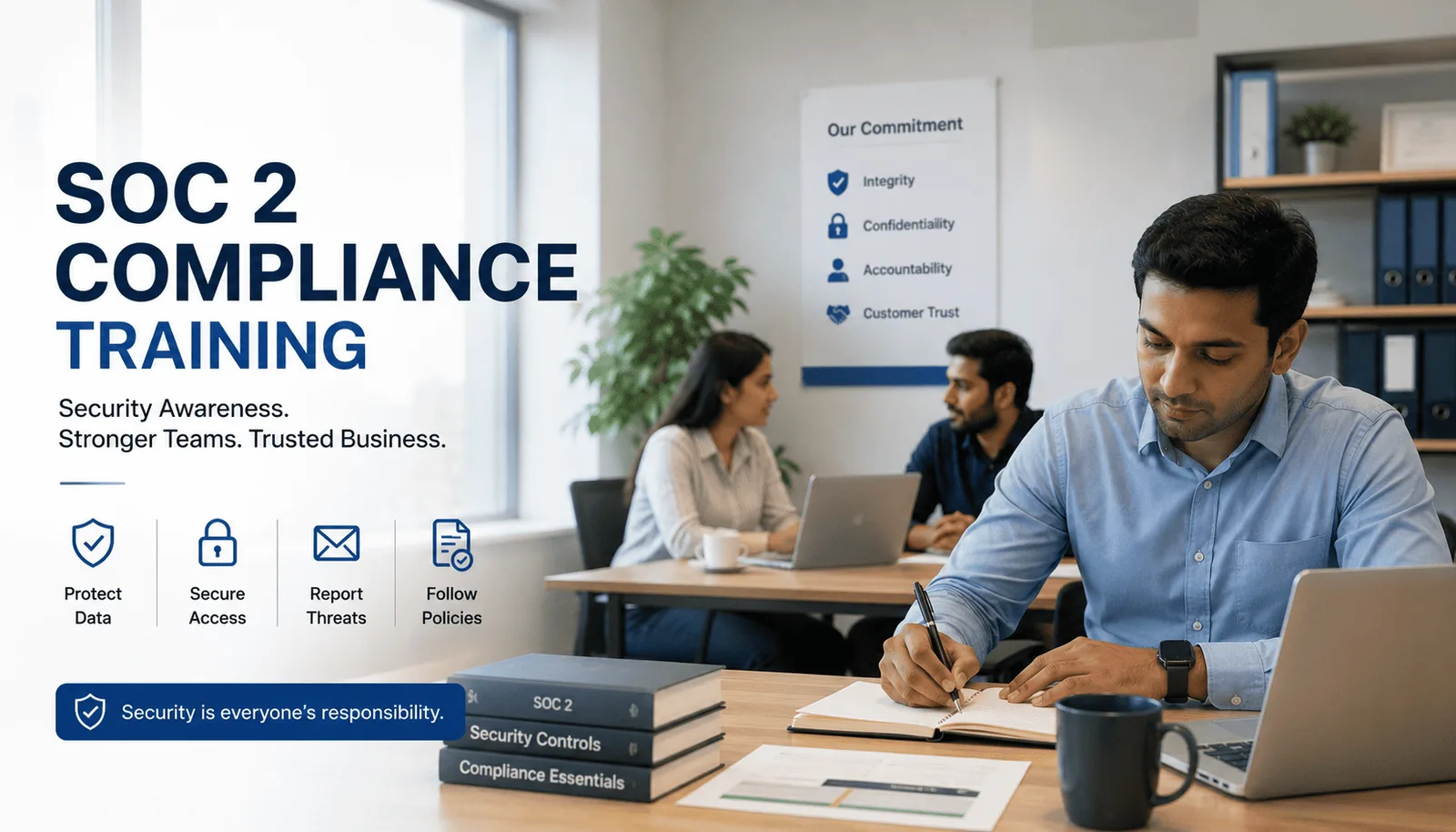
SOC 2 has become the default trust signal for Indian SaaS and services companies selling into US and global enterprise markets. Getting certified usually gets the technical controls right — access management, encryption, monitoring. What trips up more companies at audit time is the human layer: whether employees actually understand and follow the security practices those controls depend on. Auditors don't just check whether policies exist on paper. They check whether employees can explain them in their own words.
What SOC 2 Auditors Actually Test For
Employee interviews across departments, not just IT. Auditors routinely interview staff outside the security team to verify that security awareness isn't just a policy document sitting untouched in a shared drive.
Whether documented training happened, and when. Auditors want dated, specific evidence — completion records, content covered, who attended — not a general assurance that "training happens."
Whether behavior matches policy, not just whether policy exists. A well-configured access control system still fails an audit's intent if an employee shares a password, uses a personal device to access sensitive systems, or can't recognize a phishing attempt targeting company credentials.
Consistency over time, especially for Type II audits. SOC 2 Type II specifically assesses controls over a period of months, meaning consistent employee behavior across that entire window — not a one-time training event before the audit — is what actually gets evaluated.
SOC 2 Training Checklist by Role
☐ All employees: Basic data handling practices, password and access hygiene, phishing recognition and reporting, incident escalation procedures.
☐ Engineering and IT teams: Secure development practices, access control principles, change management procedures, and how their daily work maps to specific SOC 2 controls.
☐ Customer-facing and support teams: How customer data must be handled, what information can and can't be shared externally, and escalation procedures for data-related customer requests.
☐ Managers and team leads: Their role in enforcing access reviews, offboarding procedures when employees leave, and reinforcing security practices day-to-day within their teams.
☐ New hires and contractors: Security training completed before or immediately upon system access being granted — a common audit gap is contractors with access who were never included in the training program at all.
Building a Program Auditors Actually Accept
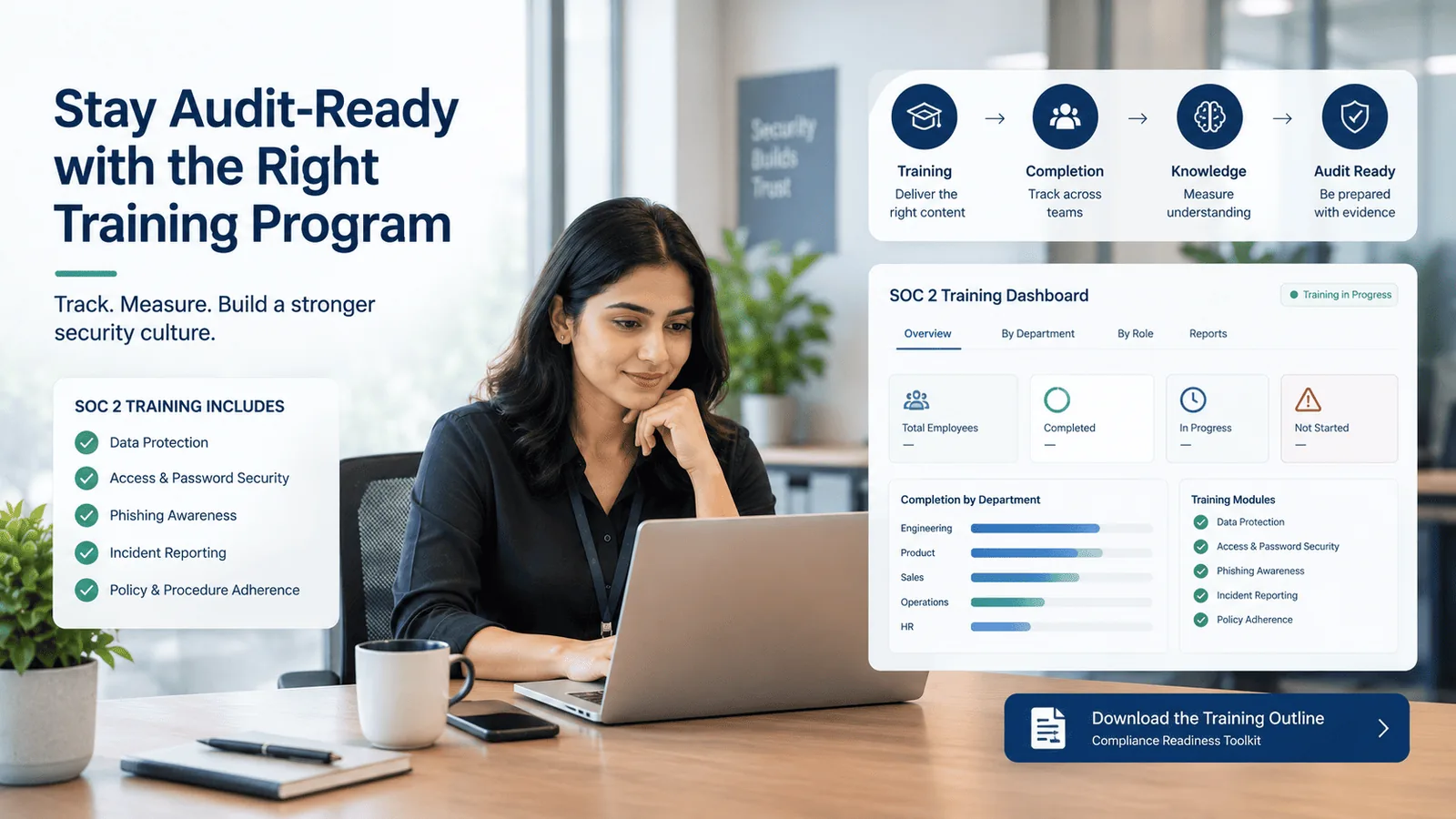
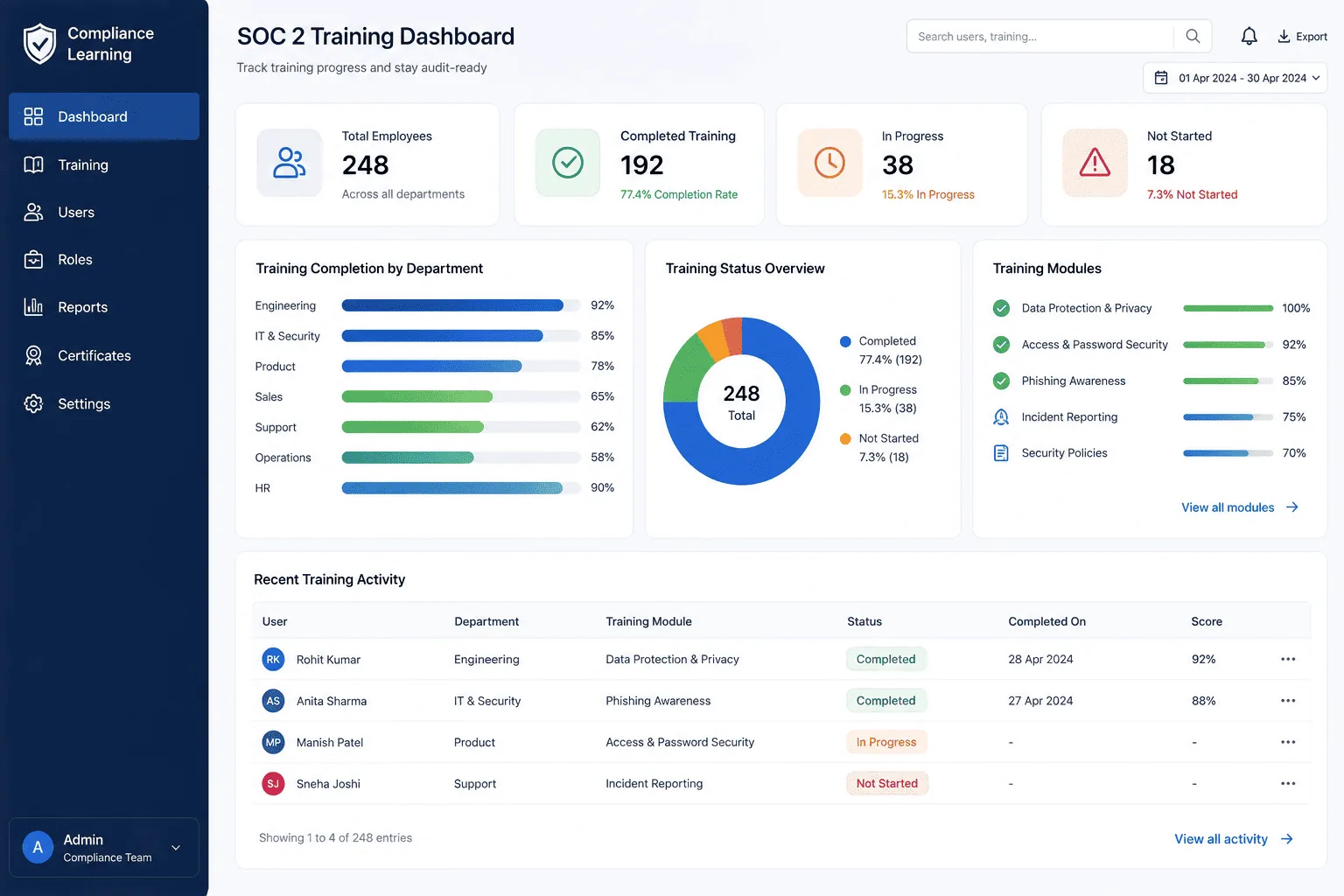
Document the training, not just deliver it. Auditors want evidence — completion records, dates, and content covered — not just confirmation that training "happened." A learning platform with tracking and reporting makes this dramatically easier than an in-person session with a paper sign-in sheet.
Make it recurring, not one-time. SOC 2 Type II specifically evaluates controls over time. Annual refreshers, not a single onboarding session, are what demonstrates sustained awareness to an auditor reviewing a multi-month period.
Tie training content directly to your actual controls. Generic security awareness content is a weaker audit artifact than training that explicitly references your organization's specific policies and control environment.
Test comprehension, not just attendance. A short knowledge check after training gives you — and your auditor — actual evidence that the content landed, not just that someone clicked through the slides.
Keep records audit-ready year-round. Waiting until audit season to assemble training records is a common, entirely avoidable scramble. A platform that maintains ongoing completion data removes this pressure completely.
Common Gaps That Surface in SOC 2 Audits
- New hires who joined between training cycles and never completed onboarding security training
- Contractors and vendors with system access who were never included in the training program
- Training content that hasn't been updated since the last policy revision
- No clear, exportable record of who completed which training, and when
Each of these is a straightforward fix once identified. The risk is not catching them until an auditor does, at which point they become a documented finding rather than a quiet correction.
Frequently Asked Questions
Does SOC 2 explicitly require employee security awareness training? Yes. SOC 2's Trust Services Criteria explicitly expect that personnel understand their role in maintaining controls — it's evaluated as part of the audit, not treated as optional supplementary practice.
How often does SOC 2 training need to happen? At minimum annually, with onboarding training for new hires completed before or immediately upon system access being granted. For SOC 2 Type II, consistent training coverage across the full audit period matters more than a single pre-audit session.
What's the difference between SOC 2 Type I and Type II training requirements? Type I assesses controls at a single point in time, so training evidence needs to show it happened before that date. Type II assesses controls over a period of months, meaning training needs to be consistently delivered and documented throughout that entire window, not just once beforehand.
Do contractors and vendors need the same SOC 2 training as employees? Anyone with access to relevant systems or data should complete role-appropriate training. Contractors and vendors with system access are a common audit gap when they're left out of the formal training program.
What evidence should compliance teams keep for SOC 2 training? Timestamped completion records per employee, the specific content or module version covered, and ideally knowledge check results — all easily exportable, since auditors will request this evidence directly.
Preparing for a SOC 2 audit or building out your compliance training program? Our Compliance Readiness Toolkit includes a training outline built for exactly this — download it to structure your program before audit season.
Primary sources
About the author
4Edge Compliance TeamCompliance Training Specialist
Designs compliance training programs at 4Edge IT Solutions covering POSH, the DPDP Act, cybersecurity awareness, ISO and SOC 2 readiness, and workplace ethics for Indian organisations.