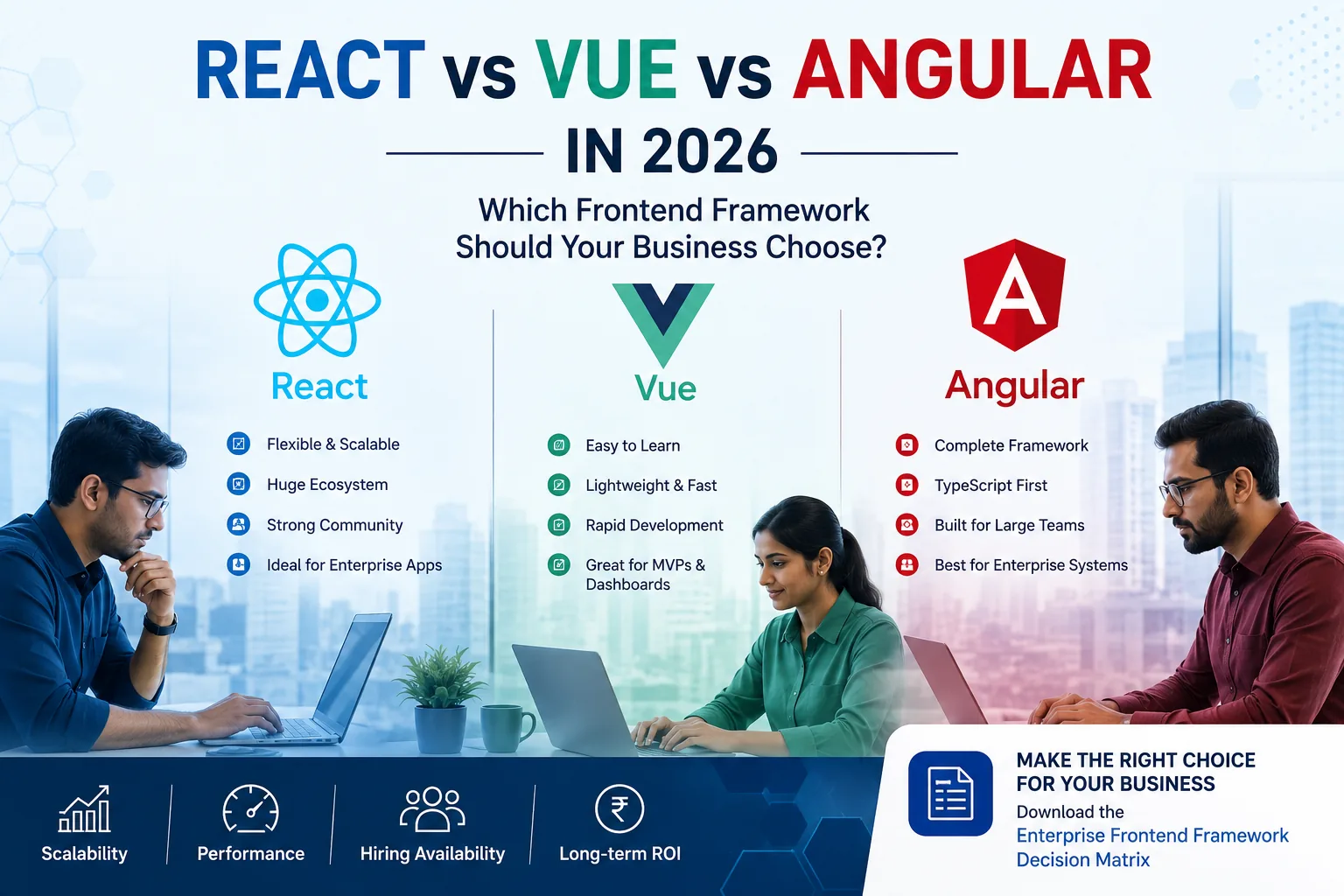
React, Vue, and Angular are all excellent frontend frameworks in 2026. React is ideal for scalable enterprise applications and SaaS platforms, Vue is best for rapid development and lightweight applications, while Angular excels in large enterprise systems requiring structured architecture and long-term maintainability.
Choosing a frontend framework isn't just a technical decision anymore—it's a business decision.
The framework your organization selects today will influence development speed, hiring costs, product scalability, maintenance effort, user experience, and even the total cost of ownership over the next five to ten years.
In 2026, React, Vue, and Angular continue to dominate the frontend development landscape. Each has matured significantly, boasts a strong community, and powers thousands of enterprise applications worldwide. But they aren't interchangeable. A framework that's perfect for a startup MVP may not be the right choice for a banking platform or a multi-tenant SaaS application.
Rather than asking, "Which framework is the best?", technology leaders should ask a more important question:
"Which framework aligns with our business goals, product roadmap, team capabilities, and long-term vision?"
This guide compares React, Vue, and Angular from a business perspective to help CTOs, Engineering Managers, and business leaders make a confident technology decision.
Why Your Frontend Framework Matters More Than Ever
A frontend framework is the foundation of your digital product. Every feature your customers interact with—from dashboards and workflows to reports and customer portals—is built on it.
Making the wrong choice can lead to slower development cycles, difficulty hiring developers, increased maintenance costs, and expensive migrations later.
Choosing the right framework, on the other hand, can help organizations:
- Deliver products faster
- Improve user experience
- Reduce development costs
- Scale applications confidently
- Simplify long-term maintenance
- Attract skilled developers
- Accelerate innovation
Think of your frontend framework as the architecture of a commercial building. A solid foundation supports future growth, while a poor one creates limitations that become increasingly expensive to fix.
React, Vue & Angular at a Glance
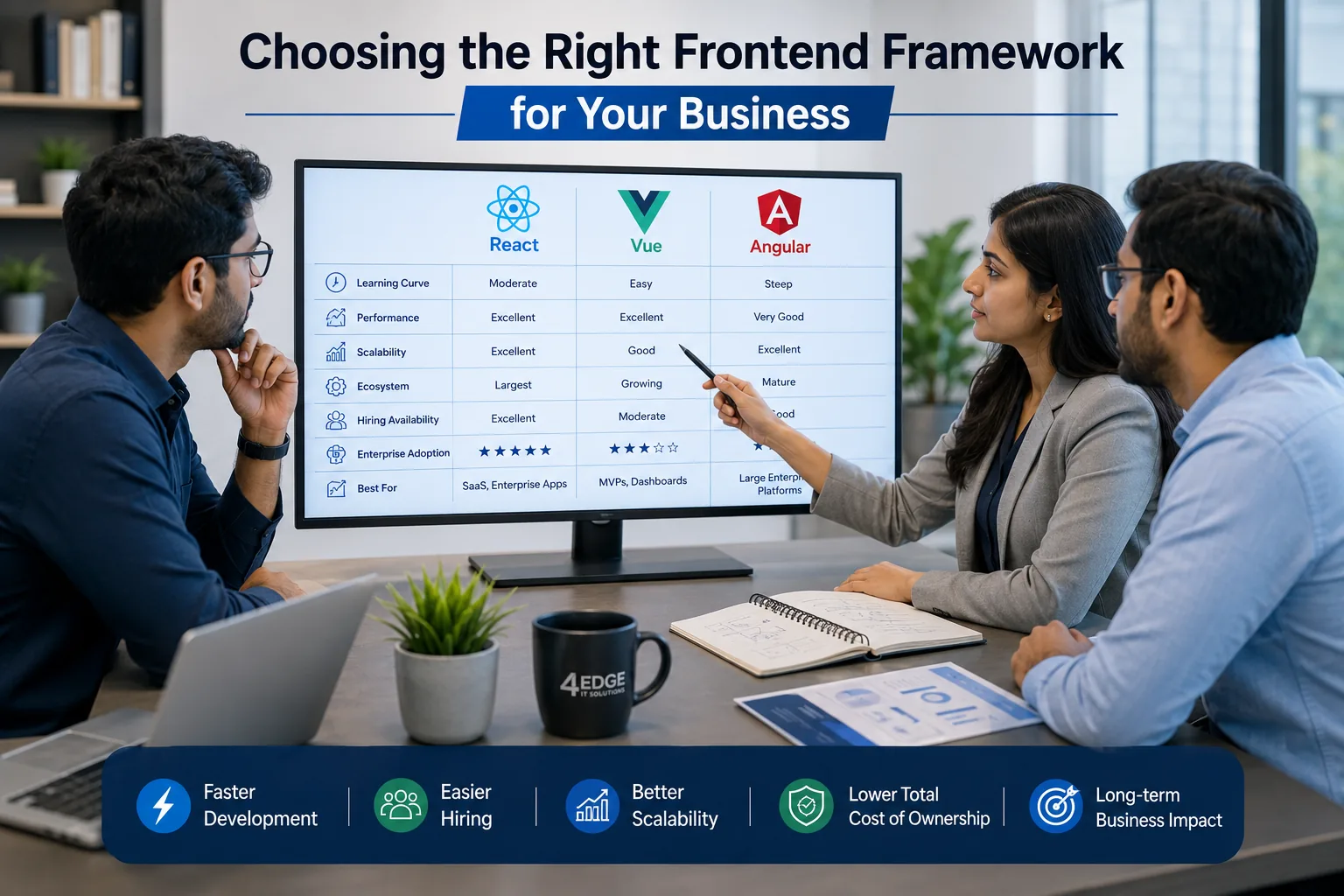
| Feature | React | Vue | Angular |
|---|---|---|---|
| Learning Curve | Moderate | Easy | Steep |
| Enterprise Adoption | ★★★★★ | ★★★☆☆ | ★★★★★ |
| Performance | Excellent | Excellent | Very Good |
| Community Support | Largest | Growing | Mature |
| Hiring Availability | Excellent | Moderate | Good |
| Scalability | Excellent | Good | Excellent |
| Best For | SaaS, Enterprise Apps | MVPs, Dashboards | Large Enterprise Platforms |
All three frameworks are capable of building modern web applications. The difference lies in how they approach development and the type of projects they are best suited for.
React: The Enterprise Favorite
React has remained one of the most popular frontend technologies because of its flexibility, performance, and massive ecosystem.
Originally developed by Meta, React allows developers to build reusable components, making applications easier to maintain as they grow.
For enterprises, React offers several advantages:
- Large developer community
- Mature ecosystem
- Excellent performance
- Strong support for reusable components
- Integration with modern technologies like Next.js and React Native
- Easier hiring due to widespread adoption
Many global SaaS platforms, enterprise portals, healthcare systems, educational platforms, and e-commerce applications rely on React because it scales well with growing business requirements.
Pros
- Massive ecosystem
- Excellent scalability
- Large talent pool
- Strong community support
- Great performance
Considerations
- Requires selecting additional libraries
- Project structure depends on development standards
- Flexibility can lead to inconsistency without governance
Best suited for
- Enterprise SaaS
- Customer portals
- Learning Management Systems
- Healthcare platforms
- FinTech applications
- Large web applications
Vue: Simplicity Without Compromising Performance
Vue has gained popularity by making frontend development approachable.
Its gentle learning curve allows development teams to become productive quickly while still offering modern capabilities expected from enterprise applications.
Vue is particularly attractive for startups and organizations looking for rapid product delivery.
Advantages include:
- Easy to learn
- Lightweight architecture
- Fast development
- Excellent documentation
- Clean syntax
For organizations launching MVPs or internal business applications, Vue often enables quicker delivery compared to more complex frameworks.
Pros
- Fast onboarding
- Excellent performance
- Lower development complexity
- Lightweight applications
Considerations
- Smaller enterprise ecosystem
- Smaller developer community than React
- Fewer enterprise-ready libraries
Best suited for
- Startup MVPs
- Internal dashboards
- Admin panels
- Business portals
- Medium-sized applications
Angular: Built for Large Enterprise Systems
Unlike React and Vue, Angular is a complete application framework.
Developed by Google, Angular includes many enterprise-ready capabilities out of the box, including routing, dependency injection, testing utilities, and TypeScript integration.
Large organizations often choose Angular because it promotes consistency across development teams.
For enterprises managing multiple developers across long-term projects, Angular provides a structured development approach.
Pros
- Complete enterprise framework
- Strong architecture
- Excellent TypeScript support
- Built-in testing capabilities
- Highly maintainable for large teams
Considerations
- Steeper learning curve
- Higher initial development effort
- More opinionated architecture
Best suited for
- Banking platforms
- Insurance systems
- Government portals
- ERP applications
- Enterprise management systems
Which Framework Fits Your Business?
| Business Requirement | Recommended Framework |
|---|---|
| Startup MVP | Vue |
| Enterprise SaaS Platform | React |
| Banking Application | Angular |
| Customer Self-Service Portal | React |
| Healthcare Platform | React |
| Internal Dashboard | Vue |
| Government Portal | Angular |
| Large Enterprise ERP | Angular |
| Learning Management System | React |
The best framework depends on your product goals, development team, and expected growth—not simply market trends.
Factors Every CTO Should Evaluate
Before making a decision, technology leaders should assess several business and technical factors.
Team Expertise
Choosing a framework that aligns with your team's existing skills can significantly reduce development time and onboarding costs.
Hiring Availability
A framework with a larger talent pool often makes recruitment easier and helps organizations scale engineering teams more efficiently.
Product Scalability
Consider where your application will be three to five years from now, not just at launch.
Ecosystem and Community
A mature ecosystem provides better libraries, tools, documentation, and long-term support.
Performance
User expectations continue to rise. Framework performance directly influences user experience, especially for enterprise applications handling large datasets.
Integration Requirements
Modern applications rarely operate in isolation. Ensure the framework integrates smoothly with APIs, authentication systems, analytics platforms, cloud services, and third-party tools.
4Edge Insight
The best frontend framework isn't the one with the most GitHub stars or social media buzz. It's the one that supports your business objectives, accelerates product delivery, attracts skilled developers, and remains maintainable as your application evolves.
Common Mistakes Businesses Make
Organizations often choose frontend technologies for the wrong reasons.
Common mistakes include:
- ❌ Following industry hype
- ❌ Choosing based on individual developer preference
- ❌ Ignoring hiring challenges
- ❌ Underestimating future maintenance costs
- ❌ Focusing only on initial development speed
- ❌ Not considering long-term scalability
Technology decisions should always support business outcomes—not temporary trends.
Our Recommendation
There is no universal winner.
Each framework excels in different scenarios.
Choose React if you're building a scalable enterprise application, customer-facing platform, or SaaS product where flexibility, performance, and long-term growth are priorities.
Choose Vue if your goal is rapid development, simple maintenance, and faster time-to-market for lightweight business applications.
Choose Angular if you're developing highly structured enterprise platforms requiring strict governance, large development teams, and long-term maintainability.
For most enterprise web applications developed today, React provides the best balance of scalability, ecosystem maturity, developer availability, and business flexibility, making it a strong choice for organizations planning long-term digital transformation initiatives.
Frontend Framework Decision Checklist
Before finalizing your technology stack, ask these questions:
| Question | Yes | No |
|---|---|---|
| Will the application scale significantly over the next five years? | ☐ | ☐ |
| Is hiring experienced developers important? | ☐ | ☐ |
| Does the application require enterprise-grade performance? | ☐ | ☐ |
| Will multiple development teams contribute? | ☐ | ☐ |
| Are SEO and user experience business priorities? | ☐ | ☐ |
| Do you expect continuous feature expansion? | ☐ | ☐ |
If most of your answers are Yes, prioritize frameworks that support long-term scalability and maintainability rather than short-term development speed.
Download the Enterprise Frontend Framework Decision Matrix
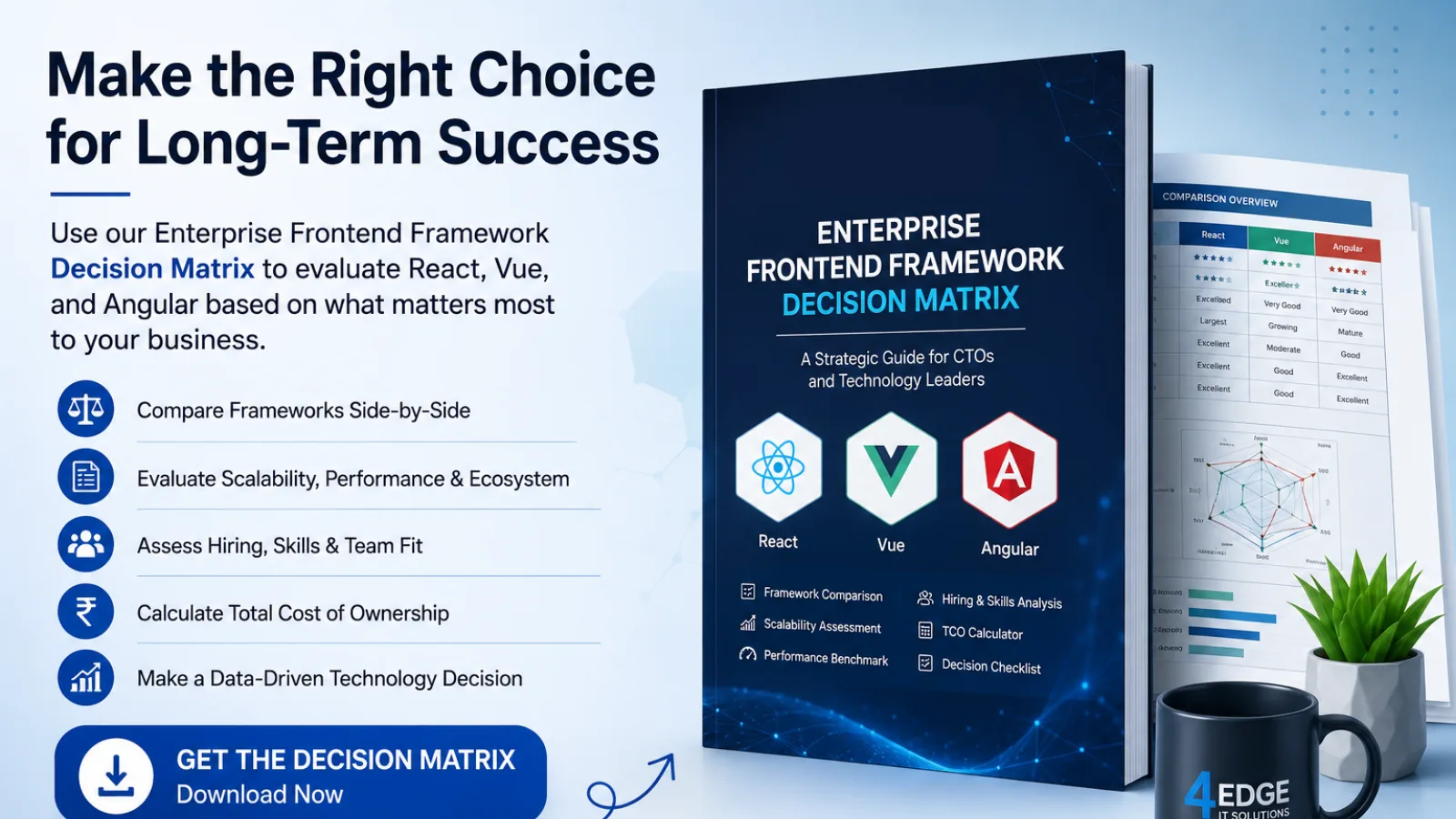
Selecting the right frontend framework doesn't have to be overwhelming.
Our Enterprise Frontend Framework Decision Matrix helps technology leaders evaluate React, Vue, and Angular based on business goals, scalability, development complexity, hiring considerations, and long-term ROI.
Download the Decision Matrix and make your next technology decision with confidence.
Frequently Asked Questions
Which frontend framework is best in 2026?
There isn't a single "best" framework. React, Vue, and Angular each excel in different scenarios. The right choice depends on your business objectives, team expertise, scalability needs, and long-term product roadmap.
Is React still the best choice for enterprise applications?
React remains one of the strongest choices for enterprise applications due to its scalability, mature ecosystem, large developer community, and flexibility for building modern digital products.
Should startups choose Vue or React?
Vue is often preferred for rapid MVP development because of its simplicity, while React is better suited for startups expecting significant growth and long-term product expansion.
Is Angular still relevant in 2026?
Yes. Angular continues to be widely used for large-scale enterprise applications, government systems, financial platforms, and complex business solutions where structured architecture is essential.
Which framework offers the best long-term ROI?
For many organizations, React delivers the strongest long-term return on investment due to its widespread adoption, availability of skilled developers, rich ecosystem, and ability to support evolving business requirements.
About the author
4Edge Engineering TeamChief Technology Officer
Heads engineering at 4Edge IT Solutions, delivering custom web and mobile applications, API integrations and Odoo ERP implementations for growing businesses.