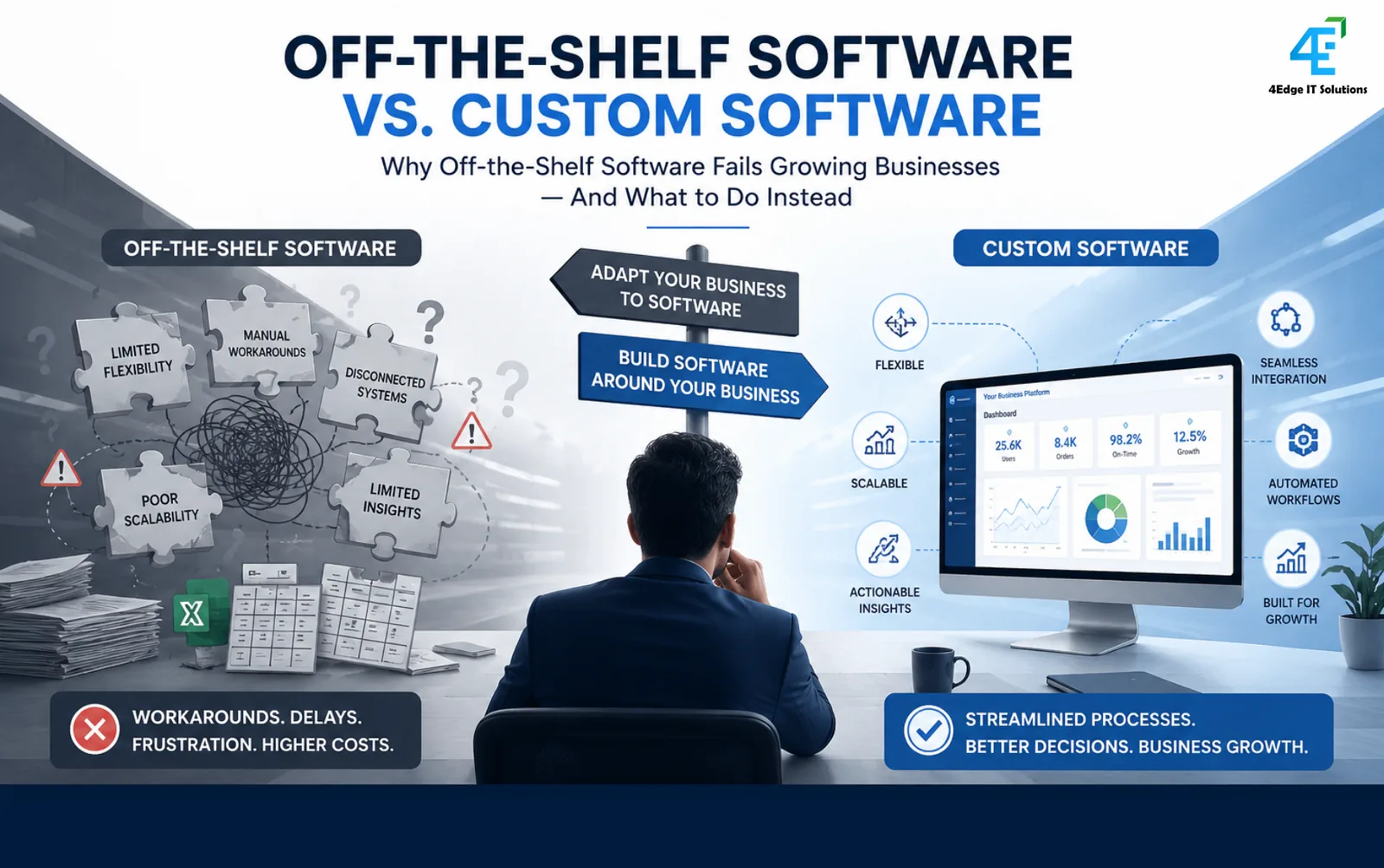
Off-the-shelf software often fails growing businesses because it cannot adapt to evolving workflows, increasing integration needs, specialized reporting requirements, and operational complexity. Custom software becomes valuable when businesses require scalable systems designed around how they actually work.
When you made your initial software choice, your business wasn't as complex as it is today.
What was once the perfect solution now means workarounds, spreadsheets, duplicate entries, disconnected tools and manual interventions.
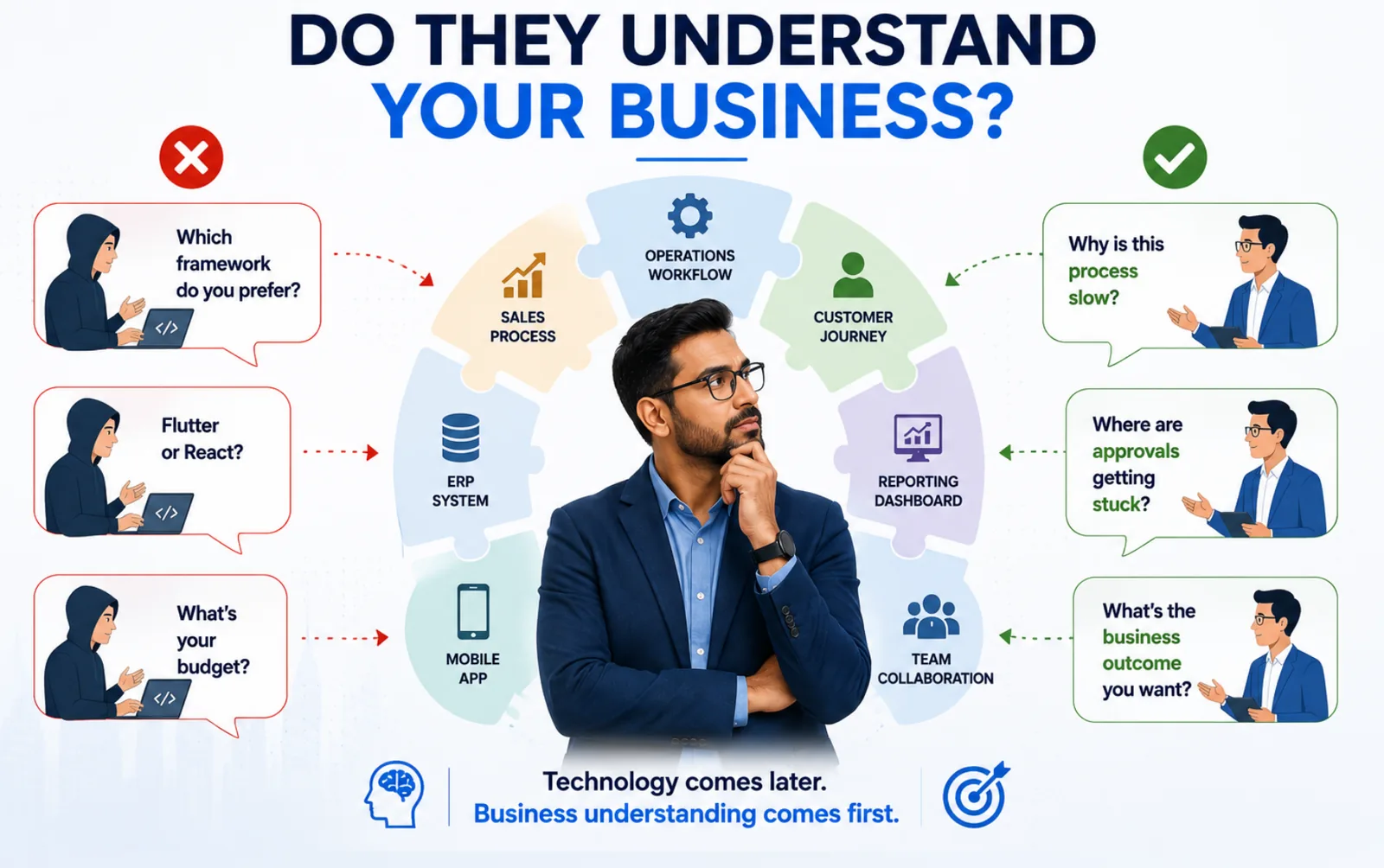
Many growing businesses get to the point where software dictates how they work, rather than supporting how they actually work.
Not always bad software. The problem is growth.
As businesses grow, processes become more specialized, teams grow, customers expect faster experiences and operations become more interlinked.
That's often when leaders begin to ask a critical question: Do we continue to fit our business to off-the-shelf software, or do we build something that's built for the way we work?
This guide explores why packaged software frequently fails growing organizations, how to recognize the warning signs, and how to make an informed build-versus-buy decision.
Why Businesses Choose Off-the-Shelf Software Initially
Off-the-shelf solutions exist for a reason.
For startups and early-stage businesses, they offer several advantages:
- Faster deployment
- Lower upfront investment
- Proven functionality
- Vendor-managed updates
- Minimal implementation effort
- Predictable subscription pricing
Whether it's CRM systems, project management tools, HR applications, or inventory platforms, pre-built software helps businesses move quickly. And often, that's exactly the right decision.
The challenge emerges when the business outgrows the assumptions built into those systems.
The Hidden Cost of Software That Doesn't Scale
Growth reveals limitations that were not visible at the outset. If businesses develop unique processes then software designed for standard use cases is not enough.
What starts as a minor inconvenience ends up as an operational bottleneck.
Common symptoms include:
1. Teams Rely on Workarounds
Employees create manual processes to compensate for system limitations.
- Exporting data into spreadsheets
- Maintaining shadow databases
- Using multiple disconnected tools
- Re-entering information repeatedly
These workarounds increase errors and reduce productivity.
2. Processes Become More Complex
As businesses mature, they often introduce:
- Multiple approval layers
- Department-specific workflows
- Compliance requirements
- Role-based responsibilities
- Specialized reporting needs
Generic software rarely accommodates these nuances effectively. Instead, teams adapt their work to fit the software.
3. Integration Challenges Multiply
Growing organizations depend on multiple systems:
- CRM platforms
- Finance applications
- HR systems
- Learning platforms
- Customer support tools
- Operational software
If these systems cannot communicate seamlessly, employees become the integration layer. The result: duplicate work, delayed decision-making, and data inconsistencies.
4. Reporting Stops Answering Real Questions
Leadership requires visibility into operations. Standard reports often fail to provide answers such as:
- Which process stages create delays?
- Which customer segments are most profitable?
- How long does onboarding actually take?
- Where are compliance gaps emerging?
Without tailored reporting, decision-making slows down.
5. User Adoption Declines
Employees resist systems that complicate their work.
- Low usage rates
- Resistance to new processes
- Increased support requests
- Continued reliance on old methods
Technology should simplify work, not create friction.
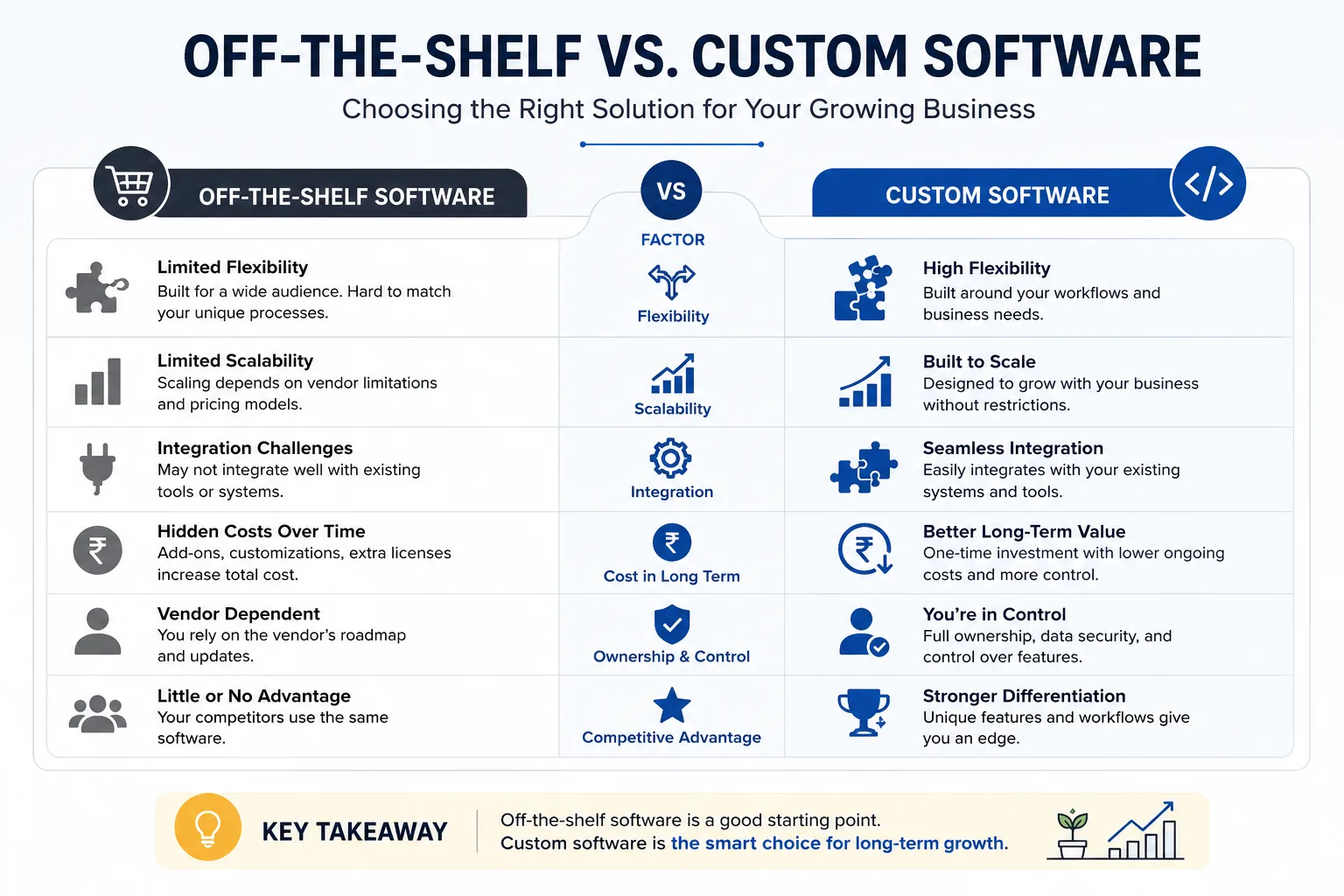
Off-the-Shelf vs Custom Software: What's the Difference?
| Factor | Off-the-Shelf Software | Custom Software |
|---|---|---|
| Implementation Speed | Faster | Moderate |
| Upfront Investment | Lower | Higher |
| Flexibility | Limited | High |
| Workflow Alignment | Generic | Built around your processes |
| Scalability | Depends on vendor roadmap | Designed for growth |
| Integrations | Restricted | Tailored integrations |
| Competitive Advantage | Minimal | Stronger differentiation |
| Ownership | Vendor-controlled | Organization-controlled |
The right choice depends on your business stage and requirements.
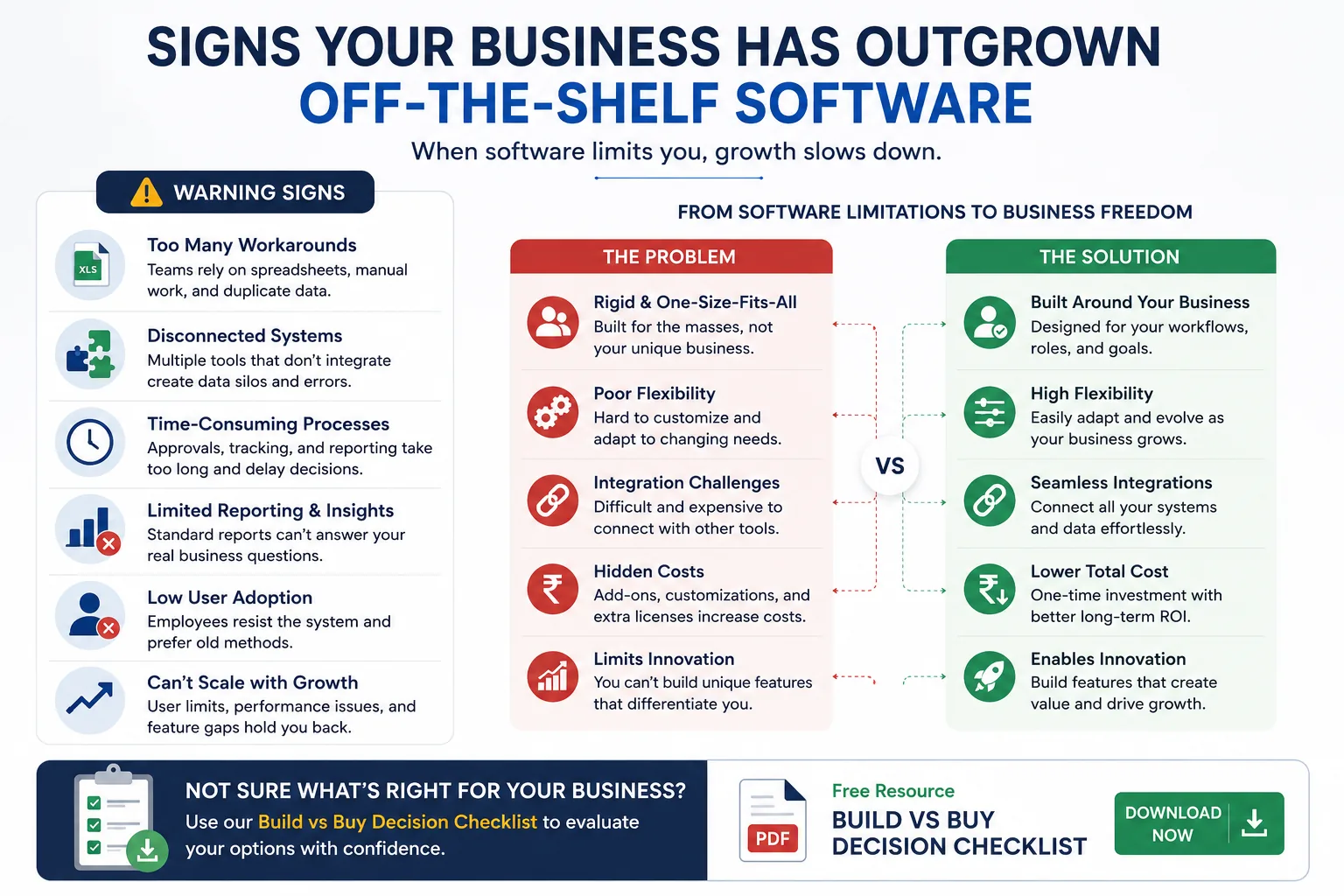
When Should You Build Custom Software?
Custom software isn't always the answer. However, several indicators suggest it's time to evaluate it seriously.
Your Processes Are Becoming Your Competitive Advantage
If the way you serve customers differentiates your business, software should support that uniqueness. Standard systems rarely accommodate specialized approaches.
Employees Spend Significant Time on Manual Tasks
Repeated administrative work indicates inefficiencies. Examples include:
- Data reconciliation
- Approval follow-ups
- Cross-platform updates
- Manual reporting
Automation opportunities often justify investment.
Multiple Tools Are Replacing One Cohesive System
Tool sprawl creates complexity. When employees constantly switch between applications to complete one task, operational efficiency suffers.
Existing Systems Cannot Scale
Common signs include:
- Performance issues
- Licensing constraints
- Limited user expansion
- Feature limitations
- Growing customization costs
At this point, maintaining the status quo may become more expensive than change.
Compliance Requirements Are Increasing
Organizations dealing with audit requirements, data privacy expectations, internal controls, and industry-specific obligations often require workflows that standard systems cannot support effectively.
The Biggest Mistake Businesses Make
Many organizations delay the conversation too long. They continue investing in additional licenses, third-party plugins, temporary fixes, and manual interventions.
Eventually, these accumulated costs exceed what proactive planning could have prevented.
The question shouldn't be: "Can we survive with our current software?" Instead, ask: "Will our current software support where we want to be three years from now?"
A Practical Build vs Buy Framework
Before making a decision, evaluate these questions:
Business Fit
- Does our software reflect how we actually operate?
- Are employees frequently bypassing the system?
Growth Readiness
- Can it support future users?
- Can new workflows be introduced easily?
Integration Capability
- Can systems exchange information seamlessly?
- Are integrations reliable?
Reporting Needs
- Can leadership access meaningful insights?
- Are decisions delayed because of reporting gaps?
Total Cost
Consider licensing fees, administrative effort, training requirements, productivity losses, and customization expenses. The lowest subscription price does not always equal the lowest long-term cost.
What Custom Software Should Actually Deliver
Custom applications should not exist simply because they're custom. They should solve measurable business problems.
Effective solutions enable organizations to:
- Streamline workflows
- Eliminate repetitive tasks
- Improve visibility
- Support growth
- Enhance employee experiences
- Increase operational efficiency
- Adapt as business needs evolve
Technology should enable progress, not constrain it.
How 4Edge Helps Organizations Build Software Around Real Work
At 4Edge IT Solutions, we help organizations design and develop applications built around how businesses actually operate.
Instead of forcing teams into rigid systems, we focus on:
- Custom Application Development: Applications aligned with business workflows and operational goals.
- Workflow Automation: Reducing manual effort and improving consistency across teams.
- Enterprise Application Development: Scalable systems designed to evolve alongside growing organizations.
- System Integration: Connecting platforms to enable smoother information flow.
- Process Optimization: Identifying inefficiencies and improving the way work gets done.
Our approach remains practical, outcome-oriented, and focused on solving operational challenges through technology-enabled solutions.
Free Download: Build vs Buy Decision Checklist
Growing businesses shouldn't make software decisions based solely on vendor promises or subscription costs. Use our practical checklist to evaluate whether your current systems can support future growth.
What's Included
- Software scalability assessment
- Workflow alignment questions
- Integration readiness review
- Reporting evaluation framework
- Total cost considerations
- Decision guidance for business leaders
Download the Build vs Buy Decision Checklist to determine whether it's time to optimize, replace, or build software that supports the way your business actually works.
Frequently Asked Questions
Is custom software always better than off-the-shelf software?
No. Off-the-shelf software works well for standardized needs and early-stage growth. Custom software becomes valuable when unique workflows, integrations, or scalability requirements emerge.
How do I know if my business has outgrown its software?
Common indicators include heavy spreadsheet usage, manual workarounds, disconnected systems, limited reporting capabilities, and increasing operational complexity.
Is custom software expensive?
It requires greater upfront investment, but the long-term value depends on reduced inefficiencies, improved productivity, and stronger alignment with business goals.
Can custom software integrate with existing systems?
Yes. Modern applications can often integrate with CRMs, ERP systems, HR platforms, learning platforms, and other operational tools.
Should I replace all existing systems?
Not necessarily. Many organizations benefit from augmenting existing investments through targeted custom applications and integrations.
Software decisions affect how organizations work, collaborate and grow. What worked for your business three years ago might not work where you're going next.
Before adding resources to yet another workaround, take a moment to ask yourself whether your systems are helping or hindering progress, quietly.
Because growing businesses need more than software. They want software built around how they work.
About the author
4Edge Engineering TeamChief Technology Officer
Heads engineering at 4Edge IT Solutions, delivering custom web and mobile applications, API integrations and Odoo ERP implementations for growing businesses.