Selecting a custom app development company is one of the most important technology decisions a business will ever make.
The right partner can help you streamline operations, automate workflows, improve customer experiences and support long-term growth.
Picking the wrong partner can lead to missed deadlines, budget overruns, technical debt, low user adoption and software that doesn't deliver business value.
Companies are not looking for vendors who write code in 2026 anymore.
They want technology partners that understand business operations, workflow automation, scalability, integrations and long term digital transformation.
But many companies still select development partners on price.
That approach often results in expensive problems later on.
Before signing up with any custom app development company in India, ask these 10 questions.
The answers will reveal far more than a proposal document ever can.
Why Vendor Selection Matters More Than Technology?
Many software projects fail before they even start development.
Not for technological reasons.
Not because of the framework.
Not because of the programming language.
They fail because organizations select partners that do not understand their business needs.”
The best software projects begin with discovery, planning, stakeholder alignment, and understanding workflows.
A good development firm asks questions of its assumptions.
A bad development company just takes requirements and starts to code.
Months later, the difference is clear.
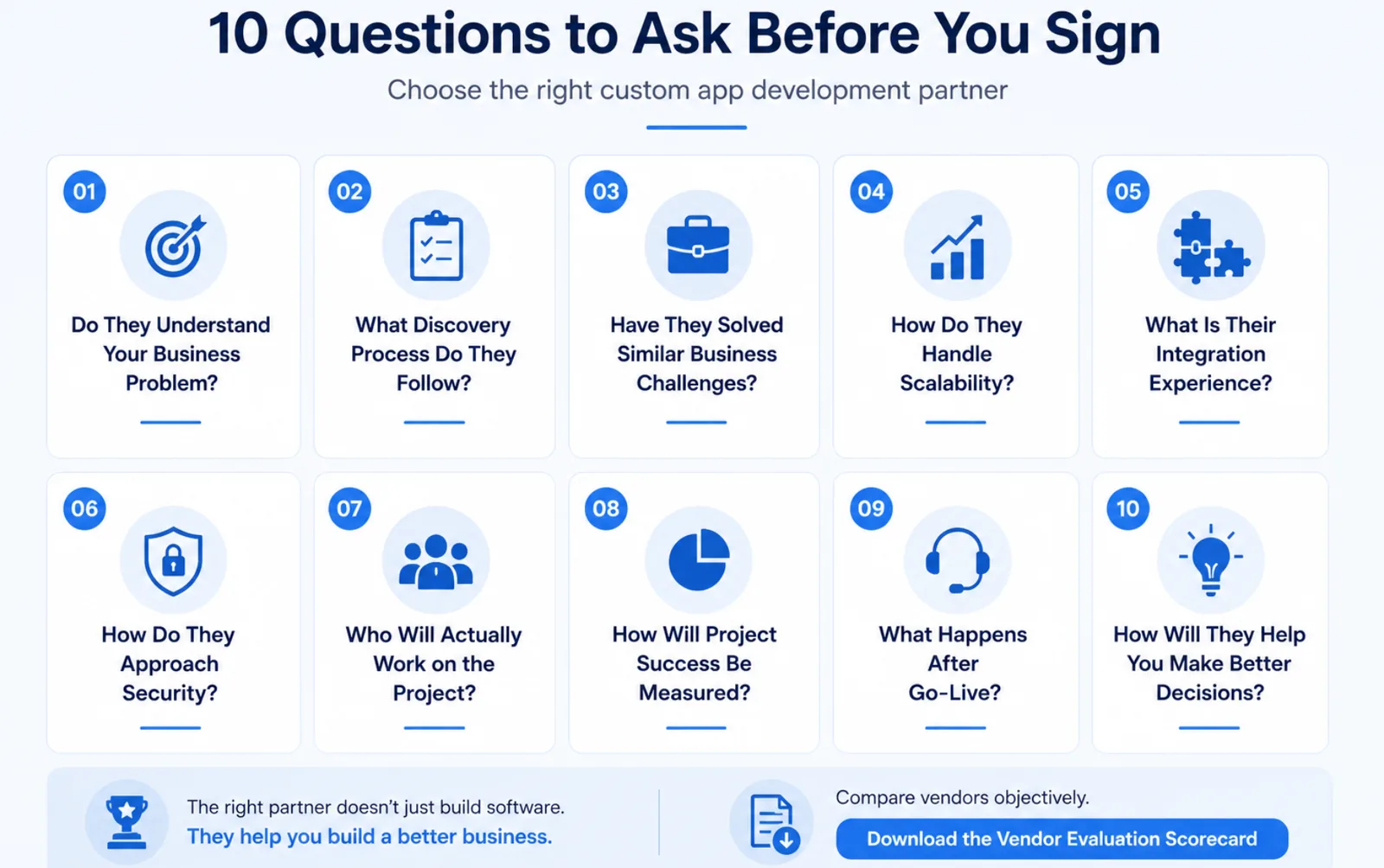
Question 1: Do They Understand Your Business Problem?
Before discussing technology, ask:
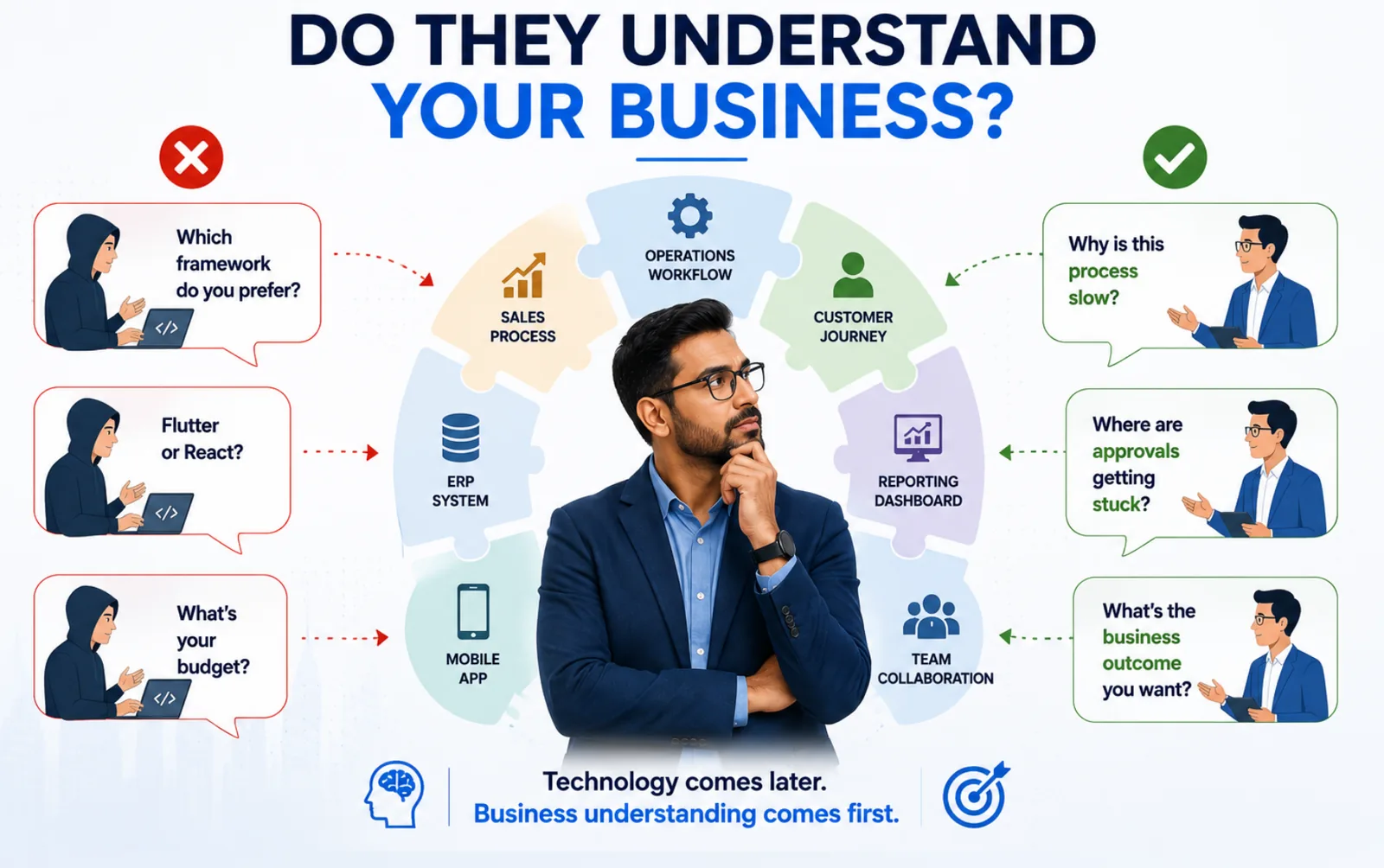
"How will you understand our business processes?"
If the first conversation immediately jumps into:
React vs Angular
Flutter vs Native
AWS vs Azure
You're having the wrong conversation.
Technology decisions should come after understanding:
Business objectives
Operational challenges
Workflow bottlenecks
User expectations
A strong partner spends more time understanding problems than recommending solutions.
Question 2: What Discovery Process Do They Follow?
Discovery is where project success begins.
Ask vendors to explain:
| Discovery Area | Why It Matters |
|---|---|
| Stakeholder Workshops | Align expectations |
| Workflow Mapping | Understand operations |
| User Journey Analysis | Improve usability |
| Requirements Documentation | Reduce ambiguity |
| Technical Assessment | Identify constraints |
If discovery isn't clearly defined, expect surprises later.
Question 3: Have They Solved Similar Business Challenges?
Every company claims experience.
Ask for specifics.
Instead of:
"Have you built mobile apps?"
Ask:
"Have you solved workflow automation challenges similar to ours?"
Focus on:
Business outcomes
Operational improvements
Process automation
User adoption
The objective isn't finding a company that builds software.
It's finding one that solves problems.
Question 4: How Do They Handle Scalability?
Many applications work well initially.
The challenge appears when organizations grow.
Ask:
Can the platform support:
More users?
More departments?
Additional workflows?
New integrations?
Higher transaction volumes?
Scalability should be designed from day one.
Not added after problems emerge.
Question 5: What Is Their Integration Experience?
Enterprise software rarely operates in isolation.
Most organizations already use:
| Existing Systems |
|---|
| ERP Platforms |
| CRM Solutions |
| HRMS Systems |
| LMS Platforms |
| Payment Gateways |
| Reporting Tools |
Ask vendors about integration experience.
If integrations are treated as an afterthought, expect future challenges.
Question 6: How Do They Approach Security?
Security should never be a feature request.
It should be a design principle.
Ask:
How do you address:
Authentication
Authorization
Role-based access
Audit logs
Data encryption
API security
A professional partner discusses security proactively.
Not only when asked.
Question 7: Who Will Actually Work on the Project?
Many organizations meet senior consultants during sales discussions.
Then the project is handed to a completely different team.
Ask:
Who will be involved?
| Role | Responsibility |
|---|---|
| Project Manager | Delivery oversight |
| Business Analyst | Requirements gathering |
| UI/UX Designer | User experience |
| Developers | Application development |
| QA Team | Testing and quality assurance |
Understanding team structure reduces surprises later.
Question 8: How Will Project Success Be Measured?
Many projects focus exclusively on deliverables.
Successful projects focus on outcomes.
Ask:
What metrics define success?
Examples include:
Reduced processing time
Faster approvals
Increased productivity
Better reporting visibility
Reduced manual effort
The right partner links technology to business outcomes.
Question 9: What Happens After Go-Live?
Many businesses focus entirely on development.
Real value begins after launch.
Ask vendors:
What support is available?
| Post-Launch Area | Importance |
|---|---|
| Bug Resolution | Critical |
| Enhancements | High |
| Monitoring | High |
| User Support | High |
| Security Updates | Critical |
| Performance Optimization | Medium |
Applications evolve continuously.
Choose a partner prepared for that journey.
Question 10: How Will They Help You Make Better Decisions?
This question often reveals the strongest partners.
Good development companies build what you request.
Great development companies help you determine what should be built.
Ask:
"What would you challenge in our current requirements?"
The response can reveal:
Strategic thinking
Industry experience
Business understanding
Long-term vision
Partners who ask difficult questions often create the best outcomes.
Red Flags That Should Concern Decision-Makers
While evaluating vendors, watch for warning signs.
| Red Flag | Why It Matters |
|---|---|
| Immediate pricing without discovery | Requirements unclear |
| No business analysis process | Higher project risk |
| Technology-first discussions | Business outcomes ignored |
| No scalability planning | Future limitations |
| Weak integration experience | Operational silos |
| Limited support plans | Long-term risk |
| Generic proposals | Low understanding |
A proposal should reflect your business.
Not look identical to every other proposal.
Scenario: Two Vendors, Two Outcomes
A growing organization received proposals from two app development companies.
Vendor A offered the lowest price.
Vendor B spent additional time conducting workshops, mapping workflows, and identifying process gaps.
Vendor B's proposal cost more.
However, they identified:
Duplicate approvals
Reporting inefficiencies
Integration challenges
User adoption risks
The final solution automated multiple processes instead of digitizing existing inefficiencies.
The result wasn't just software.
It was an operational improvement.
How 4Edge Approaches Custom Application Development
At 4Edge, we believe software should improve how organizations operate.
Our focus begins with:
Understanding workflows
Mapping business processes
Identifying operational bottlenecks
Defining measurable outcomes
Planning for scalability
Before discussing technologies.
Whether it's a web application, mobile platform, workflow automation solution, or enterprise system, the objective remains the same:
Build software that delivers business value.
Not just features.
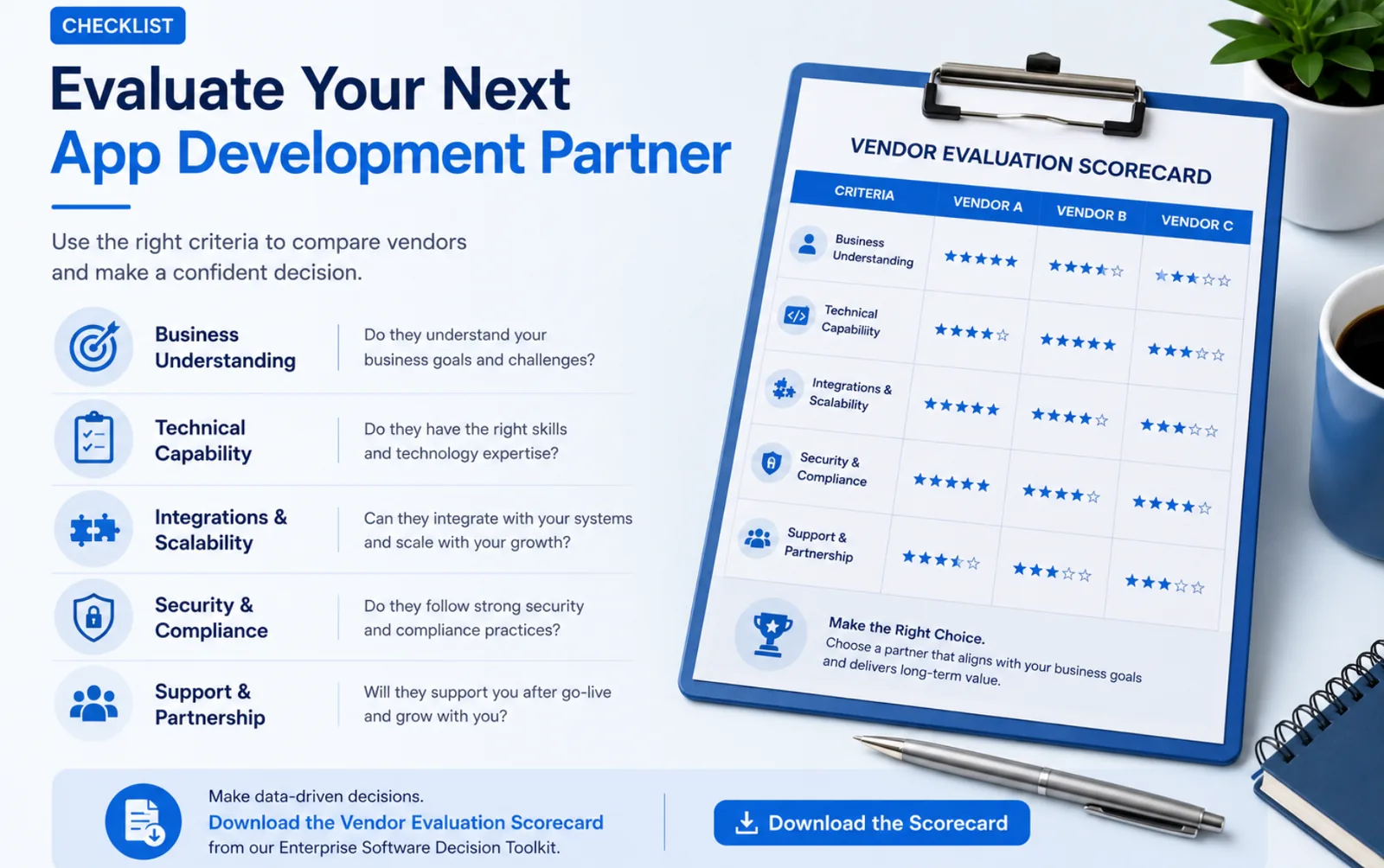
Free Resource: Enterprise Software Decision Toolkit
Before selecting a development partner, use a structured evaluation framework.
Our toolkit includes:
| Resource | Purpose |
|---|---|
| Build vs Buy Checklist | Evaluate solution options |
| Vendor Evaluation Scorecard | Compare vendors objectively |
| Project Estimation Worksheet | Improve planning accuracy |
| Enterprise Mobile App RFP Template | Define requirements clearly |
| Workflow Automation Framework | Prioritize opportunities |
Compare development companies using objective criteria rather than sales presentations.
Frequently Asked Questions
How do I choose a custom app development company in India?
Evaluate business understanding, discovery processes, scalability planning, integration experience, security practices, post-launch support, and relevant project experience—not just pricing.
What should I ask before hiring a software development company?
Ask about workflow analysis, project discovery, scalability, integrations, security, delivery methodology, support processes, and business outcome measurement.
Why do custom software projects fail?
Common causes include unclear requirements, poor stakeholder alignment, weak discovery processes, inadequate planning, and choosing vendors based solely on cost.
How important are integrations in custom software development?
Very important. Most enterprise applications need to connect with ERP, CRM, HRMS, LMS, payment gateways, and other business systems.
What is the biggest mistake businesses make when selecting a software vendor?
Choosing based on the lowest proposal rather than evaluating business understanding, delivery capability, scalability planning, and long-term partnership potential.
The best custom app development company isn't necessarily the cheapest.
Or the biggest.
Or the one with the most impressive presentation.
It's the one that understands your business, challenges assumptions, plans for growth, and helps you achieve measurable outcomes.
Because in 2026, software success is no longer about building applications.
It's about building better businesses.
About the author
4Edge Engineering TeamChief Technology Officer
Heads engineering at 4Edge IT Solutions, delivering custom web and mobile applications, API integrations and Odoo ERP implementations for growing businesses.