Every ISO audit season follows a familiar pattern in a lot of organizations: a scramble to pull together training records, a round of last-minute refresher sessions, and a quiet hope that employees remember enough of the standard to answer an auditor's questions confidently. It doesn't have to work this way. The fix isn't more last-minute training — it's a program that runs continuously instead of resetting every audit cycle.
This guide is structured around the questions compliance officers and quality heads actually ask when building or fixing an ISO training program.
Why does employee training matter so much for ISO audits?
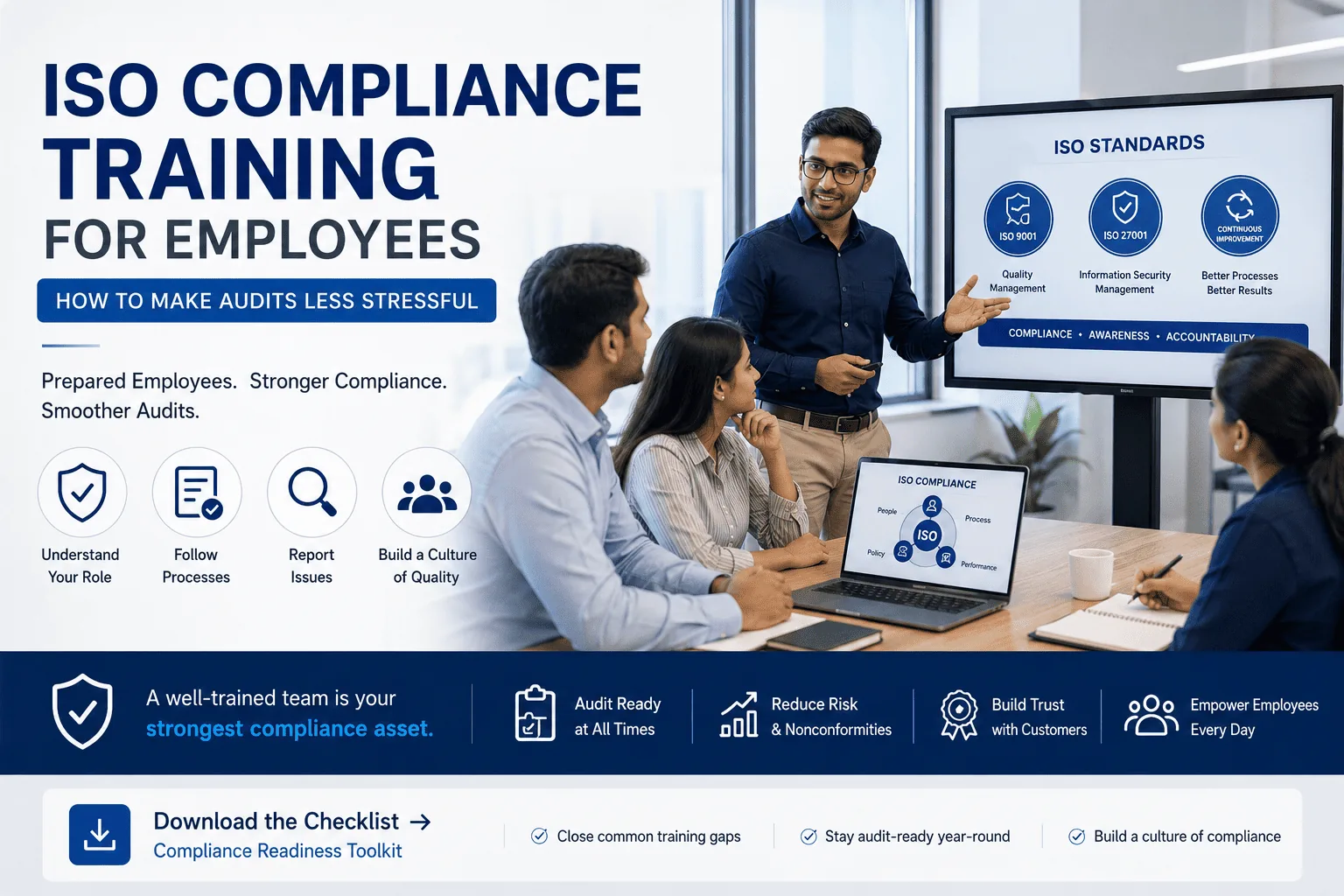
Auditors interview employees directly, not just review documents. Whether it's ISO 27001 (information security), ISO 9001 (quality management), or another standard, auditors routinely ask frontline staff to explain relevant procedures in their own words — not simply confirm that a policy document exists somewhere.
Most ISO standards also explicitly require competence and awareness as certification criteria. They include clauses requiring that personnel understand the policy, their individual contribution to its effectiveness, and the implications of not conforming — meaning training isn't a supplementary best practice, it's part of what's actually being certified.
It's also common for an organization's documented procedures to be excellent while employee understanding varies significantly by department — and that gap surfaces quickly under audit questioning, regardless of how polished the paperwork is.
What should ISO employee training actually cover?
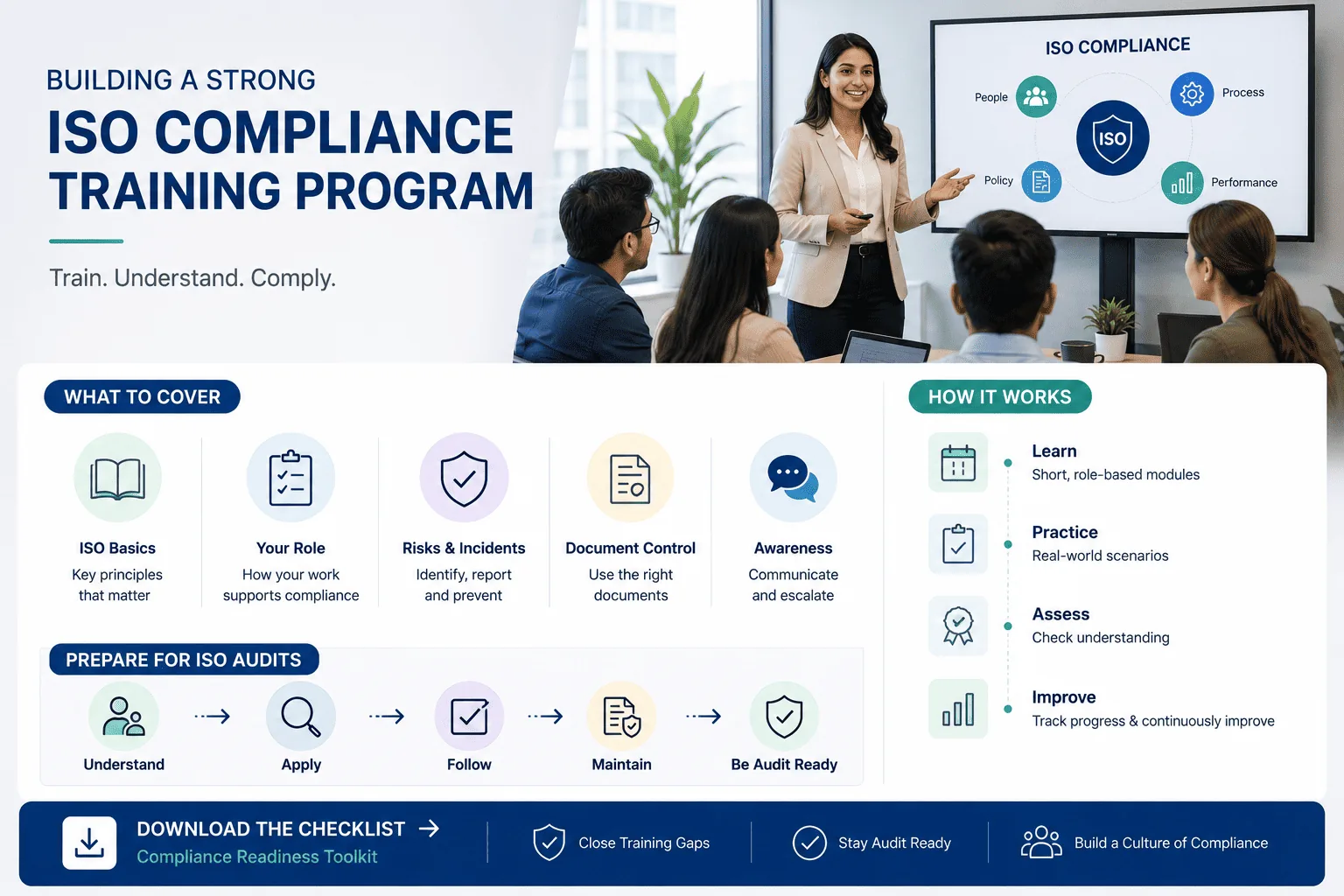
Standard-specific fundamentals relevant to each employee's role. An ISO 27001 program, for instance, needs different depth for IT staff versus general employees who handle sensitive information only incidentally.
How daily work maps to specific clauses. Training that explains why a procedure exists, not just what it requires, produces employees who can explain their role to an auditor in their own words — which is precisely what auditors are testing for.
Incident and nonconformance reporting. Employees need to know exactly how to report a deviation, a near-miss, or a potential nonconformity, and understand that reporting it is expected, not something to quietly hide.
Document control basics. For most ISO standards, employees working with controlled documents need to understand version control and know where to find the current approved version. A surprisingly common audit finding is staff working from an outdated procedure without realizing it.
How do you structure training to reduce audit stress?
Run training on a continuous cycle, not just before audits. Spreading refreshers throughout the year, rather than a single pre-audit cram session, produces both better retention and a stronger audit trail of sustained competence over time.
Segment training by role and relevance. A generic, one-size-fits-all ISO overview wastes time for some employees and under-prepares others for what they'll actually be asked. Role-based tracks make training more relevant and audits noticeably smoother.
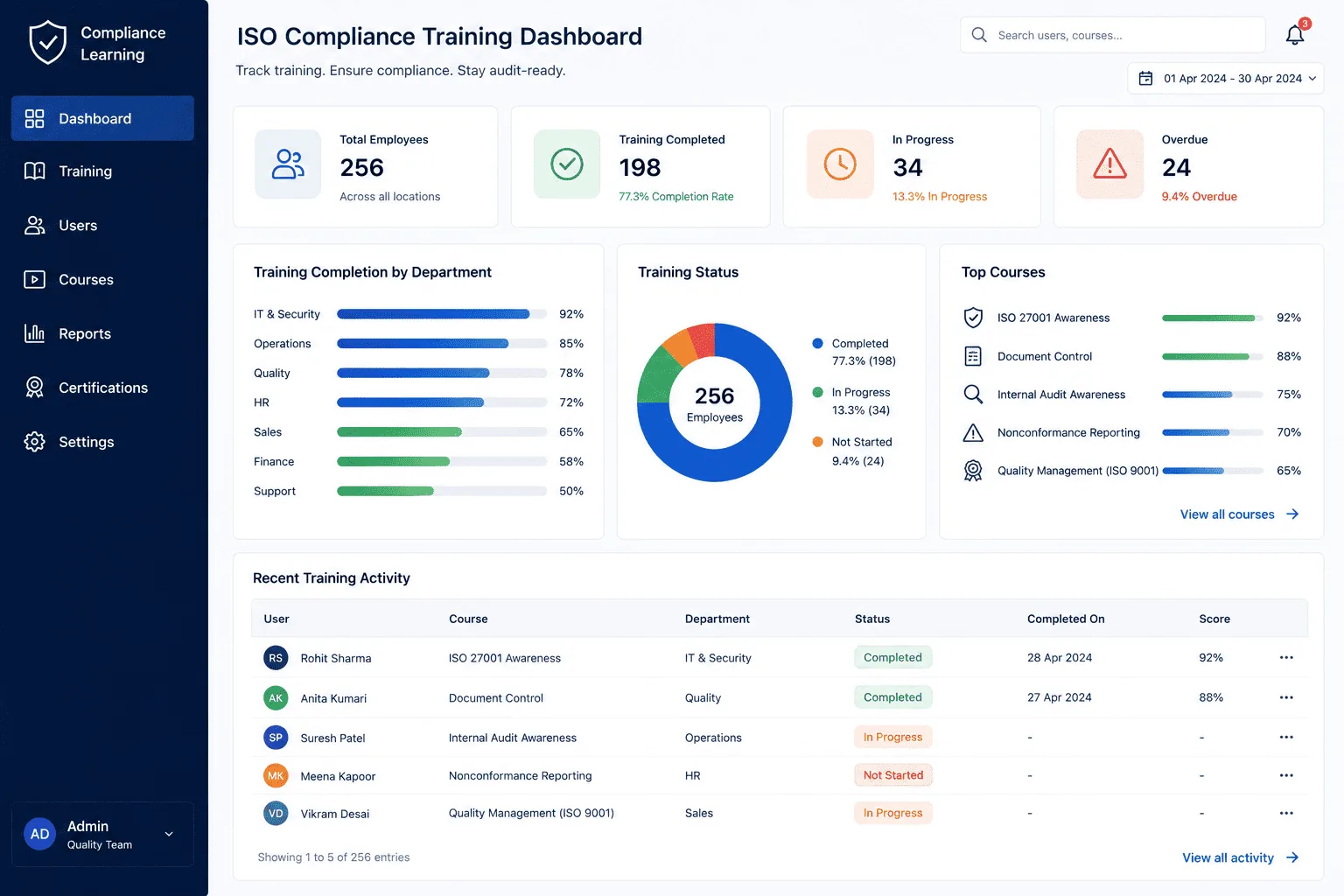
Keep digital, timestamped completion records. A learning platform that automatically logs who completed what training, when, is dramatically easier to produce as audit evidence than reconstructing attendance sheets under time pressure right before an audit.
Include real internal examples, not just generic scenarios. Training built around your organization's actual procedures and past near-misses lands better than generic ISO content that could apply to any company in any industry.
Prepare employees for the interview itself, not just the content. Auditors ask open-ended questions. Training that includes practice explaining "what would you do if..." scenarios builds the confidence that makes an actual audit interview go smoothly rather than becoming a stressful surprise.
What gaps most commonly surface during ISO audits?
- Employees who can recite a rule but can't explain the reasoning behind it — auditors read this as memorization rather than genuine understanding
- New hires who joined outside the standard training cycle and have gaps in required training
- Training content that hasn't been updated after a documented procedure changed
- No clear record connecting specific employees to specific completed training modules and dates
How is ISO 27001 employee training different from general ISO training?
ISO 27001 specifically centers on information security, so employee training needs deeper coverage of data handling, access control awareness, and incident reporting related to security events specifically — not just general quality or process awareness. IT and engineering staff typically need meaningfully more depth than general employees, who mainly need to understand their role in maintaining basic security hygiene.
Frequently Asked Questions
How often does ISO training need to be repeated for certification? Most organizations run annual refreshers at minimum, with new hires completing foundational training during onboarding. Surveillance audits and recertification cycles specifically expect to see ongoing training activity, not evidence that a program existed only once at initial certification.
What happens if an employee can't answer an auditor's question correctly? This alone doesn't necessarily fail an audit, but a pattern of employees unable to explain relevant procedures is a common source of audit findings. It typically signals that training was delivered but comprehension wasn't verified or reinforced.
Do all employees need the same depth of ISO training? No. Training should be segmented by role and relevance — employees directly responsible for a control need deeper training than those only tangentially affected by the standard.
How long does it take to build an ISO training program from scratch? A focused initial program covering core standard fundamentals can typically be built in 4–6 weeks. A more comprehensive, role-segmented program with tracking infrastructure often takes 2–3 months to fully implement.
What's the best way to keep ISO training records audit-ready year-round? Use a platform that automatically timestamps completion records and makes them exportable on demand, rather than relying on manually maintained spreadsheets or physical sign-in sheets that need to be reconstructed under time pressure before each audit.
Preparing for an upcoming ISO audit or building a continuous training program? Our Compliance Readiness Toolkit includes a training checklist to help you close common gaps before an auditor finds them — download it to get started.
Primary sources
- ISO/IEC 27001:2022 Information security management systems (International Organization for Standardization (ISO))
- ISO 9001:2015 Quality management systems (International Organization for Standardization (ISO))
About the author
4Edge Compliance TeamCompliance Training Specialist
Designs compliance training programs at 4Edge IT Solutions covering POSH, the DPDP Act, cybersecurity awareness, ISO and SOC 2 readiness, and workplace ethics for Indian organisations.