What should enterprises know before investing in mobile app development in 2026?
Enterprise mobile app development in India requires more than choosing between iOS and Android. Decision-makers should evaluate workflow complexity, integrations, security requirements, user roles, scalability, and long-term business goals. Successful enterprise applications improve operational efficiency, accelerate decision-making, and support workforce productivity through mobile-first access to critical business processes.
Mobile Apps Are No Longer Just Customer Tools
Most enterprise mobile applications were customer-facing ten years ago.
Shopping apps were launched by retail brands.
Banks released mobile banking apps.
Service providers have created customer portals.
The conversation has changed today.
Companies are building mobile applications for employees, partners, distributors, field teams, vendors, customers and management teams.
It's not just mobility.
It's business efficiency.
Mobile apps are now essential to the way that modern enterprises work, from approvals and inspections to sales enablement and operational visibility.
Yet many decision-makers still approach mobile app projects with the wrong question:
"How much will the app cost?"
The better question is:
"What business problem should the app solve?"
Because successful enterprise applications aren't built around screens.
They're built around workflows.
If you're evaluating enterprise mobile app development in 2026, this guide will help you understand what matters before investing.
Why Enterprise Mobile Applications Are Growing Rapidly
The workforce is different.
Work is no longer just desk work.
Managers are approving requests while traveling.
Sales teams update opportunities in real time.
Technicians make on-site inspections.
Partners need access to shared information.
“Executives need to see operations in real-time”
Organizations need systems that move with the employees more and more.
Mobile applications fill this gap.
They bring business processes closer to the point of action.
Enterprise Mobility Drivers in 2026
| Business Challenge | Mobile Application Impact |
|---|---|
| Slow approvals | Faster decision-making |
| Manual paperwork | Digital workflows |
| Delayed reporting | Real-time visibility |
| Disconnected field teams | Better collaboration |
| Process inefficiencies | Improved productivity |
| Limited accessibility | Anywhere access |
Organizations aren't investing in apps because they're fashionable.
They're investing because operational speed has become a competitive advantage.
What Makes Enterprise Apps Different?
Many business leaders compare enterprise apps to consumer applications.
The comparison is misleading.
A food delivery app and an enterprise workflow application solve entirely different problems.
Enterprise applications must support:
- Multiple user roles
- Security requirements
- Workflow automation
- System integrations
- Reporting needs
- Business rules
- Scalability requirements
The complexity often exists behind the interface.
A simple approval button may trigger:
- Multi-level approvals
- Notifications
- Escalations
- Audit logging
- ERP updates
- Dashboard reporting
The user sees one action.
The business sees an entire process.
Common Enterprise Mobile App Use Cases
Organizations typically invest in mobile applications when operational friction becomes visible.
Field Service Management
Technicians can:
- Capture service reports
- Upload photos
- Record inspections
- Update job status
Without returning to the office.
Sales Enablement
Sales teams can:
- Access customer information
- Track opportunities
- Generate quotations
- Update activities
Directly from mobile devices.
Workflow Approvals
Managers can approve:
- Purchase requests
- Leave applications
- Vendor onboarding
- Expense claims
Anywhere, anytime.
Customer Portals
Customers gain access to:
- Service requests
- Account information
- Documents
- Order status
Through self-service experiences.
Partner & Distributor Platforms
Partners can:
- Access resources
- Submit requests
- Track performance
- Receive updates
Using a single mobile interface.
iOS, Android, or Cross-Platform?
This remains one of the most common questions.
The answer depends on your audience.
Platform Selection Framework
| Scenario | Recommended Approach |
|---|---|
| Employees use mixed devices | Cross-platform |
| Primarily Android workforce | Android-first |
| Executive users on iOS | iOS-first |
| Customer-facing application | Both platforms |
| Budget-conscious initiatives | Cross-platform |
| Enterprise-scale deployment | Cross-platform |
Most organizations today choose cross-platform development because it allows faster deployment across both ecosystems.
However, technology decisions should always align with business objectives.
The Biggest Mistake Enterprises Make
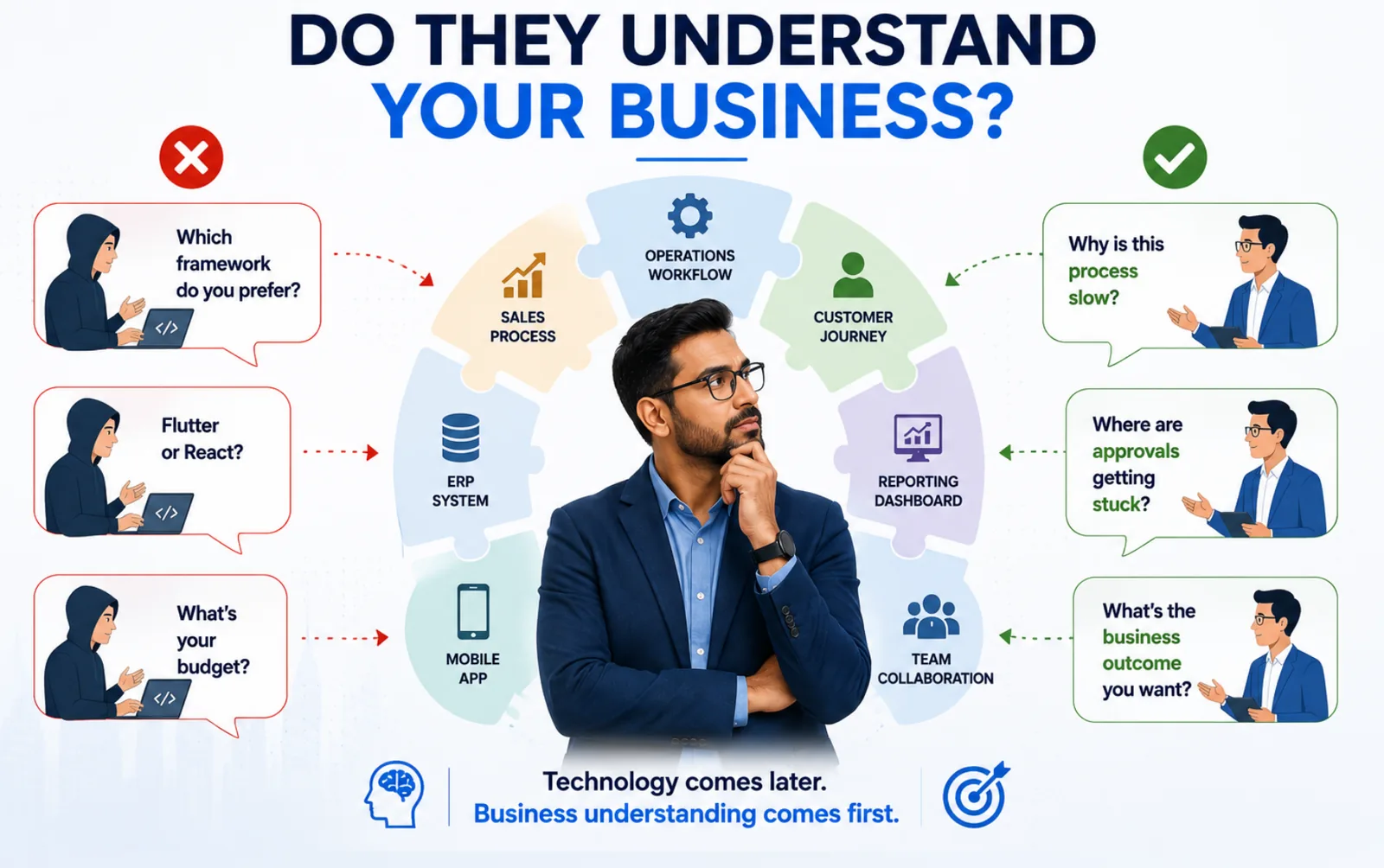
Many organizations begin projects by discussing features.
The problem is that features rarely solve business problems.
For example:
"We need a dashboard."
Why?
"We need notifications."
Why?
"We need mobile approvals."
Why?
The answer usually reveals the real challenge:
- Delayed decisions
- Poor visibility
- Process bottlenecks
- Customer experience gaps
Technology should be a response to operational challenges—not the starting point.
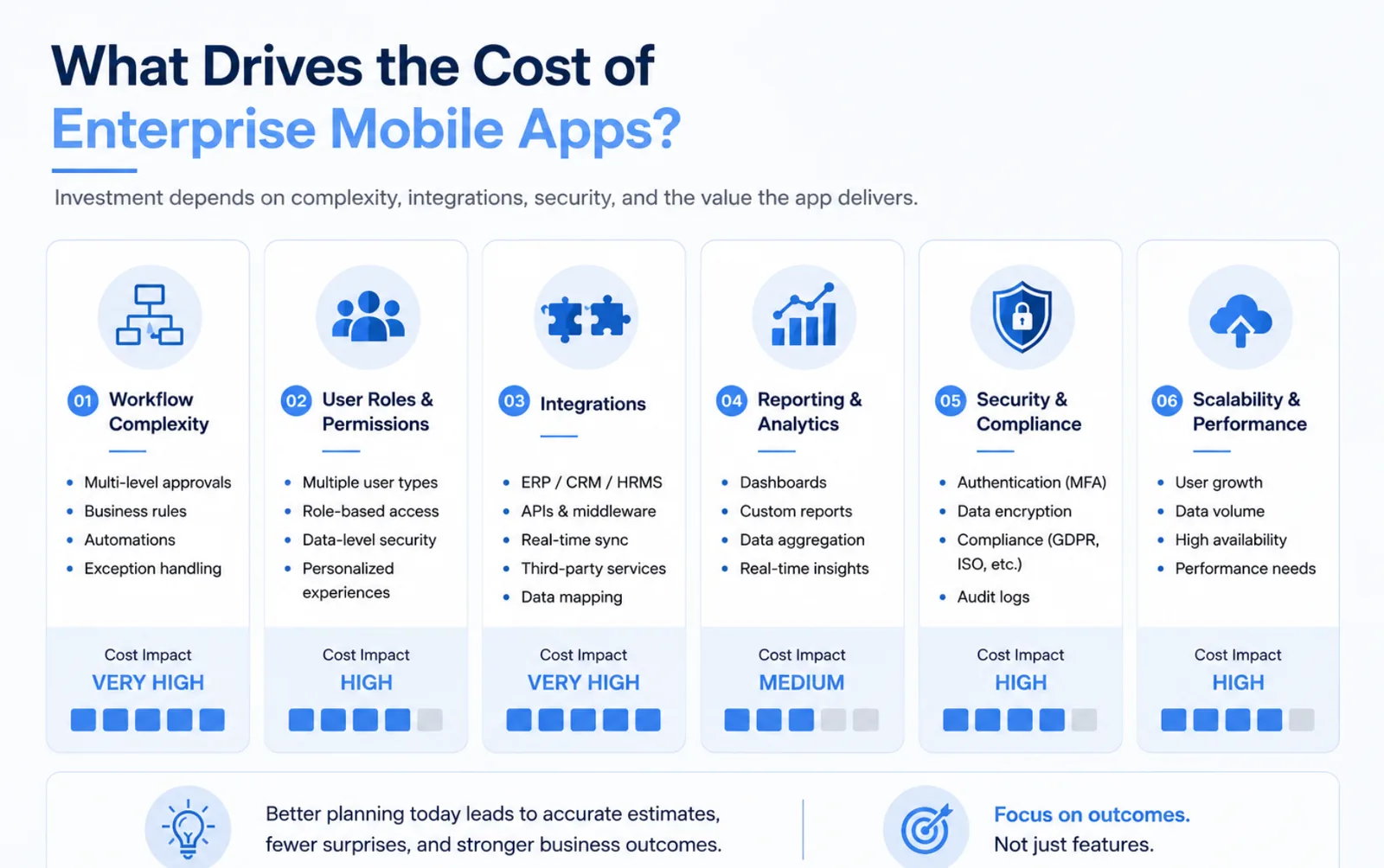
What Determines Enterprise Mobile App Costs?
Two apps can appear similar yet differ dramatically in investment requirements.
The reasons are usually hidden beneath the surface.
Major Cost Drivers
| Cost Driver | Impact on Budget |
|---|---|
| Workflow complexity | Very High |
| User roles & permissions | High |
| ERP/CRM integrations | Very High |
| Reporting requirements | Medium |
| Security & compliance | High |
| Offline capabilities | High |
| Scalability requirements | High |
Development effort increases when applications need to mirror real business operations.
The Hidden Costs of Delaying Mobility
Many organizations focus only on development costs.
The larger question is:
What is the cost of doing nothing?
Consider:
Manual Approvals
Approvals wait until managers return to their desks.
Slow Reporting
Critical information arrives too late.
Duplicate Data Entry
Employees enter information multiple times.
Operational Delays
Processes stall unnecessarily.
Reduced Visibility
Leadership lacks timely insights.
The cost of inefficiency often exceeds the cost of technology.
Scenario: The Growing Manufacturing Company
A manufacturing organization relied on email approvals and spreadsheets.
Initially, management requested a simple mobile approval application.
Discovery sessions revealed deeper challenges:
- Vendor onboarding delays
- Multi-location operations
- ERP dependencies
- Escalation workflows
- Audit requirements
The project evolved into an enterprise workflow platform.
The investment increased.
But approval cycles dropped significantly.
Visibility improved.
Manual effort decreased.
The objective wasn't mobile technology.
It was operational efficiency.
Security Matters More Than Ever
Enterprise applications increasingly handle:
- Employee information
- Operational data
- Customer records
- Financial information
Security can no longer be treated as an afterthought.
Organizations should evaluate:
| Security Consideration | Importance |
|---|---|
| Role-based access | High |
| Multi-factor authentication | High |
| Data encryption | High |
| Audit logs | Medium |
| Secure APIs | High |
| Device management policies | Medium |
A secure application protects both users and operations.
How to Evaluate a Mobile App Development Partner
Selecting the right partner often matters more than selecting the right technology.
Before engaging vendors, ask:
Do they understand workflows?
Technology should support operations.
Do they ask business questions?
Good partners focus on outcomes before features.
Can they handle integrations?
Enterprise applications rarely operate independently.
Do they plan for scalability?
Future growth should be considered from the start.
Can they support long-term evolution?
Applications change as businesses change.
How 4Edge Approaches Enterprise Mobile Applications
At 4Edge IT Solutions, we believe enterprise applications should simplify work.
Not create more of it.
Our approach focuses on understanding:
- Business workflows
- Operational bottlenecks
- User journeys
- Integration requirements
- Future growth plans
Before recommending technology.
The result is software designed around how organizations actually operate.
Because successful applications aren't measured by downloads.
They're measured by adoption, efficiency, and business impact.
Before You Start Your Mobile App Project
Most project delays occur before development begins.
Requirements are unclear.
Stakeholders are misaligned.
Expectations differ.
That's why we created the:
Enterprise Software Decision Toolkit
A practical planning resource designed for technology leaders evaluating enterprise applications.
What's Included?
| Resource | Purpose |
|---|---|
| Build vs Buy Decision Checklist | Evaluate software options |
| Project Estimation Worksheet | Improve budgeting accuracy |
| Enterprise Mobile App RFP Template | Define requirements clearly |
| Vendor Evaluation Scorecard | Compare partners objectively |
| Workflow Automation Framework | Prioritize opportunities |
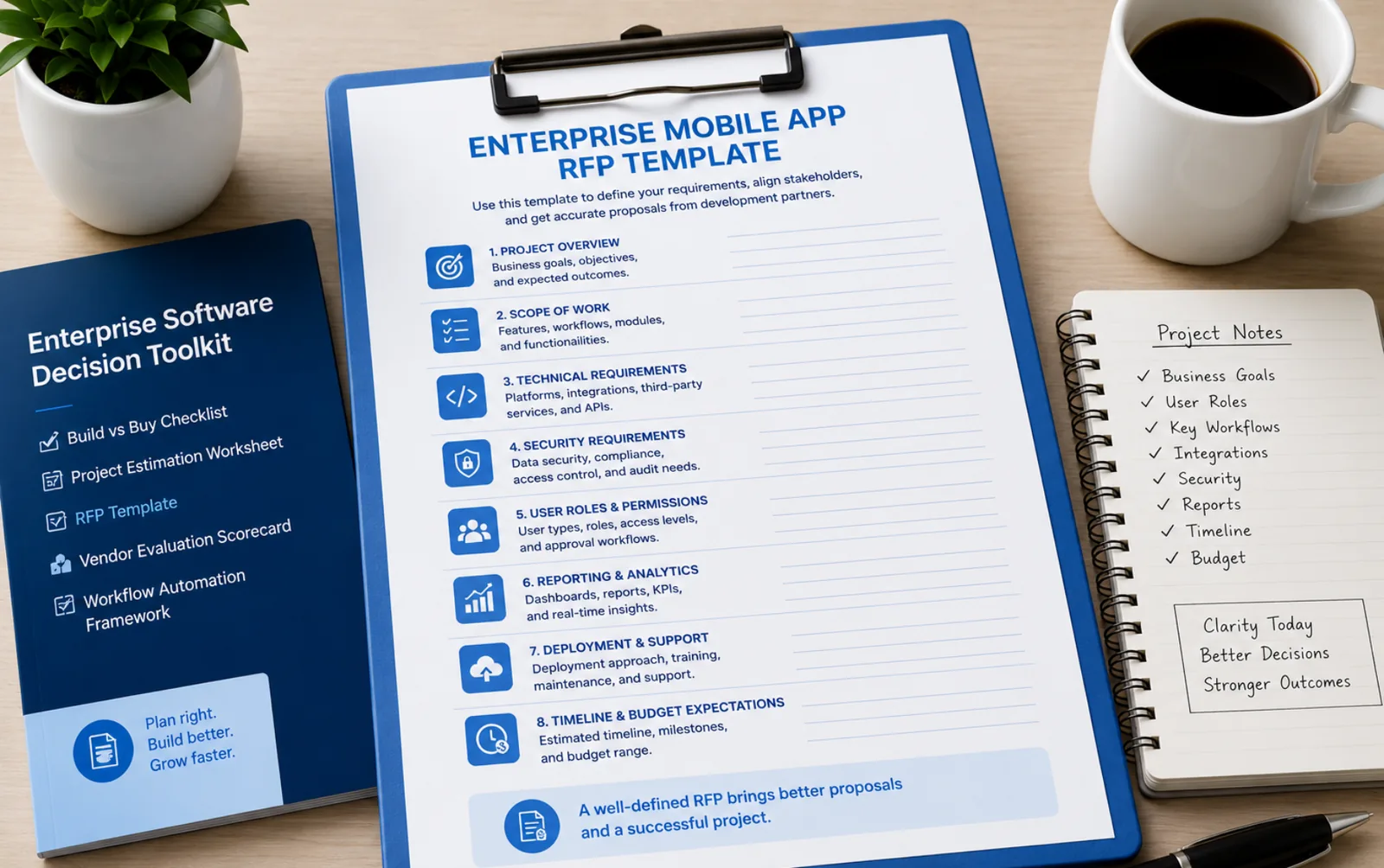
Start your project with greater clarity, better vendor conversations, and more accurate planning.
Frequently Asked Questions
How much does enterprise mobile app development cost in India?
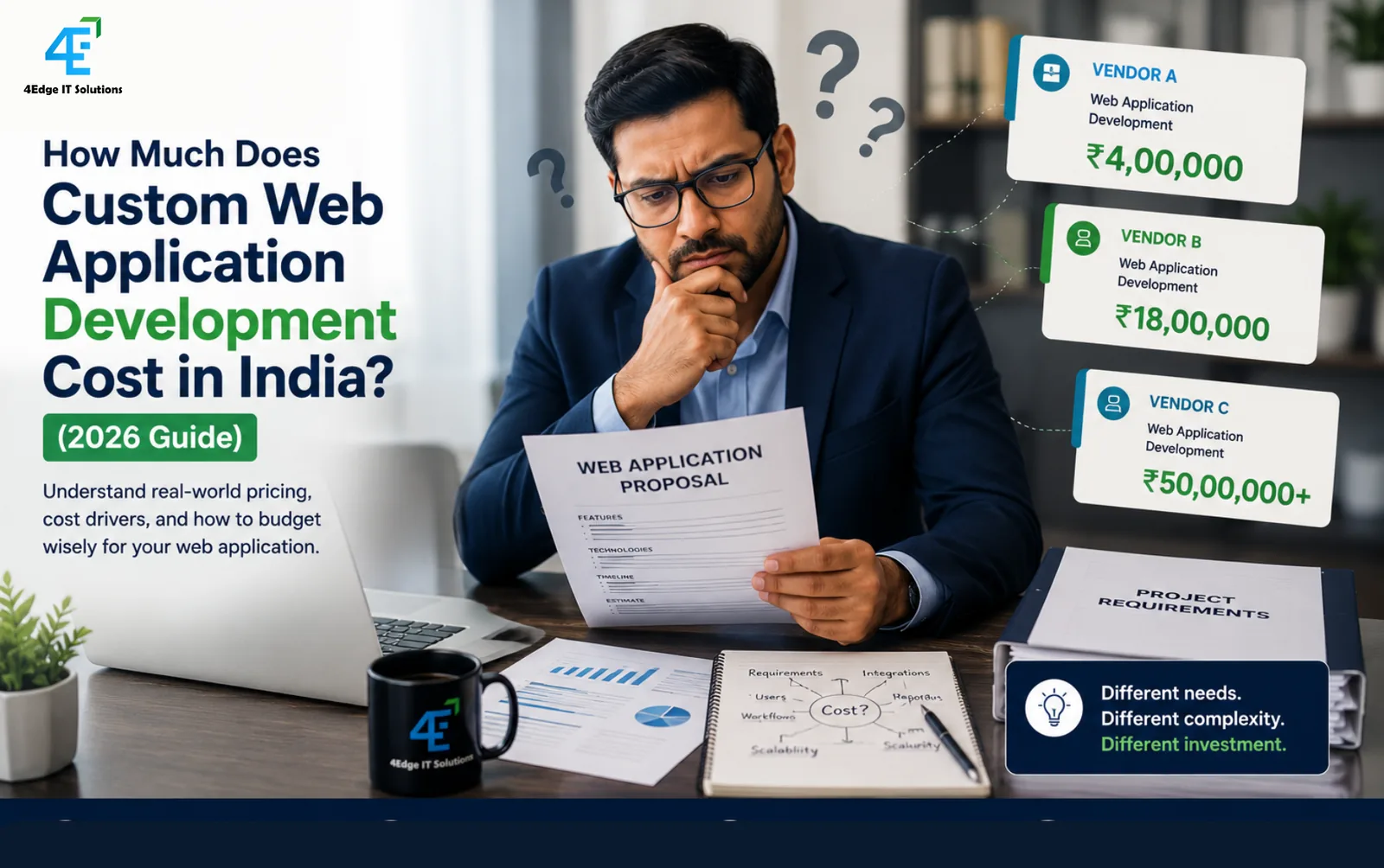
Enterprise mobile application projects typically range from ₹5 lakhs to ₹50 lakhs or more depending on complexity, integrations, user roles, security requirements, and scalability needs.
Should enterprises build separate iOS and Android apps?
Not always. Cross-platform development is often preferred when organizations need to support multiple device ecosystems efficiently.
How long does enterprise app development take?
Timelines vary based on scope. Smaller applications may take a few months, while enterprise platforms often require longer development cycles.
Can enterprise apps integrate with ERP and CRM systems?
Yes. Integrations with ERP, CRM, HRMS, LMS, payment gateways, and operational systems are common enterprise requirements.
What is the biggest reason enterprise app projects fail?
Projects often struggle when requirements, workflows, user needs, and business objectives are not clearly defined before development begins.
Final Thoughts
Enterprise mobile applications are not technology projects.
They are business transformation projects.
The most successful organizations focus less on features and more on outcomes.
Because the real question isn't:
"Do we need a mobile app?"
It's:
"What could our business achieve if critical processes were available everywhere?"
About the author
4Edge Engineering TeamChief Technology Officer
Heads engineering at 4Edge IT Solutions, delivering custom web and mobile applications, API integrations and Odoo ERP implementations for growing businesses.