What Is API Integration?
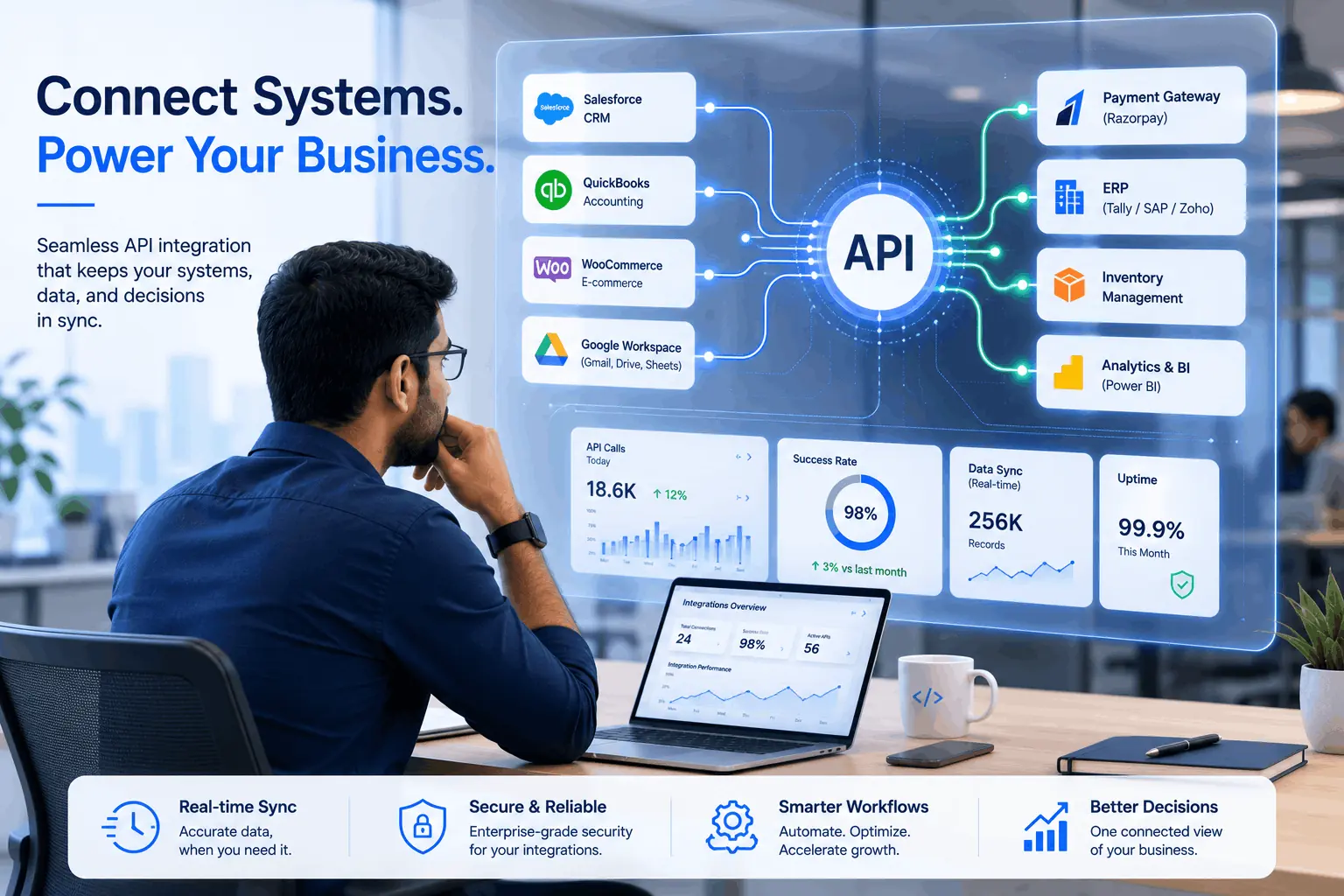
An API (Application Programming Interface) is how two pieces of software exchange data without a human copying and pasting between them. API integration is the engineering work of connecting your systems — your CRM, ERP, payment gateway, LMS, e-commerce platform — so data flows automatically where it needs to go, in real time or on a defined schedule.
This isn't exotic technology. Salesforce, Zoho, Shopify, Razorpay, Tally — virtually every serious business software tool exposes an API specifically so it can be connected to other systems. The real question businesses face isn't whether integration is technically possible. It's whether it's worth doing right now, and how to scope it so the project doesn't quietly balloon in cost.
Five Signs You Actually Need API Integration
1. Someone manually re-enters the same data in two systems. If a sales order gets typed into your CRM and then re-typed into your accounting software, that's not a process — it's a bug in your systems that a human is patching by hand, and it's a reliable source of data entry errors.
2. Reports take days to compile because data lives in silos. If finance can't get a real-time revenue view without exporting from three tools and stitching them together in Excel, integration would give that view automatically and continuously.
3. Your customer experience breaks at the handoff between systems. A support ticket that doesn't update account status, or a payment that doesn't trigger fulfillment, is an integration gap customers feel directly — and it's often the first thing that pushes a business to finally fix it.
4. You're paying for no-code automation tools to patch a gap a direct integration would close permanently. Tools like Zapier and Make are excellent for lightweight, low-volume workflows. At higher transaction volumes or with complex business logic, per-task pricing and fragile multi-step "zaps" get expensive and unreliable fast.
5. You're scaling past what manual reconciliation can handle. A process that worked fine at 50 orders a day becomes untenable at 500 — integration isn't just about efficiency at that point, it's about whether operations can keep up with growth at all.
Where Integration Projects Actually Go Wrong
Underestimating data mapping. Two systems rarely define "customer" or "order" identically. The real engineering effort is usually less about connecting the APIs technically and more about deciding how fields map between systems, what happens with mismatches, and which system wins when data conflicts.
No plan for what happens when the connection breaks. APIs change, rate limits get hit, networks fail. Integrations built without error handling and alerting fail silently — until someone notices three weeks of orders never reached the fulfillment system.
Treating it as a one-time project instead of an ongoing relationship. Vendors update their APIs regularly. An integration that isn't actively maintained will eventually break when a connected system changes its data format or authentication method — often without warning.
No single owner after launch. Integrations that "just run in the background" get forgotten until they fail, and by then nobody remembers exactly how they were built or why certain decisions were made.
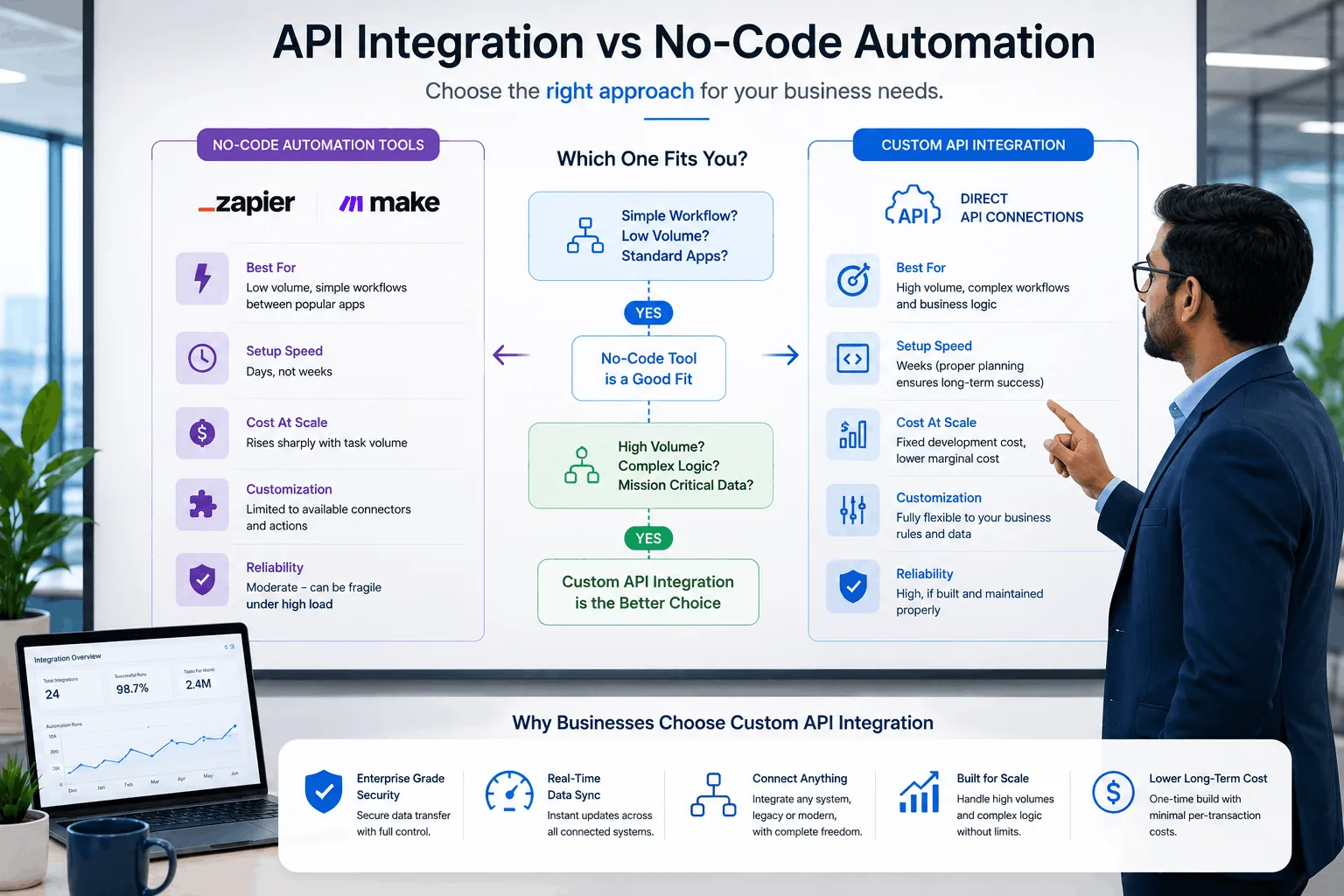
API Integration vs. No-Code Automation Tools: Which Fits Your Situation?
| Factor | No-Code Tools (Zapier, Make) | Custom API Integration |
|---|---|---|
| Best for | Low volume, simple workflows | High volume, complex business logic |
| Setup speed | Days | Weeks |
| Cost at scale | Rises sharply with task volume | Fixed development cost, lower marginal cost |
| Reliability for critical data | Moderate — can be fragile under load | High, if built and maintained properly |
| Customization | Limited to available connectors | Fully flexible |
| Ongoing maintenance | Handled by the platform | Requires an internal or partner-owned maintenance plan |
What API Integration Costs in India
As a general planning range for 2026:
- Simple, single-connection integration (e.g., CRM to accounting software, standard REST APIs on both sides): roughly ₹1–₹3 lakh
- Multi-system integration with moderate custom logic and error handling: roughly ₹3–₹8 lakh
- Complex, high-volume, or poorly documented API integration (legacy systems, custom authentication, heavy data transformation): ₹8 lakh and up, often with ongoing maintenance retainers
Poorly documented or rate-limited third-party APIs are the single biggest cause of integration projects exceeding these ranges — this is worth confirming before a project is scoped, not after.

How to Scope an Integration Project Properly
Before briefing a developer or vendor, get clear, written answers to:
- What data needs to move, in which direction, and how often — real-time, hourly, or daily batch?
- What's the source of truth when the same data exists in both systems?
- What happens on failure — does the integration retry, alert someone, or silently drop the data?
- Who owns this after launch — your internal team, or a development partner on retainer?
- What's the actual API documentation quality for each system involved? Ask to see it before committing to a timeline.
Enterprise Software Decision Toolkit
Planning an integration project and not sure whether it needs a simple connector or a custom build? Our Enterprise Software Decision Toolkit includes a planning framework for exactly this decision — download it before you brief a vendor.
Frequently Asked Questions
How much does API integration cost for a small business in India?
A simple, single-connection integration between two standard business tools typically costs ₹1–₹3 lakh. Costs rise with the number of systems involved, data volume, and how well-documented the third-party APIs are.
Is Zapier or Make enough, or do I need custom API integration?
No-code tools are usually sufficient for low-volume, simple workflows between popular apps. Once you're dealing with high transaction volumes, complex business logic, or mission-critical data flows, custom integration typically becomes more reliable and cost-effective than scaling a no-code tool.
How long does a typical API integration project take?
A simple integration between two well-documented systems can take 2–4 weeks. Multi-system integrations with custom logic often take 6–12 weeks, and projects involving legacy or poorly documented APIs can take longer.
What happens if a connected API changes after integration is complete?
This is why ongoing maintenance matters. A well-built integration includes monitoring and alerting so your team knows immediately if a connected API stops working as expected, rather than discovering it weeks later through missing data.
Who should own an API integration after it's built — IT or the development partner?
This should be decided before the project starts, not after launch. Many businesses keep simple integrations in-house and retain their development partner for more complex integrations that require specialized troubleshooting.
About the author
4Edge Engineering TeamChief Technology Officer
Heads engineering at 4Edge IT Solutions, delivering custom web and mobile applications, API integrations and Odoo ERP implementations for growing businesses.