Training budgets are often one of the first areas leadership teams question when they review costs.
The question is usually simple:
“We invested ₹10 lakh in this training. What did we get back?”
For L&D teams, answering that question can be difficult. Training may improve skills, confidence, decision-making, productivity, quality or employee performance—but not every benefit appears immediately as revenue.
That is why training ROI should not begin with a formula. It should begin with a business outcome.
A practical ROI approach connects four things:
Business Goal → Learning Intervention → Behaviour/Performance Change → Financial or Business Impact
CIPD recommends linking learning evaluation to identified performance gaps and organisational objectives rather than evaluating learning in isolation.
What Is Training ROI?
Training ROI, or Return on Investment, measures the financial return generated by a training initiative relative to its cost.
The basic formula is:
Training ROI
ROI (%) = [(Training Benefits − Training Cost) ÷ Training Cost] × 100
For example, suppose an organisation spends:
- Training cost: ₹5,00,000
- Measurable business benefit: ₹8,00,000
Then:
ROI = [(₹8,00,000 − ₹5,00,000) ÷ ₹5,00,000] × 100
ROI = 60%
This means the measurable return above the original training investment is ₹3 lakh, representing a 60% ROI.
However, the difficult part is rarely the calculation.
The difficult part is establishing what portion of the business improvement can reasonably be attributed to the training.
Why L&D Teams Struggle to Measure ROI
Many organisations already measure:
- Training completion
- Attendance
- Assessment scores
- Learner satisfaction
- Certificates issued
- Number of courses completed
These are useful operational metrics, but they don't necessarily demonstrate business impact.
For example:
95% of employees completed a sales training program.
That's a useful completion metric.
But a CFO may ask:
Did sales productivity improve?
Or:
Did conversion rates increase?
Or:
Did the cost of acquiring customers decrease?
SHRM similarly distinguishes between measuring participation and understanding whether learning translates into performance and business outcomes.
The goal is therefore to move from:
“Did people complete the training?”
to:
“What changed because of the training?”
Start With the Business Problem, Not the Course
Before calculating ROI, define the business problem the training is expected to address.
For example:
| Business Problem | Possible Training Objective | Business Metric |
|---|---|---|
| Low sales conversion | Improve consultative selling | Conversion rate |
| High operational errors | Improve process knowledge | Error rate |
| Slow employee onboarding | Improve role readiness | Time to productivity |
| Low manager effectiveness | Improve people-management skills | Team performance |
| Compliance incidents | Improve policy understanding | Incident frequency |
| Low productivity | Improve process/tool capability | Output per employee |
This is also where your Training Needs Analysis (TNA) becomes important.
A TNA identifies the gap between current capability and the capability required by the organisation. CIPD recommends connecting capability analysis and learning needs with organisational strategy and future requirements.
Related reading: Training Needs Analysis: A Step-by-Step Guide for HR and L&D Teams
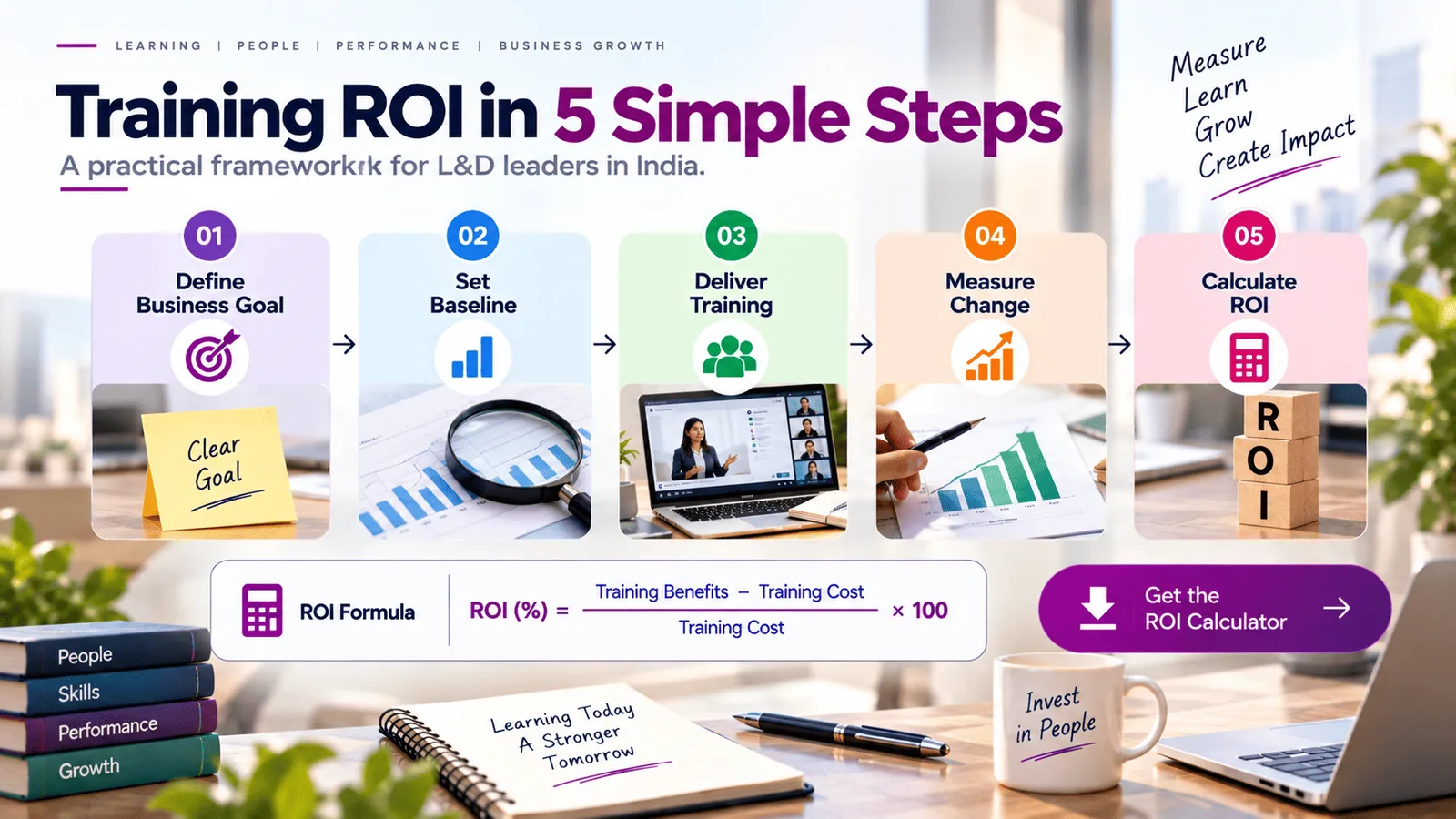
A 5-Step Framework to Calculate Training ROI
Step 1: Define the Business Outcome
Start by asking:
What should improve after the training?
Avoid vague objectives such as:
Improve employee skills.
Instead, define measurable outcomes:
Reduce customer-support resolution time by 15%.
Or:
Increase sales conversion from 18% to 22%.
Or:
Reduce processing errors from 7% to 4%.
The more clearly the outcome is defined before training begins, the easier it becomes to measure impact later.
Step 2: Establish the Baseline
You need a before-training measurement.
Without a baseline, it becomes difficult to determine whether performance actually changed.
Possible baseline metrics include:
- Revenue per employee
- Sales conversion
- Average handling time
- Error rate
- Productivity
- Customer satisfaction
- Employee retention
- Time to productivity
- Compliance incidents
- Quality scores
- Production output
Example
Before training:
Average customer resolution time = 10 hours
Three months after training:
Average customer resolution time = 8 hours
The improvement is:
20% reduction in resolution time
That gives L&D a starting point for calculating business impact.
Step 3: Measure Learning and Behaviour Change
Business results shouldn't be the only measurement.
A useful evaluation framework should look at several stages:
1. Reaction
Did employees find the learning relevant and useful?
2. Learning
Did they acquire the intended knowledge or skills?
3. Behaviour
Are they applying the new skills at work?
4. Business Results
Did performance improve?
5. Financial Impact
Can the business impact reasonably be converted into monetary value?
SHRM educational material describes evaluation across learning and performance levels and notes that ROI is not appropriate for every training situation.
CIPD also emphasises learning transfer —whether employees actually apply what they learned in the workplace.
Step 4: Convert Business Impact Into Financial Value
This is where ROI becomes more meaningful to CFOs and business leaders.
Suppose a process training program reduces operational errors.
Before training:
1,000 transactions × 8% error rate = 80 errors
After training:
1,000 transactions × 5% error rate = 50 errors
That's:
30 fewer errors
If the average cost of correcting each error is ₹2,000:
30 × ₹2,000 = ₹60,000
Estimated financial benefit:
₹60,000
This benefit can then be compared with the cost of the training.
Step 5: Calculate the ROI
Consider a larger example.
Training investment
| Cost Component | Amount |
|---|---|
| Content development | ₹1,50,000 |
| Trainer/facilitator | ₹1,00,000 |
| LMS/platform | ₹50,000 |
| Employee learning time | ₹75,000 |
| Administration | ₹25,000 |
| Total Cost | ₹4,00,000 |
After implementation, the organisation estimates measurable benefits of:
₹7,00,000
Therefore:
ROI = [(₹7,00,000 − ₹4,00,000) ÷ ₹4,00,000] × 100
Training ROI = 75%
The organisation generated ₹3 lakh in measurable benefit above its ₹4 lakh investment.
Don't Measure Every Training Program the Same Way
One of the biggest mistakes is trying to calculate financial ROI for every learning intervention.
Consider these examples:
Compliance Training
Possible metrics:
- Completion
- Assessment scores
- Policy awareness
- Incident trends
- Reporting behaviour
Sales Training
Possible metrics:
- Conversion rate
- Revenue per salesperson
- Deal size
- Sales cycle
- Win rate
Leadership Development
Possible metrics:
- Manager effectiveness
- Team engagement
- Internal mobility
- Retention
- Performance outcomes
Technical Training
Possible metrics:
- Productivity
- Error reduction
- Time saved
- Quality
- Rework
The right metric depends on the purpose of the learning intervention.
Training ROI vs Training Effectiveness
These terms are often used interchangeably, but they are different.
| Measurement | What It Answers |
|---|---|
| Completion | Did people finish? |
| Reaction | Did they value the experience? |
| Learning | Did they acquire knowledge or skills? |
| Behaviour | Are they applying it? |
| Performance | Did work improve? |
| ROI | Did the measurable financial benefit justify the investment? |
A training program can therefore be effective without having a simple financial ROI calculation.
For example, a mandatory compliance program may be evaluated through knowledge, behaviour, reporting and incident indicators rather than direct revenue generation.
SHRM notes that some training benefits are difficult to quantify financially and that ROI evaluation may not be appropriate in every situation.
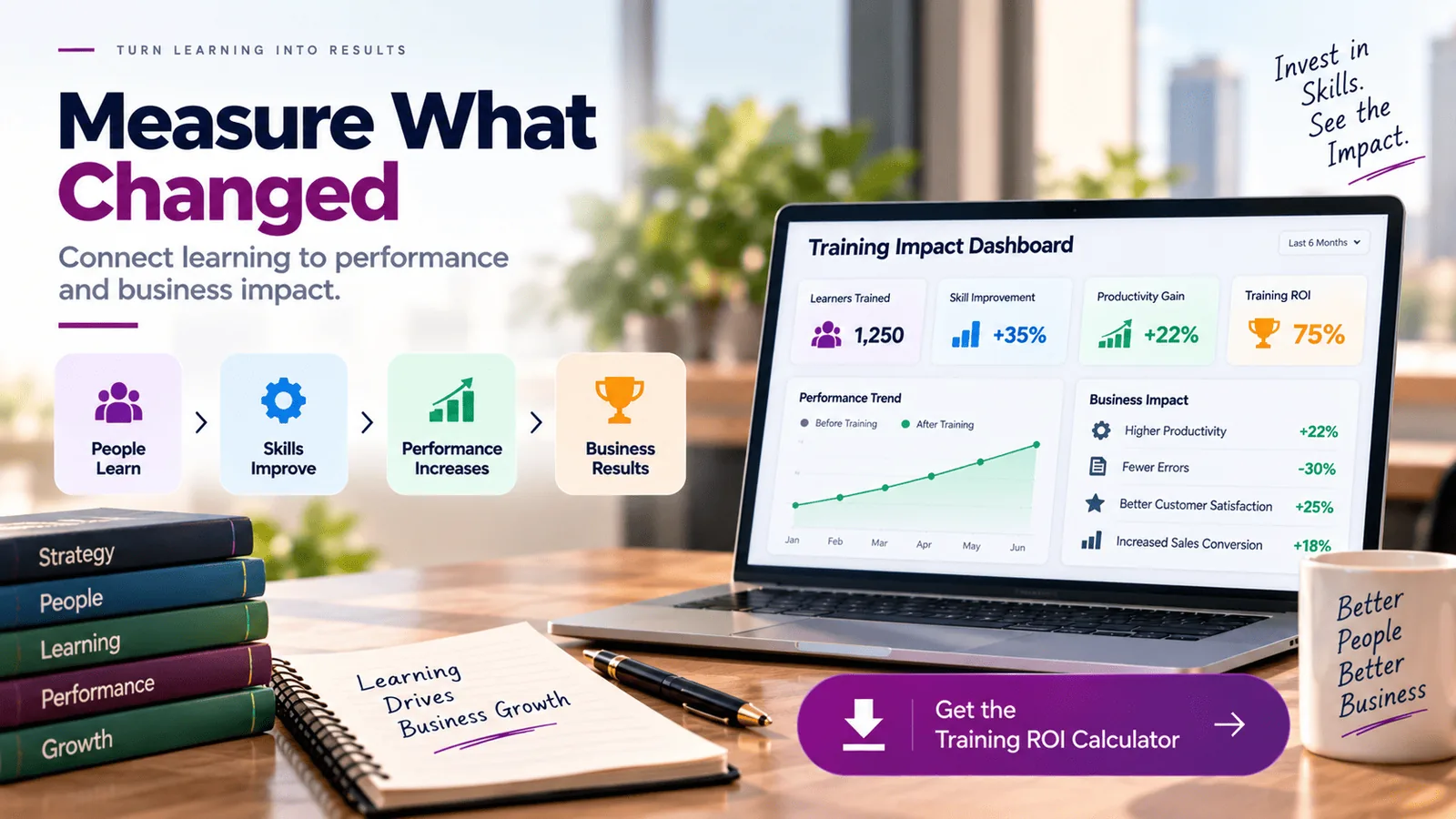
7 Metrics L&D Leaders Should Track
A practical L&D dashboard can combine learning, performance and financial metrics.
1. Completion Rate
Completed learners ÷ Assigned learners × 100
Useful for understanding participation, but not sufficient for measuring impact.
2. Knowledge Gain
Compare pre-training and post-training assessment results.
3. Skill Application
Measure whether employees demonstrate the targeted behaviour at work.
4. Performance Improvement
Compare relevant operational metrics before and after training.
5. Time to Productivity
Especially useful for onboarding and role-readiness programs.
6. Cost per Learner
Total Program Cost ÷ Number of Learners
7. Training ROI
[(Benefits − Costs) ÷ Costs] × 100
Together, these metrics provide a much more complete picture than completion rates alone.
A Practical Training ROI Dashboard
For an organisation running multiple programs, an L&D dashboard could look like this:
| Program | Cost | Business Metric | Before | After | Estimated Benefit | ROI |
|---|---|---|---|---|---|---|
| Sales Training | ₹5L | Conversion | 18% | 22% | ₹8L | 60% |
| Process Training | ₹3L | Error Rate | 8% | 5% | ₹5L | 67% |
| Leadership Program | ₹6L | Manager Effectiveness | 68% | 79% | To be evaluated | — |
| Onboarding | ₹4L | Time to Productivity | 90 days | 70 days | ₹6L | 50% |
The purpose isn't to create a perfect financial number for every program.
The purpose is to give leadership a clearer connection between:
Learning → Capability → Performance → Business Value
How Digital Learning Makes ROI Measurement Easier
A modern LMS can make the measurement process significantly more structured.
Instead of keeping training information across spreadsheets, email and separate systems, L&D teams can connect:
Skills → Assessments → Learning → Completion → Application → Performance
A digital learning platform can help track:
- Who completed training
- Assessment performance
- Learning progress
- Role-based learning
- Recurring training
- Certifications
- Skill development
- Manager feedback
- Learning history
- Reports and dashboards
4Edge's Learning Management Solutions and K-Nest LMS are designed around digital learning management, training delivery and reporting.
The Role of TNA in Training ROI
Training ROI becomes much easier when the program starts with a well-defined training need.
A strong process looks like:
TNA → Define Gap → Set Baseline → Design Learning → Deliver → Measure Transfer → Measure Performance → Calculate ROI
This prevents organisations from creating training simply because a course is available.
Instead, every major learning initiative starts with a question:
What business or capability problem are we trying to solve?
That makes the eventual ROI conversation much stronger.
5 Common Mistakes When Calculating Training ROI
1. Measuring only completion
A 100% completion rate doesn't prove business impact.
2. Starting measurement after training
If there is no baseline, proving change becomes difficult.
3. Claiming all improvement came from training
Other factors—process changes, technology, market conditions, management changes or staffing—can influence results.
4. Forcing financial ROI onto every program
Some learning outcomes are better measured through capability, behaviour, risk or performance indicators.
5. Waiting until the end
ROI measurement should be designed before the program starts, not after the results are expected.
How to Present Training ROI to the CFO or CHRO
Don't present a dashboard containing only:
4,500 learners trained
92% completion
88% satisfaction
Instead, connect the numbers to business outcomes.
Before
₹12L annual cost from process errors
Intervention
₹4L process training program
After
₹7L estimated annual cost reduction
Business Impact
₹7L measurable benefit
ROI
75%
This gives the CFO or CHRO a much clearer picture of the investment.
A Simple Training ROI Checklist
Before launching a major training program, ask:
- What business problem are we solving?
- What capability gap exists?
- What is the current baseline?
- What should change after training?
- Which behaviour should employees demonstrate?
- Which business metric will change?
- How long should we wait before measuring?
- What portion of the improvement can reasonably be attributed to training?
- What is the total cost of the program?
- Can the measurable benefit be converted into financial value?
- Is financial ROI appropriate for this program?
If these questions are answered before training begins, ROI measurement becomes considerably easier.
Training ROI isn't simply an equation.
The equation is easy:
ROI = (Benefits − Cost) ÷ Cost × 100
The real work is identifying the right business outcome, establishing a baseline, measuring learning transfer, isolating the contribution of training and translating measurable improvement into business value.
For L&D leaders, the goal should not be to prove that every training program makes money.
It should be to demonstrate, with evidence, where learning is improving capability, changing behaviour and contributing to business performance.
As CIPD notes, effective learning evaluation needs to connect learning with organisational objectives and performance gaps.
FAQs
What is the formula for calculating training ROI?
Training ROI (%) = [(Training Benefits − Training Cost) ÷ Training Cost] × 100.
How do you measure L&D effectiveness?
Measure a combination of learning, behaviour, performance and business outcomes rather than relying only on completion or satisfaction scores.
What is a good training ROI?
There is no universal ROI percentage that applies to every training program. The appropriate benchmark depends on the intervention, business objective, measurement period and how benefits and costs are calculated.
Can training ROI be calculated for soft-skills training?
Yes, but it can be more difficult to quantify. Organisations can use indicators such as manager effectiveness, employee retention, productivity, behaviour change and performance, then determine whether a defensible financial conversion is possible.
How long should you wait before measuring training ROI?
It depends on the expected behaviour and business outcome. Immediate knowledge gains can be measured soon after training, while productivity, sales, retention or operational improvements may require weeks or months of observation.
What is the difference between training effectiveness and training ROI?
Training effectiveness evaluates whether learning achieved its intended outcomes. ROI goes further by comparing measurable financial benefits with the cost of the training.
Suggested Lead Magnet
Get the Training ROI Calculator
Include fields for:
Training Cost → Learners → Baseline Metric → Target Metric → Actual Result → Financial Benefit → ROI
This can work alongside your Digital Learning Strategy Workbook.
About the author
4Edge Learning Design TeamLearning & Development Lead
Leads instructional design at 4Edge IT Solutions, building eLearning content, game-based learning and LMS rollouts for corporate, NGO and education clients across India and abroad.