Should organizations choose custom or off-the-shelf e-learning content?
Organizations should choose custom e-learning content when training must align with specific business processes, products, compliance requirements, or organizational goals. Off-the-shelf training content is ideal for general topics such as communication skills, workplace behavior, and foundational compliance awareness. Many organizations achieve the best results through a hybrid learning strategy that combines both approaches.
Organizations invest millions in learning platforms, training initiatives, onboarding programs, compliance campaigns, leadership development, and workforce upskilling.
Yet many struggle with a surprisingly simple question:
Should we build custom e-learning content or buy off-the-shelf courses?
The answer isn't always obvious.
Off-the-shelf content promises speed and lower upfront costs.
Custom content promises relevance and business alignment.
Both have advantages.
Both have limitations.
And choosing the wrong approach can lead to low engagement, poor completion rates, weak knowledge retention, and wasted training budgets.
In 2026, learning leaders are moving away from a one-size-fits-all mindset.
Instead, they're building content strategies that balance speed, relevance, scalability, and business outcomes.
This guide explores the differences between custom and off-the-shelf e-learning content to help L&D leaders, HR teams, and training managers make better decisions.
Why This Decision Matters More in 2026
Employee expectations have changed.
Learners now expect training experiences that are:
Relevant
Personalized
Mobile-friendly
Interactive
Time-efficient
Meanwhile organizations face increasing pressure to:
Accelerate onboarding
Improve compliance awareness
Upskill employees faster
Reduce training costs
Demonstrate business impact
The challenge is no longer delivering content.
The challenge is delivering content that people actually remember and apply.
Understanding Off-the-Shelf E-Learning Content
Off-the-shelf content refers to pre-built training courses that organizations can purchase and deploy immediately.
Examples include:
Communication Skills
Leadership Fundamentals
Cybersecurity Awareness
Time Management
Customer Service
Workplace Safety
These courses are designed for broad audiences and can often be implemented quickly.
Benefits of Off-the-Shelf Learning Content
Faster Deployment
Organizations can launch training initiatives within days rather than months.
This is particularly useful when training needs are urgent.
Lower Initial Investment
Because development costs are shared across many buyers, the upfront investment is generally lower.
Large Course Libraries
Many providers offer hundreds of courses covering common workplace topics.
Proven Learning Frameworks
Established libraries often use tested instructional design methodologies.
The Limitations of Off-the-Shelf Content
While convenient, pre-built courses often struggle to address organizational realities.
Generic Examples
Employees frequently encounter scenarios that don't reflect their day-to-day work.
As a result, training feels disconnected.
Limited Business Context
Generic content cannot fully incorporate:
Internal processes
Company policies
Organization-specific workflows
Brand culture
Lower Perceived Relevance
The more generic the content, the lower the perceived value.
Employees often ask:
"How does this relate to my job?"
Competitive Disadvantage
If every company uses the same training content, learning ceases to become a strategic differentiator.
Understanding Custom E-Learning Content
Custom e-learning content is designed specifically for a particular organization, audience, process, or business objective.
Instead of generic examples, learners encounter familiar situations.
Instead of broad concepts, they learn through real business scenarios.
Benefits of Custom E-Learning Development
Alignment With Business Goals
Custom learning programs can support specific objectives such as:
Sales performance
Customer experience
Leadership development
Operational excellence
Compliance awareness
Training becomes part of business strategy rather than a standalone activity.
Higher Learner Engagement
People engage more deeply with content that reflects their work environment.
When learners recognize situations, customers, tools, and challenges, participation improves.
Better Knowledge Retention
Relevant content is easier to remember.
The closer learning feels to reality, the more likely employees are to apply it.
Stronger Organizational Culture
Custom content can reinforce:
Company values
Internal processes
Leadership expectations
Workplace behaviours
This creates consistency across teams.
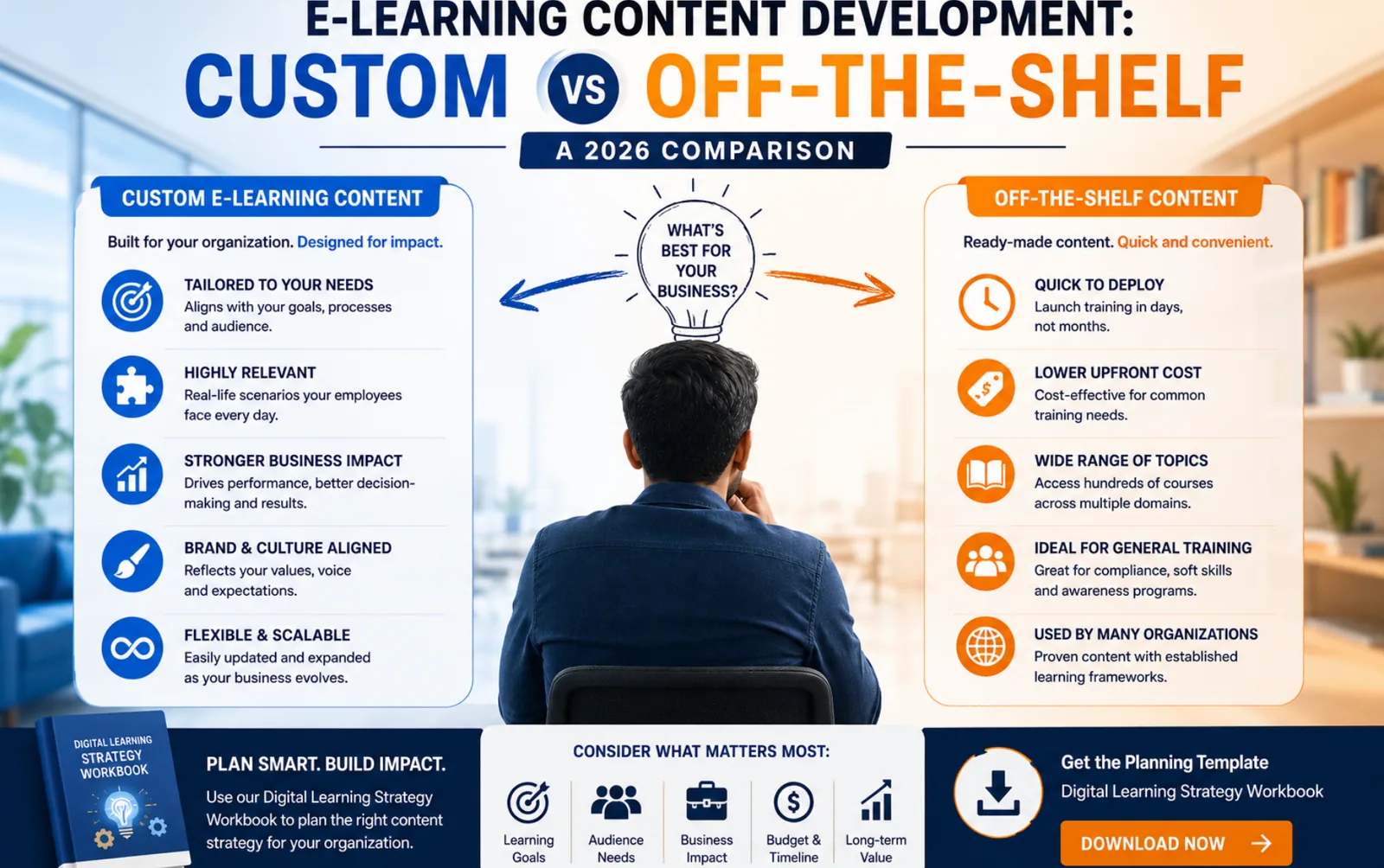
Custom vs Off-the-Shelf: Side-by-Side Comparison
| Factor | Custom Content | Off-the-Shelf Content |
|---|---|---|
| Relevance | Very High | Medium |
| Deployment Speed | Medium | Very High |
| Initial Cost | Higher | Lower |
| Scalability | High | High |
| Business Alignment | Very High | Low |
| Employee Engagement | High | Medium |
| Competitive Advantage | High | Low |
| Personalization | High | Limited |
| Flexibility | High | Low |
| Long-Term Value | High | Medium |
The Hidden Cost of Generic Learning
Many organizations focus on content acquisition costs.
However, the real question is:
What is the cost of ineffective learning?
Consider two scenarios.
Scenario A
The organization purchases a generic compliance course.
Employees complete it.
Certificates are issued.
Completion rates look acceptable.
Three months later, employees struggle to apply key concepts.
Scenario B
The organization deploys scenario-based learning tailored to its workplace environment.
Employees encounter realistic situations.
Managers reinforce concepts.
Application improves.
Compliance awareness increases.
Both programs delivered training.
Only one delivered impact.
When Off-the-Shelf Content Makes Sense
Off-the-shelf content is often ideal when:
| Use Case | Why It Works |
|---|---|
| General Soft Skills | Common learning objectives |
| Compliance Awareness | Broad regulatory topics |
| Quick Rollouts | Faster implementation |
| Budget Constraints | Lower upfront investment |
| Supplementary Learning | Supports larger programs |
Not every training challenge requires custom development.
When Custom Content Delivers Better Results
Custom content is often the better choice when:
| Use Case | Why Custom Wins |
|---|---|
| Employee Onboarding | Reflects internal processes |
| Sales Enablement | Supports products and services |
| Partner Training | Aligns with business models |
| Customer Education | Focuses on unique offerings |
| Leadership Development | Reflects organizational culture |
| Process Training | Mirrors actual workflows |
These areas directly influence business performance.
The Hybrid Approach: What Leading Organizations Do
In 2026, many organizations will avoid choosing one approach exclusively.
Instead they combine both.
Use Off-the-Shelf Content For:
Foundational skills
Compliance awareness
General professional development
Use Custom Content For:
Organization-specific processes
Strategic initiatives
Customer-facing teams
Leadership programs
Competitive differentiation
This approach balances speed and relevance.
Example: Building a Customer Service Academy
Imagine a company wants to improve customer experience.
An off-the-shelf library may provide:
Communication Skills
Customer Service Fundamentals
Conflict Resolution
These are valuable.
But they don't address:
Company-specific products
Internal escalation workflows
Customer personas
Service standards
Custom content fills these gaps.
The result is a complete learning ecosystem rather than isolated courses.
Questions Every L&D Leader Should Ask
Before selecting a content strategy, ask:
What business outcome are we trying to achieve?
Training should support measurable objectives.
How unique are our processes?
The more unique the process, the greater the value of customization.
How quickly do we need deployment?
Urgent timelines may favour off-the-shelf solutions.
Will this content remain relevant for years?
Long-term programs often justify custom investment.
How important is learner engagement?
When adoption matters, relevance becomes critical.
How 4Edge Approaches E-Learning Content Development
At 4Edge, we don't start with content.
We start with business objectives.
Our content development approach focuses on:
Learning needs analysis
Audience profiling
Instructional design
Scenario-based learning
Multimedia development
Assessment design
LMS compatibility
Whether the requirement is onboarding, compliance, customer education, leadership development, or workforce enablement, the goal remains the same:
Create learning experiences that drive measurable outcomes.
Not just course completions.
Free Resource: Digital Learning Strategy Workbook
Before deciding between custom and off-the-shelf content, organizations should evaluate:
Business goals
Audience needs
Learning priorities
Budget considerations
Delivery timelines
Our Digital Learning Strategy Workbook helps learning leaders build a structured content roadmap.
What's Included?
| Resource | Purpose |
|---|---|
| Learning Needs Assessment Framework | Identify skill gaps |
| Content Prioritization Matrix | Focus on high-impact initiatives |
| Audience Analysis Template | Understand learner needs |
| Content Planning Worksheet | Build learning roadmaps |
| Learning Measurement Framework | Track outcomes |
Get the Digital Learning Strategy Workbook
Make content decisions based on business impact, not assumptions.
Frequently Asked Questions
Is custom e-learning better than off-the-shelf content?
Not always. The best choice depends on learning objectives, audience needs, business goals, timelines, and budget. Many organizations benefit from a hybrid approach.
Why do employees disengage from training?
One common reason is lack of relevance. Employees are more likely to engage when content reflects their actual work environment and challenges.
When should organizations invest in custom learning content?
Custom content is often valuable for onboarding, process training, leadership development, customer education, partner enablement, and strategic initiatives.
Is off-the-shelf content suitable for compliance programs?
Yes. Many organizations use off-the-shelf compliance content for foundational awareness while supplementing it with organization-specific guidance.
What is the biggest advantage of custom content?
The ability to align learning experiences with business objectives, workflows, culture, and real-world employee challenges.
The debate isn't really custom versus off-the-shelf.
The real question is:
Which approach helps employees perform better?
The most successful learning strategies combine speed where standardization works and customization where business impact matters.
Because effective learning isn't measured by the number of courses delivered.
It's measured by what people do differently afterward.
About the author
4Edge Learning Design TeamLearning & Development Lead
Leads instructional design at 4Edge IT Solutions, building eLearning content, game-based learning and LMS rollouts for corporate, NGO and education clients across India and abroad.