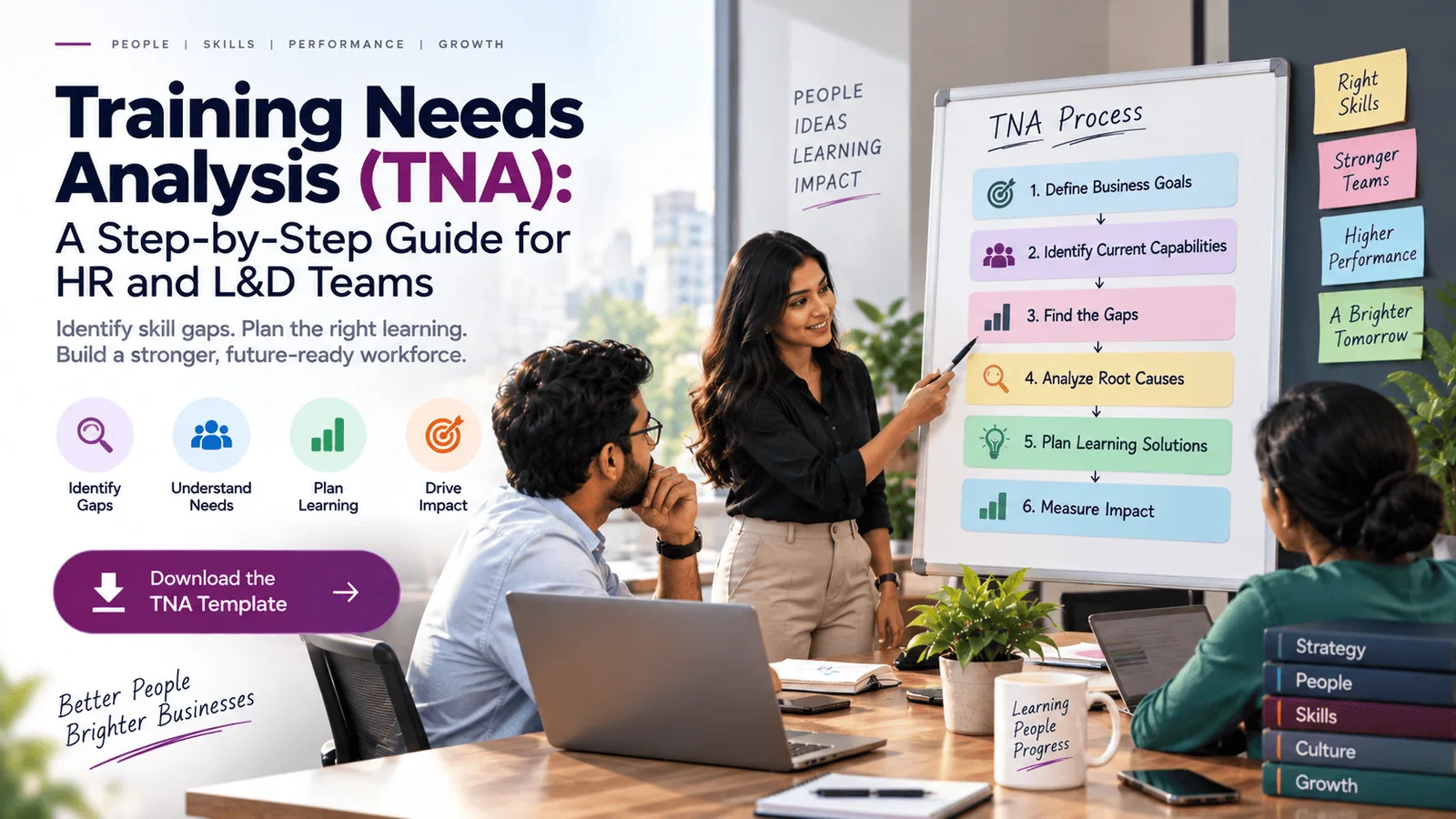
Training should solve a business problem—not simply fill a calendar.
Yet many organizations still approach employee training by starting with a familiar question:
“What training should we conduct this year?”
A better question is:
“What capability do our people need to perform better, and what is causing the gap?”
That is the purpose of a Training Needs Analysis (TNA).
A well-designed TNA helps HR and L&D teams identify the difference between current capability and required capability, understand why the gap exists, prioritize learning needs and select the right intervention. describes training needs analysis in similar terms: comparing current competency, skills or knowledge with the required standard to determine training needs.
For organizations building a more strategic learning function, TNA can become the bridge between business goals, workforce capability and learning investment.
What Is Training Needs Analysis?
Training Needs Analysis is a structured process for identifying:
- What employees need to know
- What they need to be able to do
- What they can do today
- Where the gaps are
- Why those gaps exist
- Which gaps can be addressed through learning
- Which gaps require another business intervention
A simple way to visualize it is:
Business Goal → Required Capability → Current Capability → Gap → Root Cause → Action
For example:
A company wants to improve customer retention.
The required capability might include:
Customer communication + product knowledge + problem-solving
The TNA could reveal that employees understand the products but struggle with difficult customer conversations.
The solution may therefore be scenario-based communication training, rather than another product-knowledge course.
Why TNA Matters More Now
Workforce skills are changing quickly.
The World Economic Forum's Future of Jobs Report 2025 estimates that 39% of workers' existing skill sets may be transformed or become outdated between 2025 and 2030. The report also found that 63% of surveyed employers identified skills gaps as a major barrier to business transformation. World Economic Forum
That makes identifying capability gaps more important than simply increasing training hours.
A TNA can help L&D teams answer:
Which skills matter?
For whom?
At what level?
Why are they missing?
What should we do about them?
TNA vs Training Gap Analysis vs Learning Needs Analysis
These terms are often used interchangeably, but there can be differences in scope.
| Term | Typical focus |
|---|---|
| Training Needs Analysis | Identifying needs for a specific training intervention |
| Training Gap Analysis | Comparing current capability against required capability |
| Learning Needs Analysis | Broader, ongoing analysis of learning and development needs |
| Skills Gap Analysis | Identifying differences between available and required skills |
CIPD distinguishes a TNA as a more specific analysis for a particular training activity, while describing learning needs analysis as a broader and ongoing process connected to organisational strategy and capability.
For HR and L&D teams, the practical lesson is simple:
Don't treat TNA as a once-a-year form-filling exercise.
The analysis should evolve as business priorities, roles and capabilities change.
The 3 Levels of Training Needs Analysis
A useful TNA examines needs at three levels.
1. Organisational Level
Start with the business.
Ask:
- What are our strategic priorities?
- What business problems are we trying to solve?
- Which capabilities will become important?
- Where are performance problems appearing?
- What changes are coming?
- What compliance or regulatory requirements matter?
For example:
Business goal: Expand into international markets.
Potential capability requirements:
- Cross-cultural communication
- International sales
- Market knowledge
- Global compliance
- Digital collaboration
2. Team or Job-Role Level
Next, examine specific functions and roles.
For example:
| Role | Required capability |
|---|---|
| Sales Executive | Consultative selling |
| Sales Manager | Pipeline management |
| Customer Support | Conflict resolution |
| Team Leader | Coaching |
| HR Manager | People analytics |
| IT Team | Cybersecurity awareness |
This prevents the common mistake of assigning the same training to everyone.
3. Individual Level
Finally, determine who needs what.
Two employees in the same role may have different gaps.
Employee A may need:
Advanced Excel
Employee B may need:
Presentation skills
Employee C may need:
Leadership development
SHRM similarly recommends avoiding the assumption that everyone needs the same training and instead identifying competency gaps across individuals, job categories and teams.
Step-by-Step Training Needs Analysis Process
Step 1: Start With the Business Objective
Don't begin with a course catalogue.
Begin with the business problem.
Instead of:
“We need a leadership workshop.”
Ask:
“What leadership problem are we trying to solve?”
For example:
Problem: New managers struggle to manage team performance.
Desired outcome: Managers can conduct effective one-to-ones, provide feedback and address performance issues.
Now the learning requirement becomes much clearer.
Step 2: Define the Required Capability
Once the business objective is clear, identify what people must be able to do.
Use a simple structure:
Role → Task → Capability → Expected Performance
Example:
| Role | Task | Capability | Expected standard |
|---|---|---|---|
| Sales Executive | Customer discovery | Consultative questioning | Consistently identifies customer needs |
| Manager | Performance review | Feedback | Gives structured, actionable feedback |
| Support Agent | Complaint handling | Conflict resolution | Resolves complaints using approved process |
This becomes the foundation of your TNA.
Step 3: Measure Current Capability
Now find out where employees actually stand.
Don't rely only on employee opinions.
Combine multiple sources.
Useful TNA data sources
- Performance reviews
- Manager interviews
- Employee surveys
- Self-assessments
- Skills assessments
- Knowledge tests
- Customer feedback
- Quality scores
- Sales performance
- Productivity data
- Error rates
- Incident reports
- Compliance findings
- Business plans
- Strategic workforce plans
SHRM's learning needs assessment template similarly recommends using multiple sources, including performance reviews, business plans, manager feedback, employee self-assessments, customer or quality data and compliance requirements.
Step 4: Identify the Gap
Now compare:
Current Capability
vs.
Required Capability
For example:
| Capability | Current | Required | Gap |
|---|---|---|---|
| Product knowledge | 4/5 | 4/5 | Low |
| Consultative selling | 2/5 | 4/5 | High |
| CRM usage | 3/5 | 4/5 | Medium |
| Negotiation | 2/5 | 4/5 | High |
This immediately makes the training conversation more specific.
Instead of saying:
“Sales needs training.”
You can say:
“The biggest capability gaps are consultative selling and negotiation.”
That is much more actionable.
Step 5: Find the Root Cause
This is where many TNA processes go wrong.
Not every performance problem is a training problem.
Imagine employees are making frequent mistakes.
Possible causes include:
Knowledge problem
They don't know the process.
→ Training may help.
Skill problem
They understand the process but can't perform it.
→ Practice/coaching may help.
Process problem
The workflow itself is confusing.
→ Process redesign may be required.
Technology problem
The software is difficult to use.
→ Technology improvement may be required.
Resource problem
Employees don't have enough time or resources.
→ Operational intervention may be required.
Motivation problem
Employees know what to do but aren't doing it.
→ Management, incentives or accountability may need attention.
emphasizes that L&D teams should consider the appropriate ways to address a performance need rather than automatically defaulting to a course.
Step 6: Prioritise the Training Needs
You probably won't be able to address every gap immediately.
Create a priority matrix.
| Training need | Business impact | Urgency | Audience | Priority |
|---|---|---|---|---|
| Cybersecurity awareness | High | High | All employees | High |
| Consultative selling | High | High | Sales | High |
| Presentation skills | Medium | Medium | Managers | Medium |
| Advanced Excel | Medium | Low | Selected teams | Medium |
| Time management | Low | Low | Selected employees | Low |
This helps L&D move from:
“We have 30 training requests.”
to:
“These five capability gaps matter most right now.”
Step 7: Choose the Right Learning Intervention
Training doesn't always mean a classroom workshop.
Depending on the gap, the intervention could be:
- Instructor-led training
- eLearning
- Microlearning
- Simulation
- Game-based learning
- Coaching
- Mentoring
- Job aids
- Knowledge resources
- On-the-job practice
- Peer learning
- Blended learning
- Performance support
For example:
Knowledge gap → eLearning
Practical skill gap → Simulation
Behavioural gap → Coaching + practice
Complex decision-making → Scenario-based learning
Process knowledge → Microlearning + job aid
This is where TNA connects directly with learning design.
Step 8: Define Learning Objectives
Don't create a course simply because a skill has been identified.
Turn the need into measurable objectives.
Weak objective:
Understand customer service.
Better:
Handle a difficult customer interaction using the company's escalation framework.
Even better:
Given a simulated customer complaint, select the appropriate response and escalation path with at least 80% accuracy.
The final version gives the learning designer something that can actually be taught and assessed.
Step 9: Select the Delivery Format
Your TNA should inform the learning format.
For a distributed workforce, you might use:
Microlearning + LMS + assessments
For frontline employees:
Mobile learning + short simulations
For managers:
Workshop + coaching + practice
For complex technical roles:
Instructor-led learning + simulations + hands-on practice
For compliance:
Scenario-based digital learning + knowledge assessment
A strong learning strategy therefore doesn't ask:
“Should we use eLearning?”
It asks:
“What learning experience best addresses this particular capability gap?”
Step 10: Measure the Outcome
TNA shouldn't end when the course is launched.
Define the success measure before the training begins.
For example:
| Gap | Intervention | Success measure |
|---|---|---|
| Sales discovery | Sales simulation | Higher discovery quality |
| Customer complaints | Scenario training | Improved resolution rate |
| Cybersecurity | Awareness programme | Better assessment scores |
| Manager feedback | Leadership workshop | Improved feedback quality |
| Product knowledge | Microlearning | Higher knowledge assessment |
This makes it easier to demonstrate L&D's business contribution.
recommends connecting learning analysis with evaluation, impact and transfer rather than treating participation alone as the outcome.

A Practical TNA Framework
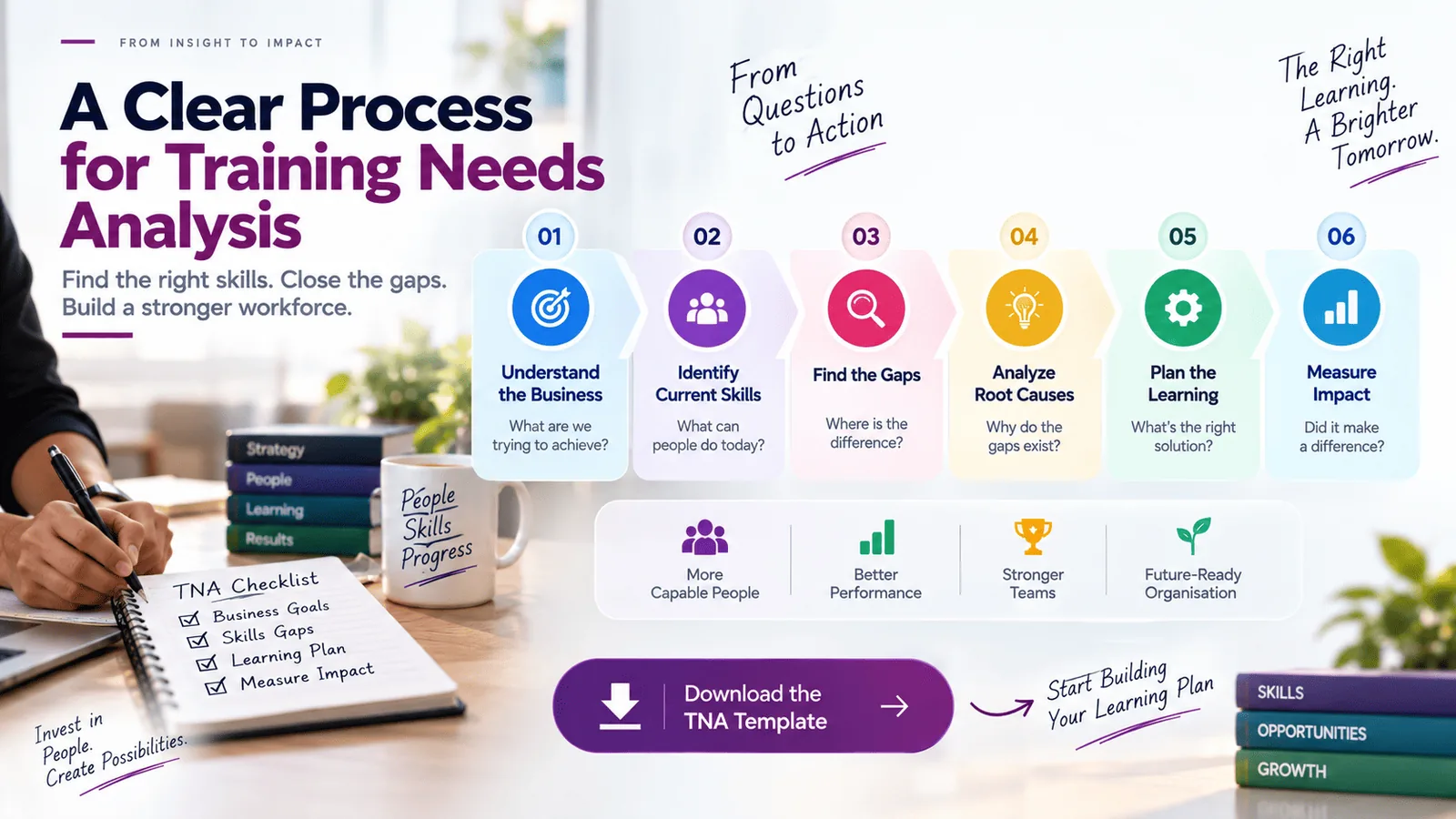
For HR and L&D teams, the entire process can be reduced to this framework:
01 — Business Need
What is the organisation trying to achieve?
↓
02 — Performance Requirement
What should employees be able to do?
↓
03 — Current Capability
What can they do today?
↓
04 — Gap
What is missing?
↓
05 — Root Cause
Why does the gap exist?
↓
06 — Intervention
What is the best way to address it?
↓
07 — Measurement
How will we know it worked?
This is the core of a practical training needs assessment.
Training Needs Analysis Template
A simple training needs analysis template India can include the following fields:
| Field | What to capture |
|---|---|
| Business unit | Department/function |
| Role | Target job role |
| Business objective | Desired business outcome |
| Required capability | What the role needs |
| Current capability | Existing level |
| Gap | Difference |
| Root cause | Why the gap exists |
| Evidence | Data supporting the gap |
| Priority | High/Medium/Low |
| Target audience | Who needs intervention |
| Learning objective | What learners should achieve |
| Intervention | Training/coaching/etc. |
| Delivery format | Classroom/eLearning/blended |
| Measurement | Success indicator |
| Owner | Responsible stakeholder |
| Timeline | Planned completion |
SHRM provides a learning needs assessment template using similar areas, including role and capability mapping, gap identification, data sources, impact/risk assessment, learning priorities and validation.
Example: TNA for a Growing Sales Team
Imagine an organisation has grown rapidly and hired 50 new sales employees.
Management notices:
- Inconsistent sales conversations
- Low CRM adoption
- Long sales cycles
- Poor qualification
- Inconsistent follow-up
The L&D team could conduct a TNA.
Business objective
Improve sales conversion.
Required capabilities
- Consultative questioning
- Product knowledge
- Qualification
- CRM usage
- Negotiation
Data collection
- Sales performance
- Manager interviews
- CRM data
- Employee survey
- Customer feedback
- Role-play assessment
Findings
The biggest gaps are:
Qualification + consultative selling
Intervention
Instead of a generic “Sales Skills Workshop”:
Digital modules → Sales simulations → Manager coaching → Practice → Assessment
Measurement
Track:
- Qualification quality
- Conversion rate
- CRM adoption
- Sales-cycle duration
- Assessment performance
Now the training programme is connected to a business outcome.
Common TNA Mistakes
Mistake 1: Starting with the Training Catalogue
“We have a leadership course. Who needs it?”
Reverse the process.
Identify the gap first.
Mistake 2: Treating Every Gap as a Training Problem
Some problems are caused by processes, systems, incentives or resources.
Don't train people to compensate for a broken process.
Mistake 3: Asking Only Employees
Employee surveys are useful, but they are only one source.
Combine:
Employee + Manager + Performance Data + Business Data
Mistake 4: Using the Same Training for Everyone
A new employee, experienced specialist and senior manager may have completely different capability gaps.
Segment your TNA.
Mistake 5: Measuring Completion Instead of Capability
98% completion doesn't necessarily mean the problem has been solved.
Measure whether capability or performance changed.
Mistake 6: Doing TNA Once a Year
Business priorities change.
New technology changes roles.
New products create new skills.
Regulatory requirements change.
recommends viewing learning needs analysis as an ongoing process connected to organisational strategy rather than an isolated annual exercise.
How Digital Tools Can Improve TNA
Traditional TNA often relies on:
Excel + Email + Surveys + Interviews
These can work, but digital learning platforms can make the process easier to manage at scale.
A modern learning ecosystem can connect:
Skills → Assessments → Learning → Completion → Performance Data
For example:
Identify gap
↓
Assign learning
↓
Assess
↓
Recommend next learning
↓
Track progress
↓
Measure outcome
This becomes especially useful when organisations have multiple teams, locations and job roles.
From TNA to a Digital Learning Strategy
TNA shouldn't exist separately from your wider learning strategy.
The flow should look like:
Business Strategy
↓
Capability Requirements
↓
Training Needs Analysis
↓
Learning Priorities
↓
Learning Design
↓
Learning Delivery
↓
Assessment
↓
Performance & Impact
similarly frames learning needs analysis as part of a broader L&D process that includes strategy, intervention design, delivery and evaluation.
This makes TNA much more valuable than a simple training request form.
Build Your TNA Process Around Evidence
The strongest TNA process combines multiple evidence sources:
Quantitative
- Performance scores
- Sales data
- Quality scores
- Assessment results
- Error rates
- Customer metrics
- Productivity
- Compliance data
Qualitative
- Manager interviews
- Employee interviews
- Focus groups
- Observation
- SME feedback
- Customer feedback
The more sources point toward the same capability gap, the stronger the case for intervention.
A Simple TNA Checklist for HR & L&D
Before finalising your training plan, ask:
☐ Is the business problem clearly defined?
☐ Is the required capability documented?
☐ Do we know the current capability level?
☐ Have we identified the actual gap?
☐ Have we investigated the root cause?
☐ Is this genuinely a learning problem?
☐ Have managers and SMEs validated the findings?
☐ Have we prioritised the gaps?
☐ Have we selected the right intervention?
☐ Are learning objectives measurable?
☐ Have we defined success metrics?
☐ Do we have a way to measure transfer and impact?
If several answers are “No”, the TNA probably isn't complete yet.
The Real Purpose of TNA
Training Needs Analysis isn't about creating a longer list of courses.
It's about making better learning decisions.
The best TNA process helps an L&D team move from:
“What training should we provide?”
to:
“What capability does the business need, where is the gap, why does it exist, and what intervention will make a measurable difference?”
That shift can make learning more focused, more relevant and easier to connect with organisational priorities.
With workforce skills continuing to evolve, structured capability analysis is becoming increasingly important. The World Economic Forum's 2025 research found that 85% of surveyed employers planned to prioritise workforce upskilling, while skills gaps were identified as the leading barrier to business transformation. World Economic Forum
Start with the business needs. Find the capability gap. Then design the learning.
Download the TNA Template
Need a practical starting point?
Use a Training Needs Analysis Template to map:
Business Need → Role → Required Skills → Current Skills → Gap → Root Cause → Learning Intervention → Measurement
Use the template as a working document with HR, L&D, managers and subject-matter experts rather than treating it as a standalone employee survey.
For organisations developing a broader learning strategy, 4Edge IT Solutions can also support Digital Learning and learning technology initiatives around structured employee development.
Frequently Asked Questions
What is Training Needs Analysis?
Training Needs Analysis is a structured process used to identify the difference between the capabilities employees currently have and those required to perform their roles or support organisational goals. The analysis helps determine whether training or another intervention is appropriate.
Why is TNA important for HR and L&D?
TNA helps HR and L&D prioritise learning investments based on business requirements and evidence rather than assumptions or generic training requests.
What is the difference between TNA and a training gap analysis?
A training gap analysis focuses primarily on the difference between current and required capability. TNA goes further by investigating the cause of the gap and determining the appropriate intervention.
How often should a TNA be conducted?
There is no universal annual schedule. TNA should be revisited when business priorities, roles, technologies, performance requirements or workforce capabilities change. recommends an ongoing approach to learning needs analysis.
What data should be used for a TNA?
Useful sources include performance reviews, manager feedback, employee assessments, customer or quality data, business plans, compliance requirements and workforce planning information.
Does every performance gap require training?
No. A gap may result from processes, systems, resources, incentives or other factors. Training should be selected when learning is an appropriate way to address the underlying need.
What should a TNA template include?
A practical template should capture the role, business objective, required capability, current capability, gap, evidence, root cause, priority, target audience, learning intervention, timeline and success measure.
How does TNA support digital learning?
TNA helps determine what employees need to learn, for whom, and why. Those findings can then inform the design of eLearning, microlearning, simulations, assessments, blended programmes and other digital learning experiences.
About the author
4Edge Learning Design TeamLearning & Development Lead
Leads instructional design at 4Edge IT Solutions, building eLearning content, game-based learning and LMS rollouts for corporate, NGO and education clients across India and abroad.