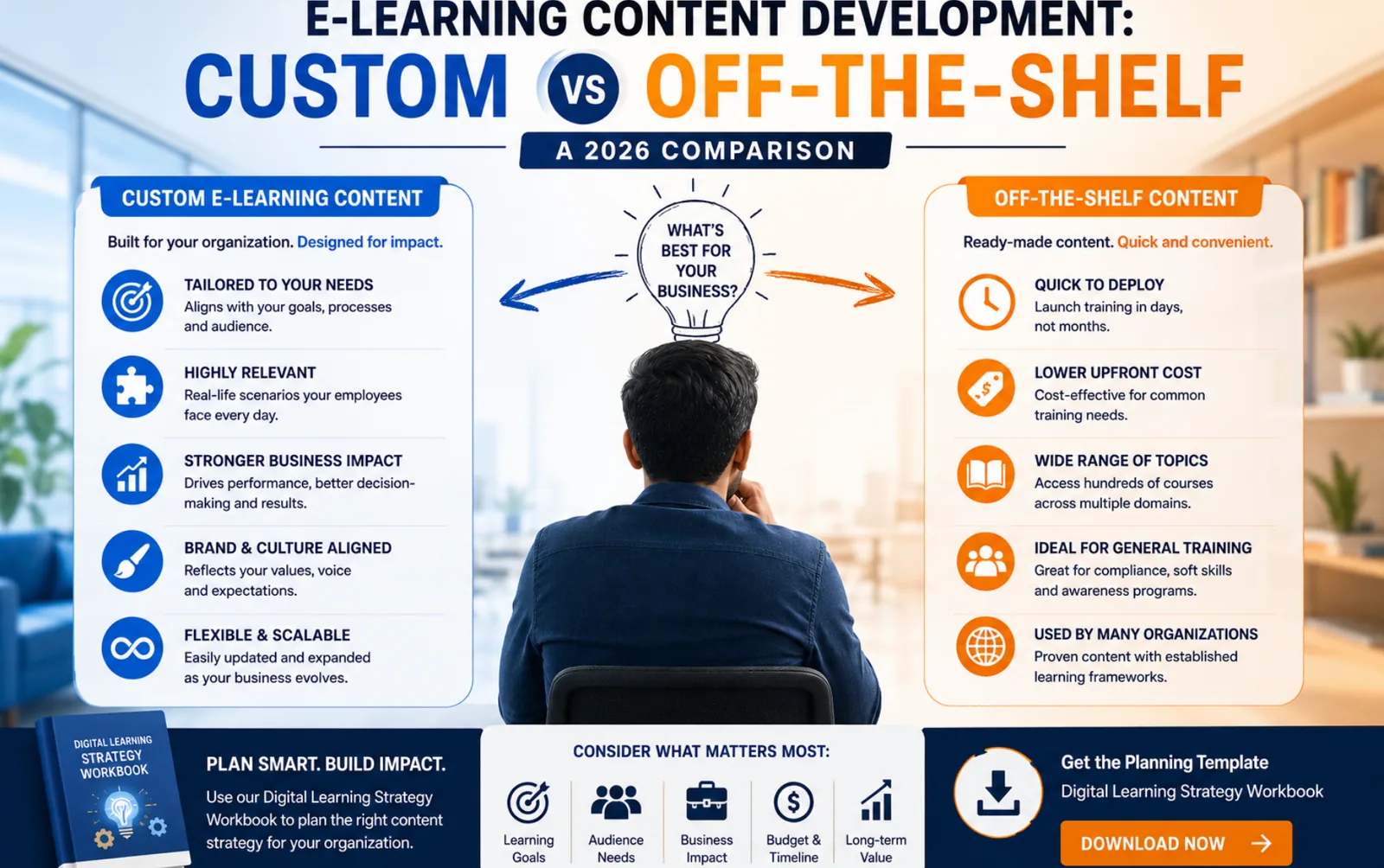
Employee training content often fails because it prioritizes completion over capability. Generic programs, outdated materials, low engagement, and limited measurement reduce knowledge retention and prevent meaningful behaviour change. Effective training content should evolve with business needs and help employees apply learning in real-world situations.
When training budgets come under scrutiny, organizations often ask whether they are spending too much on training. The better question is whether the training content is actually delivering value.
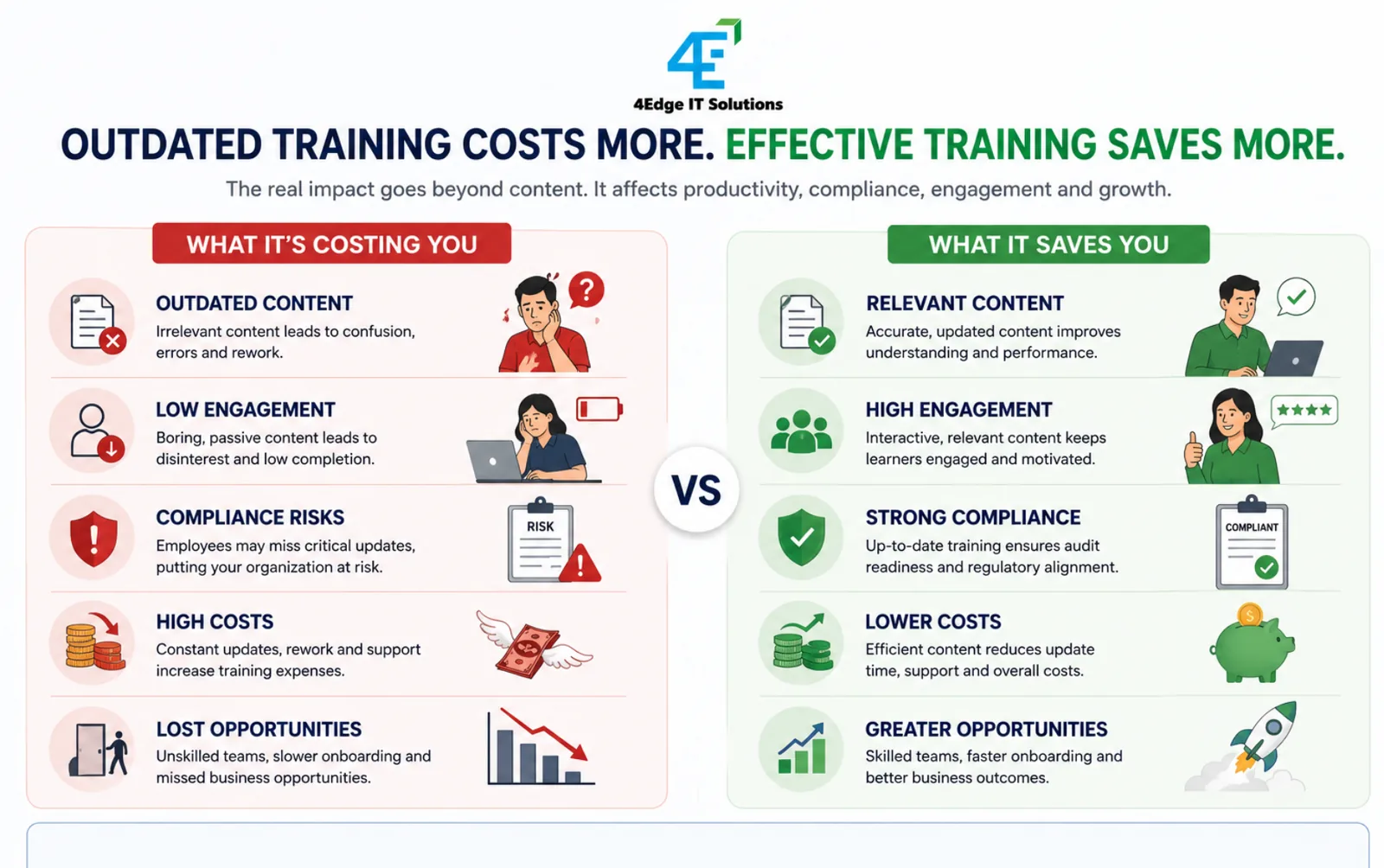
Ineffective training content does not just waste learning budgets. It quietly drains productivity, slows onboarding, frustrates employees, increases compliance risks, and forces organizations to spend more fixing the same problems repeatedly.
Many organizations assume that because they have e-learning modules, training videos, or mandatory programs in place, learning is happening. Completion rates look healthy, certificates are issued, and training calendars are full.
Yet employees continue making avoidable mistakes, managers repeat the same coaching conversations, and HR teams struggle to demonstrate business impact.
Training content that fails to engage, evolve, or support performance can end up costing far more than it saves.
Why Training Content Fails More Often Than We Admit
Bad training is not usually something organizations do on purpose. In fact, a lot of work goes into writing programs. The problem is usually elsewhere.
- Content created years ago does not reflect the realities of today.
- All employees receive cookie-cutter experiences, no matter their position.
- Practical use is overshadowed by information overload.
- Learning turns into administration instead of becoming a business enabler.
- Organizations stop asking whether their content is still working.
Sign 1: Employees Complete Training but Behaviours Don't Change
Completion rates can be misleading. An employee clicking through slides does not necessarily mean they understand, retain, or apply what they have learned.
Many organizations celebrate metrics such as:
- 95% completion rates
- Training attendance numbers
- Certificates issued
But if customer complaints remain unchanged, compliance errors persist, or managers continue addressing the same capability gaps, training content may be failing its intended purpose.
| What You Measure | What Actually Matters |
|---|---|
| Course completion | Behaviour change |
| Attendance | Knowledge application |
| Certificates | Performance improvement |
| Learner participation | Business outcomes |
Training should not simply inform. It should influence action.
Sign 2: Employees Describe Training as Boring
Every L&D professional has heard comments such as: I just clicked through it, I skipped most of it, or it was not relevant to my job. While difficult to hear, this feedback provides valuable insight.
Today's employees consume information differently. They expect concise, relevant, visually engaging experiences. Lengthy presentations, static PDFs, and text-heavy modules often struggle to maintain attention.
Engagement is not about entertainment. It is about relevance. When learners fail to connect training to their day-to-day responsibilities, retention declines rapidly.
Scenario: The Annual Compliance Program
An organization required all employees to complete a mandatory compliance course. Completion exceeded 98%, yet six months later policy violations remained unchanged.
A content review revealed the problem. The modules relied heavily on legal terminology, lengthy explanations, and outdated examples. Employees understood that they had to finish the training, but they could not relate it to situations they encountered at work.
The content informed. It did not prepare.
Sign 3: You're Delivering the Same Content to Everyone
Different employees face different challenges, yet many organizations continue deploying identical training experiences across departments.
| Audience | What They Need |
|---|---|
| New Employees | Foundational knowledge and onboarding support |
| Managers | Leadership and coaching guidance |
| Customer-Facing Teams | Communication and service skills |
| Operations Teams | Process accuracy and efficiency |
| Compliance-Sensitive Roles | Scenario-based risk awareness |
One-size-fits-all training rarely addresses these nuances effectively. As organizations grow, learning experiences must evolve accordingly.
Sign 4: Content Hasn't Been Updated in Years
Business priorities change, processes evolve, policies shift, and technology advances. But training content often remains frozen in time.
Many organizations continue using modules developed years earlier because:
- They are still technically accurate.
- Updating them feels expensive.
- The team does not have the bandwidth.
However, outdated training can create confusion and inconsistency. Employees may follow obsolete processes, new hires may receive conflicting guidance, and managers may spend time correcting misconceptions.
| Hidden Cost | Operational Impact |
|---|---|
| Obsolete examples | Reduced relevance |
| Outdated procedures | Increased errors |
| Conflicting information | Employee confusion |
| Repeated clarifications | Lost productivity |
| Regulatory changes ignored | Compliance risk |
Maintaining training content is part of maintaining operational consistency.
Sign 5: HR and L&D Can't Demonstrate Impact
One of the biggest challenges facing learning teams today is proving value. Leadership increasingly asks what the organization gained from the investment.
Many organizations can report number of learners trained, hours completed, and courses launched, but cannot confidently demonstrate:
- Reduced onboarding time
- Improved productivity
- Fewer compliance incidents
- Higher employee confidence
- Better customer outcomes
Without meaningful evaluation, training risks being viewed as a cost centre rather than a strategic enabler.
The Cost of Ineffective Training Adds Up
Training budgets are not limited to development expenses. Poor learning experiences create ripple effects across the business.
| Hidden Training Cost | Potential Business Impact |
|---|---|
| Low engagement | Reduced retention |
| Generic content | Lower relevance |
| Poor knowledge transfer | Repeat mistakes |
| Outdated materials | Operational inconsistency |
| Limited measurement | Difficulty proving ROI |
| Slow onboarding | Delayed productivity |
What appears inexpensive upfront can become costly over time.
What Effective Training Content Actually Looks Like
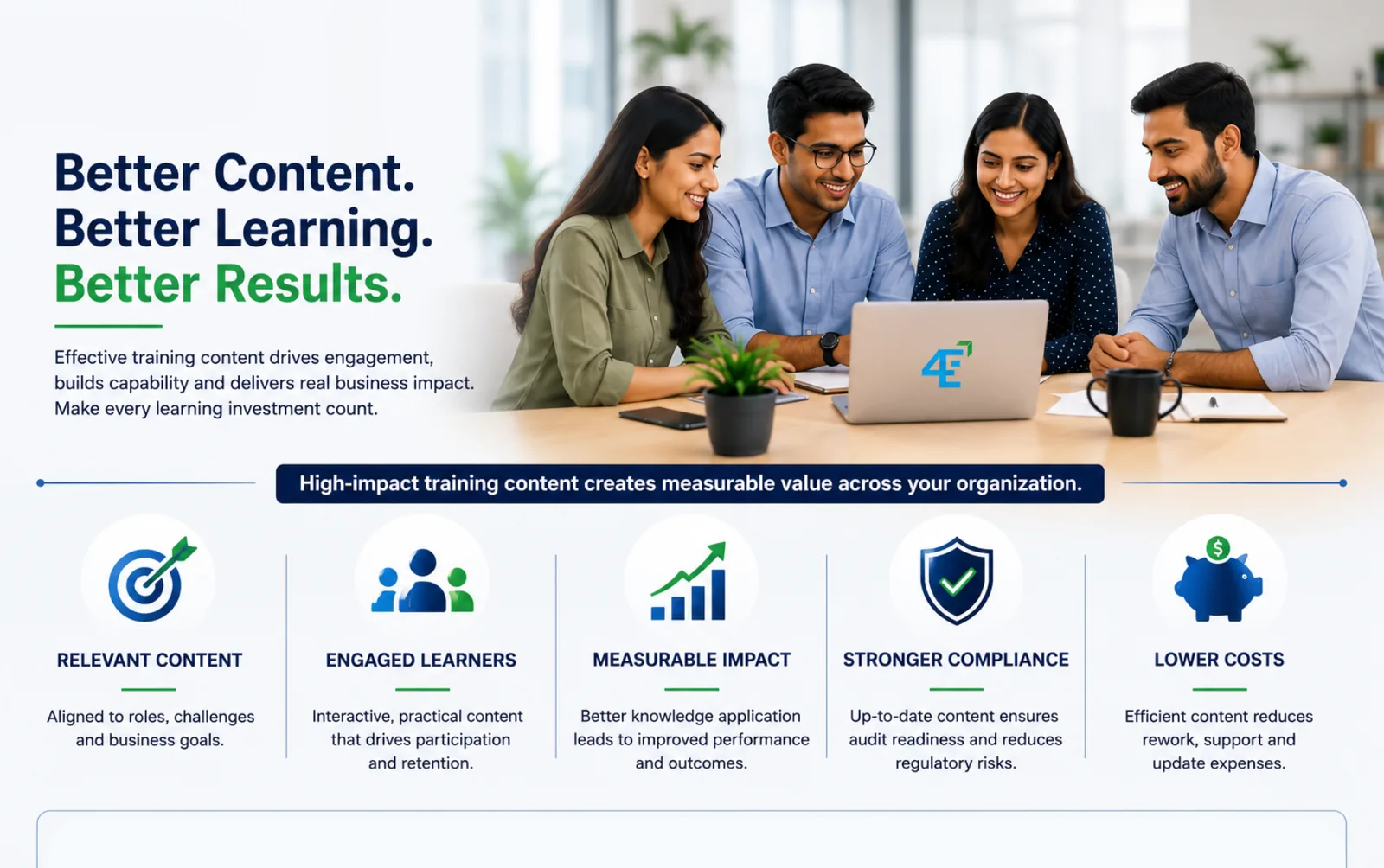
Effective learning experiences are not necessarily more complex. They are simply designed differently.
- Relevance: Employees understand why the content matters.
- Practical Application: Learning reflects real workplace scenarios.
- Accessibility: Content is easy to consume and revisit.
- Adaptability: Programs evolve alongside business needs.
- Measurement: Outcomes extend beyond completion statistics.
When these elements align, learning shifts from obligation to enablement.
Expert Perspective from 4Edge
One of the most common misconceptions about digital learning is that content only needs to be created once. In reality, learning content should evolve just as businesses do.
Organizations that regularly review and refine training experiences often improve consistency, strengthen knowledge retention, and better align learning investments with business priorities.
The goal is not simply to train employees. It is to equip them to perform with confidence.
Is It Time to Audit Your Training Content?
If any of these signs feel familiar, it does not necessarily mean your training initiatives have failed. It means they have outgrown their original design.
Many issues can be addressed through thoughtful evaluation and targeted improvements. Sometimes small adjustments create meaningful impact. Sometimes organizations discover the need for a broader content strategy. Either way, clarity comes before change.
Free Download: Training Content Audit Template
Before investing in new learning initiatives, evaluate what you already have. Our Training Content Audit Template helps HR and L&D teams assess whether existing programs remain effective, relevant, and aligned with business objectives.
What's Included
| The Template Helps You Evaluate | Why It Matters |
|---|---|
| Content relevance | Ensures alignment with current needs |
| Learner engagement | Identifies experience gaps |
| Role-based applicability | Improves personalization |
| Content freshness | Reduces outdated information |
| Measurement approaches | Supports ROI discussions |
| Improvement priorities | Guides future investments |
Download the Training Content Audit Template to identify what is working, uncover what is costing more than it should, and build learning experiences designed to support both employees and business outcomes.
Training content should not exist simply because it was created once. It should continue earning its place.
The real cost of ineffective learning is found in repeated mistakes, slower onboarding, disengaged employees, and missed opportunities to build capability where it matters most.
The question is not whether you have training content. It is whether your training content is helping people do their jobs better.
Frequently Asked Questions
Why do employee training programs fail?
Employee training programs often fail because they focus heavily on completion rather than capability. Generic content, limited interactivity, outdated examples, and a lack of real-world relevance can reduce engagement and knowledge retention.
How can I tell if our training content is ineffective?
Common warning signs include repeated employee mistakes, poor learner engagement, low knowledge retention, outdated materials, and an inability to demonstrate business impact beyond completion rates.
How often should employee training content be reviewed?
Training content should ideally be reviewed at least once a year and whenever there are significant changes to business processes, policies, technologies, compliance requirements, or workforce needs.
What makes employee training content engaging?
Engaging training content is practical, concise, and relevant to the learner's role. Scenario-based examples, interactive elements, microlearning formats, relatable visuals, and opportunities for application often improve participation and knowledge retention.
How do organizations measure training effectiveness?
Effective measurement goes beyond attendance and completion statistics. Organizations should evaluate behavioural change, productivity improvements, reduced errors, faster onboarding, increased learner confidence, compliance outcomes, and business performance metrics.
About the author
4Edge Learning Design TeamLearning & Development Lead
Leads instructional design at 4Edge IT Solutions, building eLearning content, game-based learning and LMS rollouts for corporate, NGO and education clients across India and abroad.