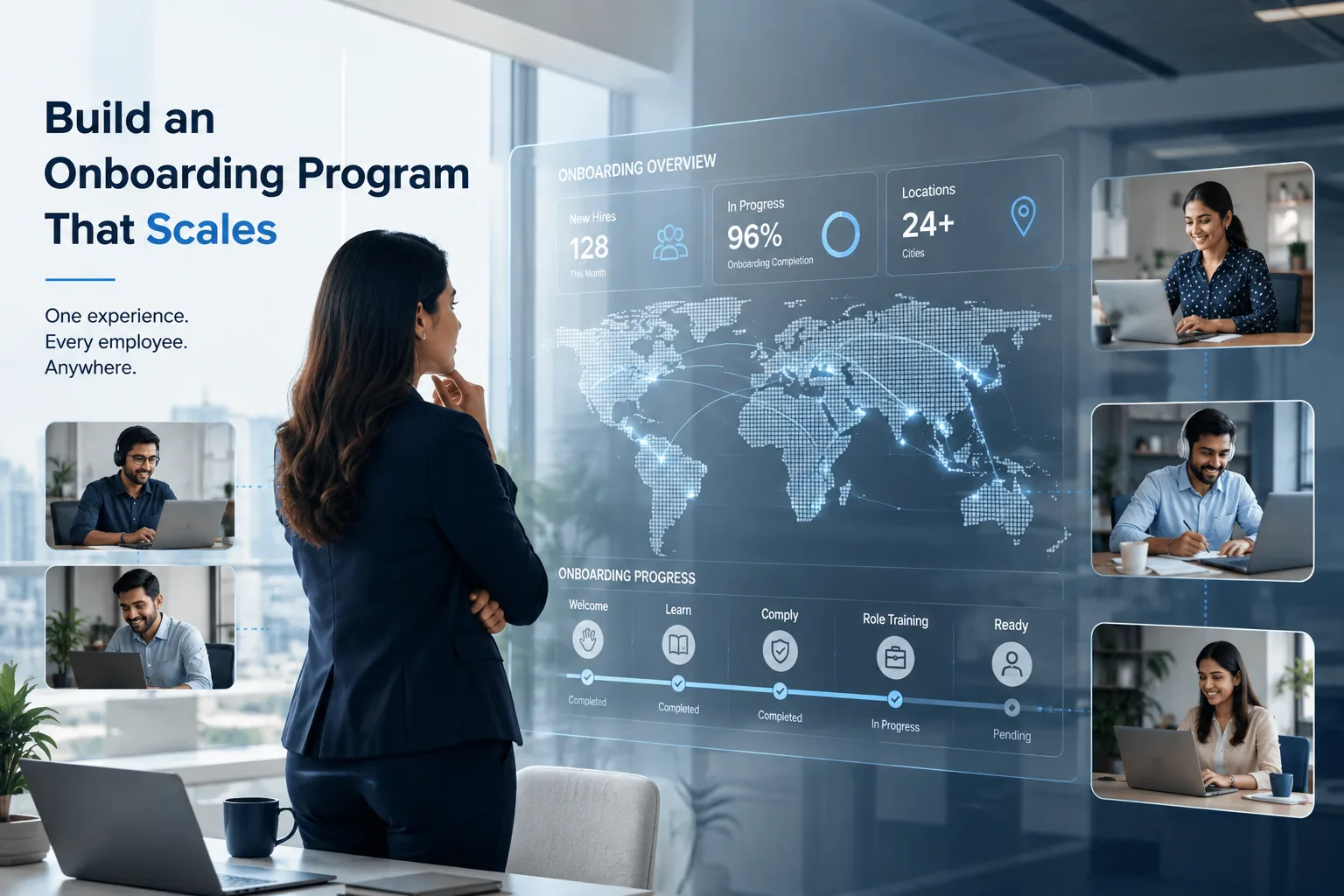
Remote and hybrid work have fundamentally changed how organizations welcome new employees. Today's workforce is often spread across multiple cities, states, or even countries. While distributed teams offer flexibility and access to wider talent pools, they also introduce a critical challenge: delivering a consistent onboarding experience at scale.
An employee's first few weeks shape their confidence, productivity, and long-term engagement. Yet many organizations still rely on scattered documents, live sessions, and manual follow-ups that become increasingly difficult to manage as teams grow.
A scalable onboarding training program addresses these challenges by combining structured learning paths, digital content, and automation—ensuring every employee receives the same high-quality experience regardless of where they work.
Why Traditional Onboarding Doesn't Scale
As organizations expand, manual onboarding quickly becomes difficult to sustain.
Common challenges include:
- Inconsistent onboarding across locations
- Repeated trainer-led sessions
- Delays in sharing learning materials
- Limited visibility into employee progress
- Difficulty maintaining compliance training
- Higher administrative workload for HR and L&D
These issues often lead to slower productivity and uneven employee experiences.
Expert Insight: Research from Microsoft's Work Trend Index and LinkedIn Workplace Learning reports consistently highlights that effective onboarding significantly improves employee engagement and long-term retention.
What Makes an Onboarding Program Scalable?
A scalable onboarding program delivers the same quality of learning regardless of whether you're onboarding 10 employees or 1,000.
Its focus is not simply automation—it is consistency, personalization, and measurable outcomes.
Core Characteristics
| Traditional Onboarding | Scalable Digital Onboarding |
|---|---|
| Classroom sessions | Self-paced digital learning |
| Manual tracking | Automated progress monitoring |
| Email-based document sharing | Centralized LMS access |
| Trainer-dependent | Standardized learning journeys |
| Difficult to update | Content updated once for everyone |
The Five Building Blocks of a Modern Digital Onboarding Program
1. Standardize the Learning Journey
Create a structured roadmap instead of relying on ad hoc training.
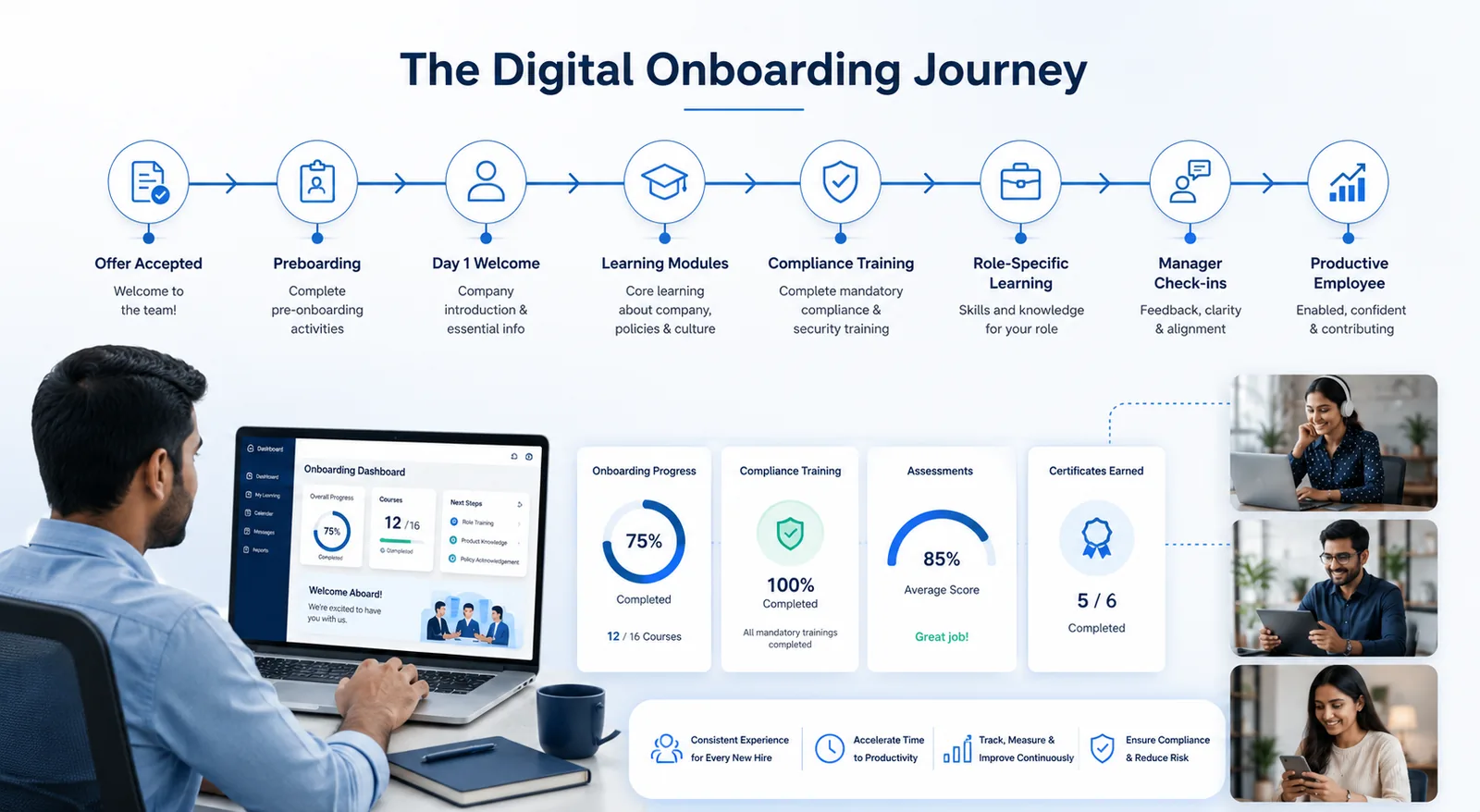
A typical onboarding journey includes:
- Welcome from leadership
- Company culture and values
- HR policies
- IT setup
- Security awareness
- Compliance training
- Product or service knowledge
- Role-specific learning
- Manager check-ins
- Performance expectations
A defined learning path ensures every employee starts with the same foundation.
2. Deliver Learning Through an LMS
A Learning Management System (LMS) becomes the central hub for onboarding.
Instead of managing spreadsheets and email attachments, organizations can:
- Assign courses automatically
- Track completion
- Send reminders
- Assess understanding
- Generate reports
- Support mobile learning
For distributed teams, an LMS eliminates geographical barriers while giving HR complete visibility into onboarding progress.
3. Combine Self-Paced Learning with Human Interaction
Technology should enhance—not replace—human connection.
An effective onboarding experience blends digital learning with opportunities to engage.
Examples include:
- Virtual introductions
- Team meet-and-greets
- Weekly manager conversations
- Mentor or buddy programs
- Live Q&A sessions
This balance helps remote employees feel connected while maintaining flexibility.
4. Use Microlearning for Better Retention
Instead of long training sessions, break learning into short, focused modules.
Examples include:
- Five-minute videos
- Interactive scenarios
- Knowledge checks
- Infographics
- Quick quizzes
Microlearning reduces cognitive overload and allows employees to revisit content whenever needed.
5. Measure Success with Analytics
Without data, it's difficult to improve onboarding.
Monitor metrics such as:
| KPI | Why It Matters |
|---|---|
| Course completion rate | Measures engagement |
| Assessment scores | Evaluates learning effectiveness |
| Time to productivity | Indicates onboarding success |
| Compliance completion | Reduces organizational risk |
| Employee feedback | Identifies improvement opportunities |
| Manager satisfaction | Measures readiness |
Continuous analysis helps refine the onboarding experience over time.
A 30-60-90 Day Onboarding Framework
| Timeline | Focus |
|---|---|
| First 30 Days | Company orientation, policies, compliance, culture, IT setup |
| Days 31–60 | Department processes, product knowledge, collaboration |
| Days 61–90 | Role mastery, performance goals, advanced learning |
This phased approach prevents information overload while supporting continuous learning.
Common Mistakes to Avoid
Many organizations invest in onboarding technology but overlook the learner experience.
Avoid these pitfalls:
- Delivering too much information on Day One
- Using lengthy presentation-based training
- Ignoring mobile accessibility
- Failing to personalize role-specific learning
- Not collecting employee feedback
- Treating onboarding as a one-day event instead of an ongoing journey
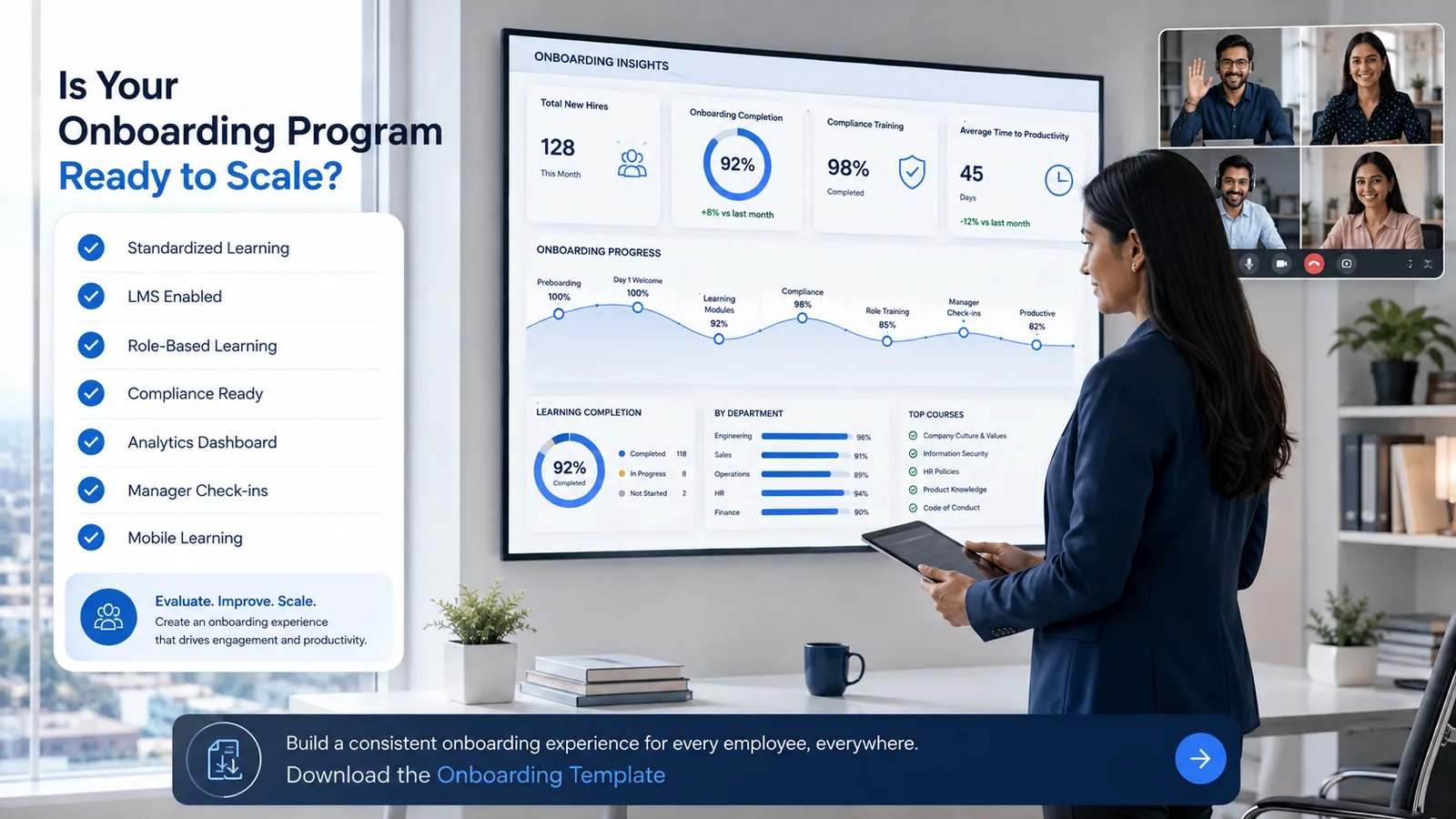
Checklist: Is Your Onboarding Program Ready to Scale?
✔ Standardized onboarding roadmap
✔ Digital learning content
✔ Mobile-friendly LMS
✔ Automated course assignments
✔ Compliance training included
✔ Role-specific learning paths
✔ Progress tracking and analytics
✔ Manager and mentor engagement
✔ Regular learner feedback
✔ Continuous content updates
Why an LMS Makes the Difference
As distributed work becomes the norm, organizations need onboarding systems that can scale without increasing administrative effort.
A modern LMS enables teams to:
- Deliver consistent onboarding experiences
- Reduce manual coordination
- Track learner progress in real time
- Support remote and hybrid employees
- Ensure compliance training completion
- Continuously improve onboarding through analytics
Solutions like K-Nest LMS help HR and L&D teams centralize onboarding, automate workflows, and create engaging digital learning experiences that grow alongside the organization.
Building a scalable onboarding training program is no longer just an operational improvement—it's a strategic investment in employee success.
By combining structured learning journeys, digital content, automation, and analytics, organizations can provide every new hire with a consistent and engaging experience, regardless of location.
As distributed teams continue to grow across India and globally, organizations that modernize onboarding will be better positioned to improve productivity, strengthen employee engagement, and accelerate business outcomes.
Digital Learning Strategy Workbook
Planning a scalable onboarding program starts with the right framework.
Download our Digital Learning Strategy Workbook to map onboarding journeys, identify learning gaps, and create a structured roadmap for distributed teams.
4Edge IT Solutions helps organizations design engaging digital onboarding experiences with K-Nest LMS, customized learning paths, automation, and analytics.
Frequently Asked Questions (FAQs)
What is a scalable onboarding training program?
A scalable onboarding training program is a structured learning framework that allows organizations to onboard employees consistently, regardless of team size or location. It combines standardized content, automation, and digital learning tools to deliver a seamless onboarding experience while reducing manual effort.
Why is onboarding important for distributed teams?
Distributed teams often work across different locations and time zones, making traditional in-person onboarding difficult. A well-designed digital onboarding program ensures every employee receives the same training, understands company expectations, and feels connected from day one.
How can an LMS improve employee onboarding?
A Learning Management System (LMS) centralizes onboarding content and automates the learning process. It enables organizations to:
- Assign learning paths automatically
- Track employee progress
- Deliver self-paced training
- Conduct assessments and quizzes
- Generate reports and analytics
- Ensure compliance training completion
This makes onboarding more efficient and measurable.
What should be included in a digital onboarding program?
An effective digital onboarding program typically includes:
- Company introduction and culture
- HR policies and employee handbook
- IT and system setup guides
- Compliance and cybersecurity training
- Product or service knowledge
- Role-specific learning modules
- Team introductions
- Manager check-ins and feedback sessions
How long should an onboarding program last?
While orientation may take a day or two, effective onboarding usually spans 30 to 90 days. A phased approach allows new hires to gradually learn about the organization, develop role-specific skills, and become productive without feeling overwhelmed.
How do you measure the success of an onboarding program?
Organizations can evaluate onboarding effectiveness using metrics such as:
- Course completion rates
- Assessment scores
- Time to productivity
- Employee engagement and feedback
- Manager evaluations
- Compliance training completion
- New hire retention rates
These insights help HR and L&D teams continuously improve the onboarding experience.
What are the biggest challenges in remote employee onboarding in India?
Some common challenges include:
- Inconsistent onboarding across locations
- Limited face-to-face interaction
- Delays in sharing training resources
- Difficulty tracking learning progress
- Maintaining employee engagement
- Ensuring compliance across distributed teams
A digital onboarding strategy supported by an LMS helps address these challenges effectively.
How does microlearning improve onboarding?
Microlearning delivers information in short, focused modules such as videos, quizzes, and interactive lessons. This approach improves knowledge retention, reduces information overload, and allows employees to learn at their own pace.
Can onboarding be personalized while still being scalable?
Yes. Modern LMS platforms allow organizations to create role-based learning paths, department-specific content, and personalized recommendations while maintaining a standardized onboarding framework for all employees.
How can 4Edge IT Solutions help organizations build scalable onboarding programs?
4Edge IT Solutions helps organizations design and implement digital onboarding programs through K-Nest LMS and customized learning solutions. From creating engaging onboarding content to automating learning journeys and tracking employee progress, we enable HR and L&D teams to deliver consistent, scalable, and measurable onboarding experiences.
About the author
4Edge Learning Design TeamLearning & Development Lead
Leads instructional design at 4Edge IT Solutions, building eLearning content, game-based learning and LMS rollouts for corporate, NGO and education clients across India and abroad.