If your business sells through distributors, resellers, or channel partners, a large share of your revenue depends on people who don't report to you knowing your product as well as your own sales team does. That's a fundamentally harder training problem than internal enablement, and most companies try to solve it with a PDF product sheet and an optimistic assumption that it gets read before the next sales call.
It usually doesn't. And the cost shows up quietly — inconsistent positioning in the market, partners defaulting to competitor products they understand better, and deals lost to objections your own product could have easily handled if the partner's rep had known the right answer.
Why Partner Training Is a Genuinely Different Problem
You can't mandate it the way you mandate employee training. Partners aren't employees — they choose whether to engage, and training that feels like a burden simply gets ignored, regardless of how good the content actually is.
Partners represent multiple vendors, not just you. Your training is competing for a finite amount of partner attention against every other vendor line they carry. It has to be efficient and clearly valuable, not exhaustive.
Partner organizations turn over staff you don't control. The person you trained last quarter may have moved to a different account by now. A scalable program has to account for churn on the partner side that you have zero visibility into.
Distance and language add real complexity. Distributed partner networks — regional, multi-language, varying levels of digital access — need a program flexible enough to work across all of them, not just your best-connected, most digitally fluent partner.
What This Costs You If Left Unaddressed
Poorly trained channel partners show up as measurable business cost, not just an HR inconvenience: longer partner ramp-up time before they're productively selling, inconsistent product positioning that confuses the market, missed upsell opportunities because partners don't know your full product range, and deals lost to competitors whose partner reps simply knew more.
What Effective Partner Training Programs Include
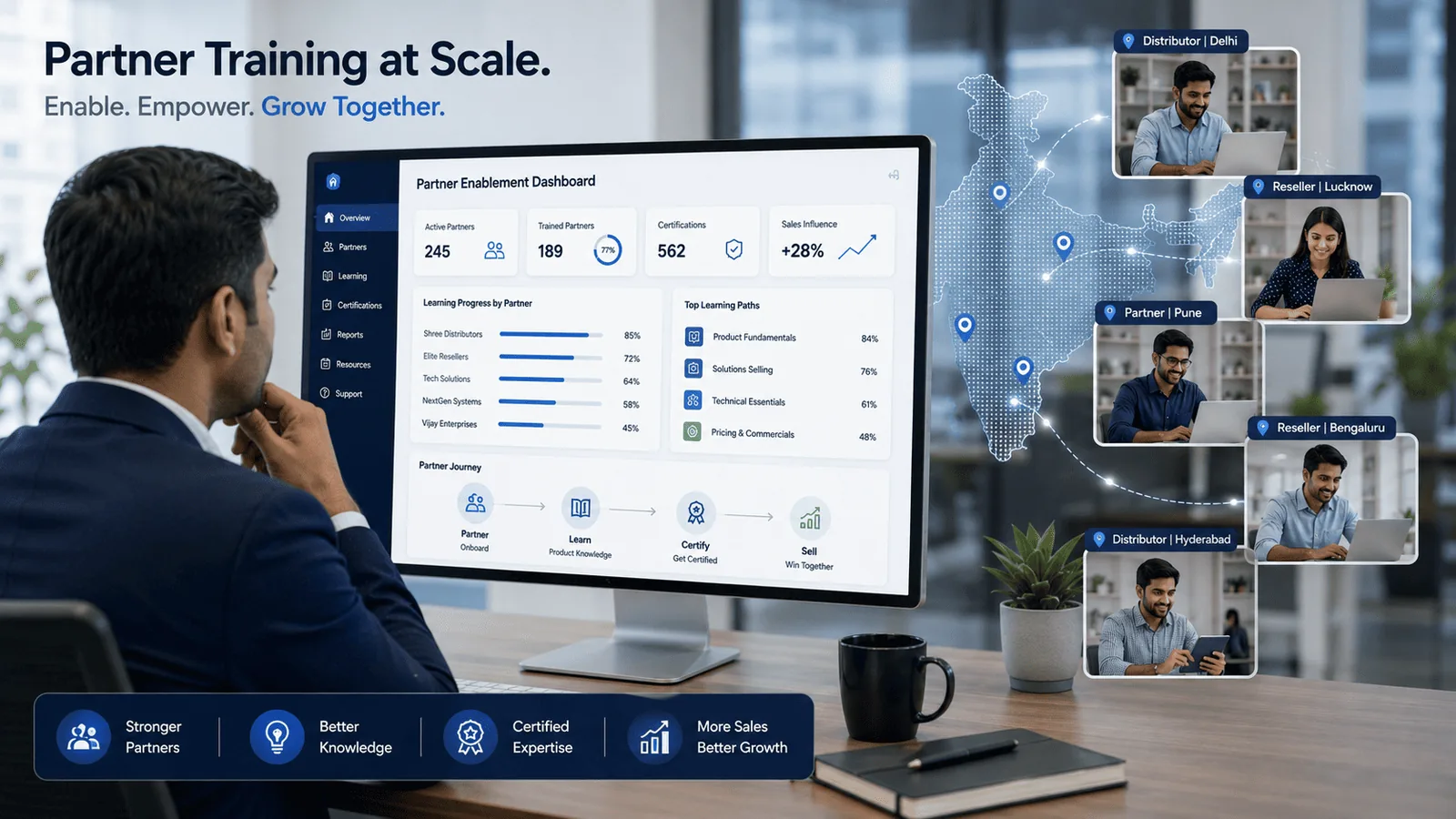
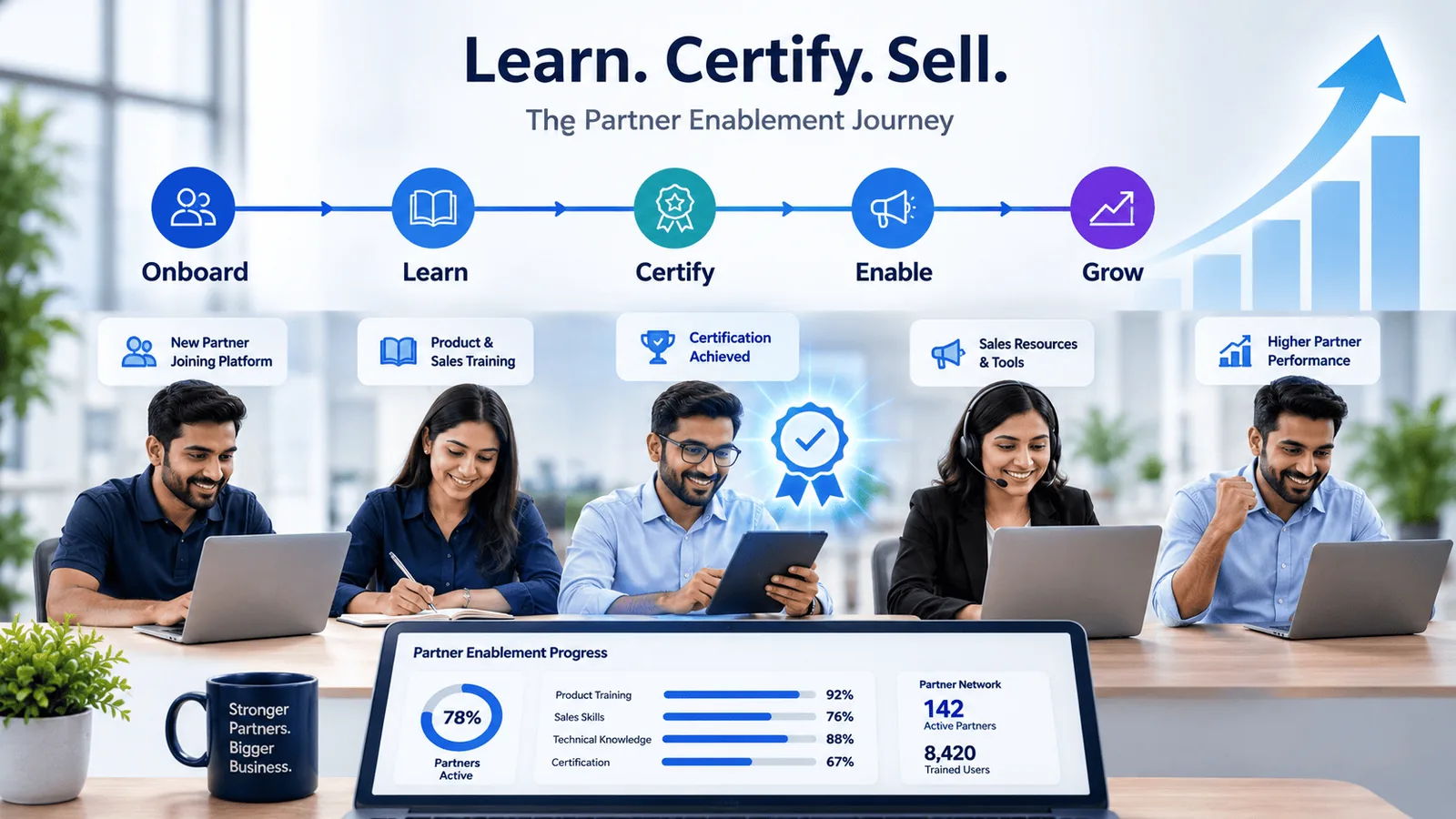
A structured onboarding track for new partners. New partners need a clear path — not a folder of documents — covering product fundamentals, positioning, pricing, and how to actually sell it, delivered in sequence rather than all at once in a single overwhelming session.
Role-based content for different partner functions. A partner's sales rep and their technical support staff need different training. A single generic course serves neither group particularly well.
Short, digestible modules over long courses. Partner attention is even more limited than internal employee attention, since engagement is voluntary. Microlearning-style modules typically outperform long-form training specifically because partners can complete them between their own priorities.
Certification tied to real incentives. Partners engage more consistently when training completion connects to something tangible — deal registration eligibility, marketing co-op funds, or preferred-partner status — not just a certificate with no attached benefit.
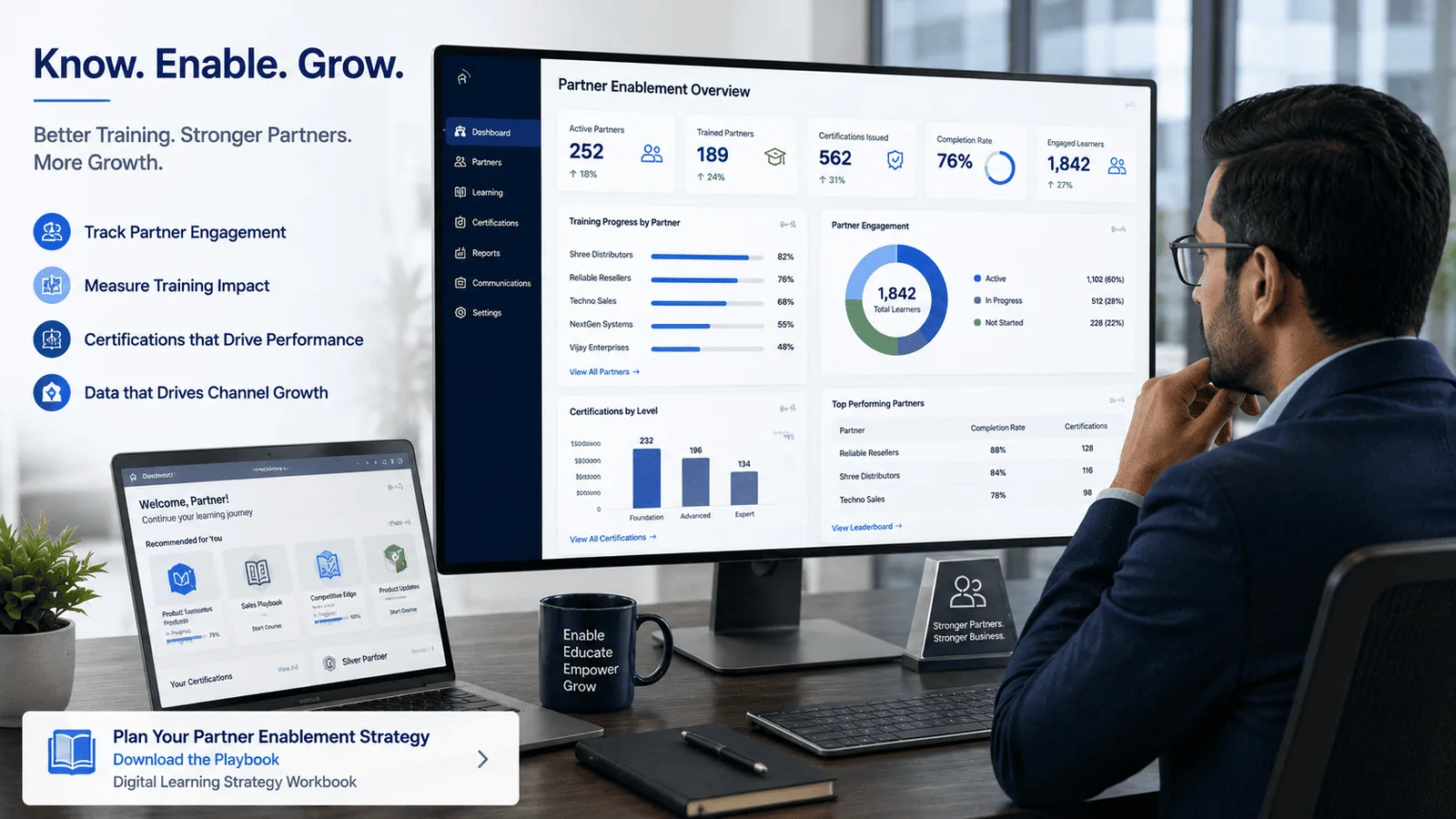
Visibility into partner engagement. A platform that shows which partners, and which individuals within partner organizations, are actually completing training lets your channel team focus enablement effort where it's genuinely needed instead of guessing.
Choosing the Right Platform
Internal LMS platforms aren't always built for external audiences. Partner training typically needs:
- Multi-tenant access, so different partner organizations only see their own content and data
- Simplified self-registration, since you can't run partner onboarding through the same IT-provisioned account process used for employees
- Reporting that rolls up by partner organization, not just by individual, so channel managers can see which partner companies are engaged and which are lagging
This is where a purpose-built or purpose-configured learning platform earns its cost. Trying to force partner training through a system designed only for employees usually creates workarounds that generate more admin overhead than the training program itself was meant to save.
Common Mistakes to Avoid
Treating partner training as a one-time launch event. Product updates, new competitors, and pricing changes mean partner training needs to be a maintained, living program, not a course built once for a product launch and left untouched afterward.
Overloading new partners in week one. A 3-hour onboarding course completed once rarely sticks. Spread partner onboarding across the first month with shorter modules and real engagement checkpoints built in.
No feedback loop from partners themselves. Partners will tell you directly what's missing from training if you actually ask them. Most programs never do, and miss the chance to fix gaps that are actively costing deals in the field.
Getting Started
Start with your highest-revenue or fastest-growing partner segment rather than building for your entire network simultaneously. A focused pilot gives you real engagement data and direct partner feedback to refine the program before scaling it across your full channel.
Frequently Asked Questions
What's the difference between employee training and partner training platforms? Partner training platforms need multi-tenant access so different partner organizations see only their own content, simplified self-registration since partners aren't provisioned like employees, and reporting that rolls up by partner organization — features most internal-only LMS platforms don't prioritize.
How do you get partners to actually complete training if you can't mandate it? Tie completion to tangible incentives — deal registration eligibility, co-op marketing funds, or preferred-partner status — and keep modules short enough that completing them doesn't compete significantly with a partner's own priorities.
How often should partner training content be updated? Whenever pricing, positioning, or major product features change — treating partner training as a living program rather than a one-time launch asset is what keeps it useful and prevents partners from selling outdated information.
Should partner training be the same content as internal sales training? No. Partner training needs to be more concise and self-contained, since partners lack the ongoing internal context employees absorb naturally, and it needs role-specific tracks since a partner's technical and sales staff have different needs.
How do you measure whether a partner training program is working? Track completion rates by partner organization, time-to-first-sale for newly trained partner reps, and — where possible — win rates or deal size for partners who completed training versus those who didn't.
Building or scaling a partner training program? Our Digital Learning Strategy Workbook includes a partner enablement playbook to help you structure the program before you choose a platform — download it to get started.
About the author
4Edge Learning Design TeamLearning & Development Lead
Leads instructional design at 4Edge IT Solutions, building eLearning content, game-based learning and LMS rollouts for corporate, NGO and education clients across India and abroad.