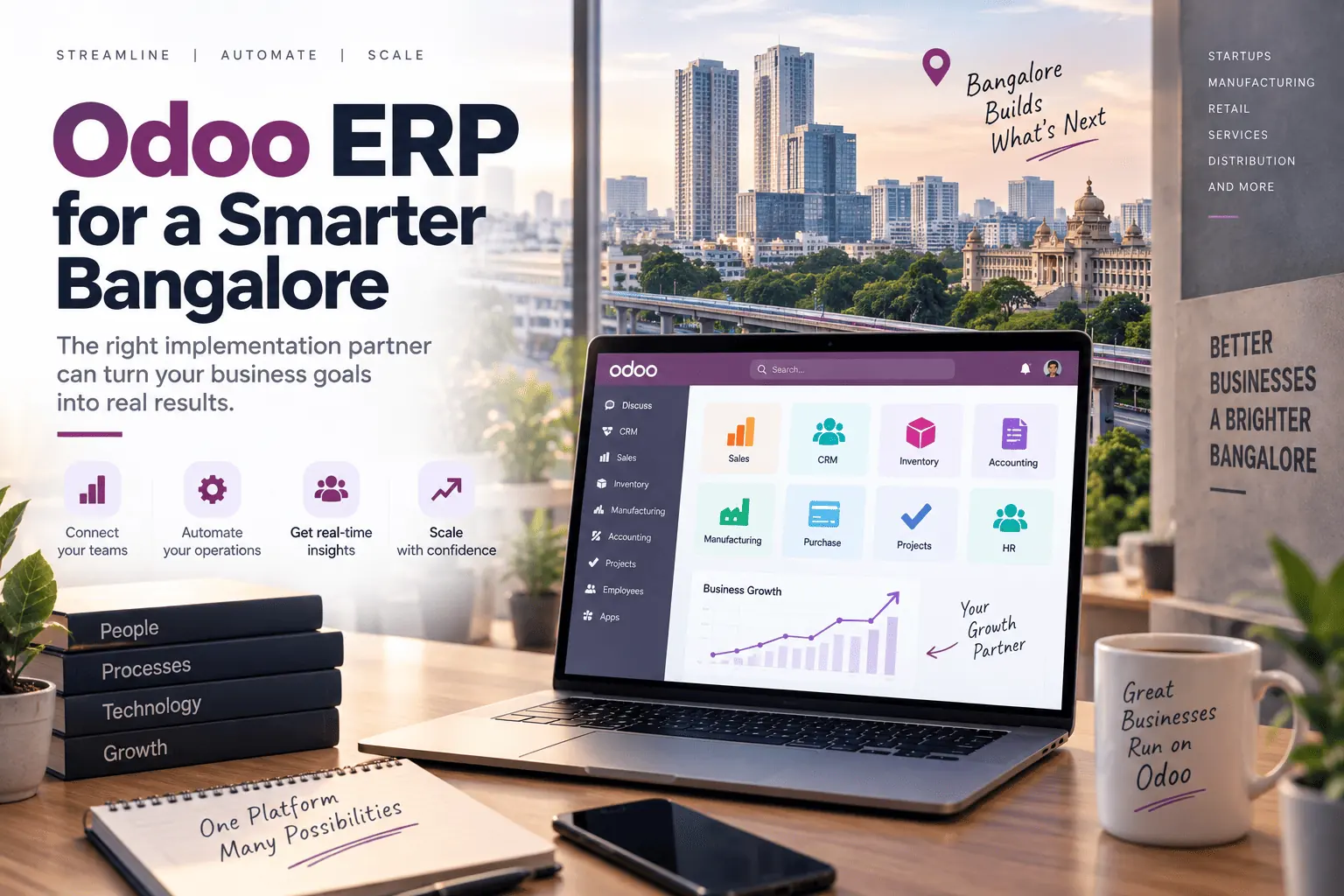
Bangalore businesses rarely have a technology shortage.
They have a system problem.
Sales may be working in one application. Finance may depend on accounting software. Inventory may live in spreadsheets. Customer information may sit inside a CRM. Manufacturing teams may maintain separate production records. Management then spends time asking:
“Which number is correct?”
That is where an ERP implementation becomes more than a software project.
For businesses in Bangalore, Odoo ERP can bring CRM, sales, accounting, inventory, manufacturing, purchasing, project management and other business functions into a connected platform. Odoo describes its suite as a collection of integrated business applications rather than a collection of isolated tools.
But choosing the right Odoo implementation partner in Bangalore matters just as much as choosing the ERP itself.
A successful implementation isn't simply:
Install Odoo → configure screens → train users → go live.
It is:
Understand the business → redesign workflows → configure Odoo → integrate systems → migrate data → train teams → measure adoption.
This guide explains what Bangalore businesses should look for when choosing an Odoo ERP partner, Odoo consultant, or Odoo implementation company.
What Does an Odoo Implementation Partner Actually Do?
An Odoo implementation partner helps translate your business processes into an ERP system.
That can involve:
- Business process discovery
- ERP consulting
- Odoo module selection
- Workflow design
- Odoo configuration
- Customization
- Data migration
- Third-party integrations
- Accounting and GST configuration
- User roles and permissions
- Testing
- Training
- Go-live support
- Post-implementation support
Odoo itself maintains a partner ecosystem where businesses can search implementation partners by factors such as industry, company size, country and location.
That is important because there isn't necessarily one implementation approach that works for every organization.
A manufacturing company in Peenya may have very different requirements from a SaaS company in Whitefield.
A distributor in Bengaluru may need a very different workflow from a professional-services organization in Koramangala.
Why Bangalore Businesses Are Looking at Odoo ERP
Bangalore has businesses ranging from startups and technology companies to manufacturers, distributors, professional-services firms and growing mid-market organizations.
As companies grow, their operational systems often grow independently.
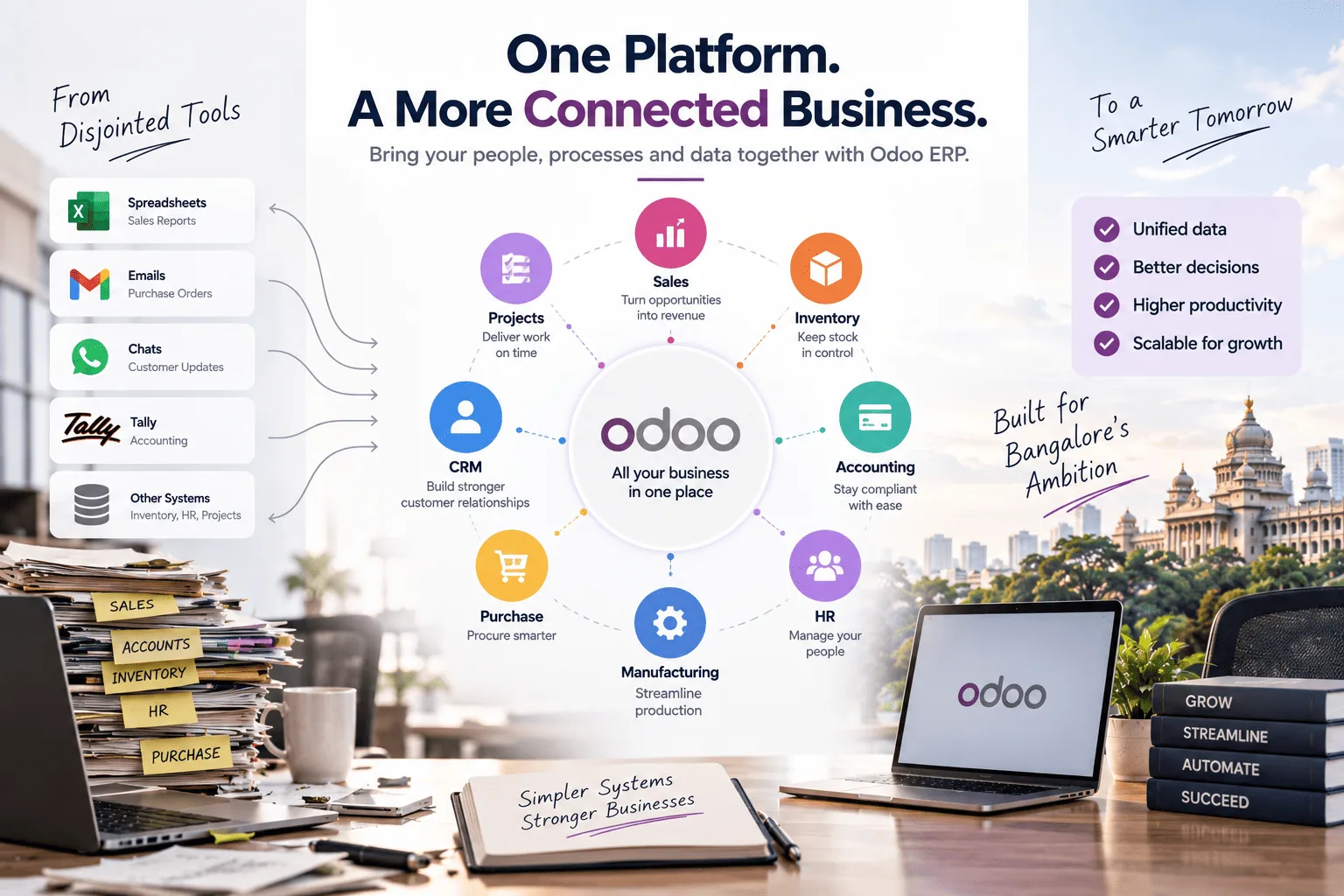
The result can look like this:
Sales → CRM
Finance → Accounting software
Inventory → Spreadsheet
Purchasing → Email
Manufacturing → Separate application
Customer communication → WhatsApp
Reporting → Excel
The problem isn't necessarily any individual system.
The problem is the lack of connection between them.
An integrated ERP can create a common operational layer across these functions.
Odoo's application ecosystem currently includes areas such as CRM, Sales, Accounting, Inventory, Manufacturing, Purchase, Project, Website, eCommerce and more.
What Should You Look for in an Odoo ERP Partner in Bangalore?
1. Start With Business Processes — Not Odoo Modules
One of the easiest mistakes is starting with:
“Which Odoo apps should we install?”
Start with:
“How does our business actually work?”
For example, consider a manufacturing company.
Its actual process might be:
Lead → Quotation → Sales Order → Procurement → Production → Quality Check → Dispatch → Invoice
The implementation partner should understand that complete workflow before deciding how Odoo should be configured.
A good discovery process should examine:
- Current workflow
- People involved
- Approvals
- Existing software
- Data sources
- Manual work
- Reporting requirements
- Exceptions
- Compliance requirements
- Integration requirements
Only then should the implementation architecture be finalized.
2. Check Odoo Implementation Experience
There is a difference between:
Knowing Odoo
and
Implementing Odoo for a real business.
Ask potential partners:
- How many implementations have you completed?
- Which industries have you worked with?
- Which Odoo versions have you implemented?
- Have you handled migrations?
- Have you built integrations?
- Do you provide post-go-live support?
- Can you demonstrate a relevant workflow?
- Can you explain what was configured versus customized?
Odoo's official partner directory itself allows businesses to filter implementation partners by industry and other characteristics.
That gives businesses a useful starting point for evaluating partner fit.
3. Understand Configuration vs Customization
This is one of the most important questions to ask.
Suppose your company has a unique approval process.
There are several possible approaches:
Option 1 — Configure Odoo
Use existing functionality.
Option 2 — Modify the workflow
Adapt the system where practical.
Option 3 — Build custom functionality
Develop something that genuinely isn't available through standard configuration.
The wrong approach is to customize everything.
The right approach is to ask:
Can the business process be improved to fit standard Odoo before we build something custom?
This can reduce complexity and make future upgrades easier.
4. Don't Ignore Data Migration
ERP implementation often fails quietly because of poor data.
Imagine importing:
- 25,000 customers
- 60,000 products
- 10,000 suppliers
- Historical invoices
- Opening balances
- Inventory
- Pricelists
- Product variants
If the source data is inconsistent, moving it into Odoo doesn't magically fix it.
A proper migration process should include:
Extract → Clean → Map → Validate → Import → Reconcile
Your implementation partner should clearly explain:
- What data will be migrated?
- What historical data is required?
- Who cleans the data?
- How will duplicate records be handled?
- How will opening balances be validated?
- How will migration be tested?
5. Check Integration Capability
Odoo doesn't necessarily need to replace every system your company uses.
Sometimes the better architecture is:
Odoo + Existing Systems + APIs
For example:
Website → Odoo CRM
eCommerce → Odoo Inventory
Payment Gateway → Odoo Accounting
HRMS → Odoo Employees
Custom Application → Odoo API
Shipping Platform → Odoo Delivery
This is why an Odoo development company with integration capability can be valuable for businesses with an existing technology stack.
Odoo's application ecosystem is designed around connected business functions, but the exact integration architecture should be determined by the company's requirements.
6. Ask About Indian GST Requirements
For Indian businesses, localization matters.
Odoo's current India documentation includes functionality covering areas such as:
- Indian accounting
- GST-related reporting
- E-invoicing
- E-way bills
- GST-related integrations
- TDS/TCS configuration in supported versions
The exact capabilities and configuration depend on the Odoo version and implementation setup, so the partner should validate the requirements during discovery.
For example, Odoo's current documentation describes Indian GST configuration and integrations for e-invoicing and e-way bills.
Questions to ask your partner
- How will GST be configured?
- How will e-invoicing work?
- How will e-way bills be handled?
- How will GST reporting be validated?
- What accounting processes need customization?
- Who will validate the final configuration?
Don't accept:
“Yes, Odoo supports GST.”
Ask:
“Show us how our actual GST workflow will work.”
7. Manufacturing Businesses Need a Different Conversation
For Bangalore manufacturers, ERP requirements can become significantly more operational.
You may need:
- Bills of Materials
- Manufacturing Orders
- Work Orders
- Work Centres
- Inventory
- Quality
- Purchase
- Maintenance
- Traceability
- Barcode workflows
- Production planning
Odoo's manufacturing application includes features such as manufacturing orders, bills of materials, traceability, master production scheduling and IoT-related integrations.
So instead of asking:
“Can you implement Odoo Manufacturing?”
Ask:
“Can you demonstrate our production workflow from sales order to finished goods?”
That's a much better test.
8. Ask How the Implementation Will Be Delivered
A professional implementation should have defined stages.
A practical roadmap might look like:
| Phase | Focus |
|---|---|
| 01 | Business discovery |
| 02 | Process mapping |
| 03 | Solution design |
| 04 | Odoo configuration |
| 05 | Customization & integration |
| 06 | Data migration |
| 07 | Testing |
| 08 | User training |
| 09 | Pilot / UAT |
| 10 | Go-live |
| 11 | Stabilization |
| 12 | Ongoing support |
The exact timeline will depend on the number of users, modules, integrations, data complexity and customization requirements.
Odoo Implementation Isn't About Installing Everything
One of the biggest misconceptions about ERP implementation is:
More modules = better ERP.
Not necessarily.
Imagine a company that needs:
CRM + Sales + Inventory + Accounting
There may be no reason to implement ten additional modules immediately.
A phased approach can be more practical:
Phase 1
CRM + Sales + Accounting
Phase 2
Inventory + Purchase
Phase 3
Manufacturing + Quality
Phase 4
Advanced integrations + automation
This gives teams time to adopt the system instead of changing everything at once.
How Much Does Odoo Implementation Cost in Bangalore?
There is no responsible single price for an Odoo implementation.
The cost can change substantially depending on:
- Number of users
- Number of modules
- Business complexity
- Data migration
- Custom development
- Third-party integrations
- Reporting requirements
- Accounting requirements
- Manufacturing requirements
- Support requirements
- Hosting model
- Training requirements
A company asking for an Odoo quotation should therefore provide its implementation partner with enough information to produce a meaningful scope.
Instead of asking only:
“What is the Odoo implementation cost?”
Ask:
“What is included in the implementation scope?”
A lower initial quotation can become expensive if important requirements are excluded.
Odoo Implementation Partner vs Odoo Consultant vs Odoo ERP Company
People often search these terms interchangeably:
- Odoo implementation partner Bangalore
- Odoo ERP partner Bangalore
- Odoo consultant Bangalore
- Odoo implementation Bangalore
- Odoo ERP company Bangalore
- Odoo customization Bangalore
But they can represent slightly different expectations.
| Search term | What the buyer may be looking for |
|---|---|
| Odoo Consultant | Business/process guidance |
| Odoo Implementation Partner | End-to-end implementation |
| Odoo ERP Partner | Broader ERP services |
| Odoo ERP Company | Implementation + development + support |
| Odoo Customization Company | Custom workflows/features |
| Odoo Developer | Technical development |
| Odoo Integration Partner | Connecting Odoo with other systems |
For a complex ERP project, you may need all of these capabilities under one implementation team.
Why Technical Capability Matters
ERP isn't only about screens and workflows.
Modern implementations frequently involve:
ERP + APIs + Web Applications + Databases + Cloud + Automation
This is particularly relevant when a business already has custom software.
A partner with broader software engineering capability can help determine whether a requirement should be solved through:
- Configuration
- Studio/customization
- Odoo development
- API integration
- Middleware
- Existing application changes
That can make a difference to the long-term architecture.
4Edge IT Solutions, for example, positions its broader technology capabilities around enterprise software, web/mobile applications and system integration, alongside its digital learning products.
Why Bangalore Businesses Should Think Beyond Go-Live
Go-live isn't the finish line.
It's the beginning of adoption.
After implementation, businesses may still need:
- User support
- Workflow improvements
- New integrations
- Reports
- Automation
- Performance optimization
- New modules
- Version upgrades
- Data governance
- User training
Ask potential partners:
“Who supports us six months after go-live?”
That question can reveal a lot about the implementation model.
A Simple Odoo Partner Evaluation Checklist
Before selecting an Odoo implementation partner in Bangalore, score each potential partner against these questions:
| Question | What to check |
|---|---|
| Business understanding | Do they understand your processes? |
| Odoo expertise | Relevant implementation experience? |
| Industry experience | Similar business models? |
| Customization | Can they develop when required? |
| Integration | API/system integration capability? |
| Migration | Structured data migration process? |
| GST | Indian localization experience? |
| Manufacturing | Relevant MRP experience if required? |
| Training | Structured user training? |
| Testing | UAT and migration testing? |
| Support | Post-go-live support? |
| Scalability | Can the solution grow with you? |
| Documentation | Clear technical and process documentation? |
| Commercials | Transparent scope and assumptions? |
Why 4Edge IT Solutions for Odoo Implementation?
For organizations looking for an Odoo implementation partner in Bangalore, 4Edge IT Solutions brings a broader software-engineering perspective to ERP projects.
Our approach is centered on understanding the business workflow first, then configuring, customizing and integrating Odoo around those requirements.
That can include:
Consulting → Implementation → Customization → Migration → Integration → Training → Support
The broader 4Edge technology practice includes custom application development, web and mobile development and enterprise system integration.
For organizations evaluating technology partners, you can also explore the company's broader technology capabilities and case studies before starting an ERP discussion.
Choosing an Odoo ERP partner in Bangalore shouldn't be about finding the company that promises the fastest implementation.
It should be about finding a team that can answer four fundamental questions:
1. Can they understand our business?
2. Can they translate our processes into Odoo?
3. Can they handle the technical complexity around Odoo?
4. Can they stay with us after implementation?
Because ERP success isn't measured by whether Odoo was installed.
It's measured by whether your people can run the business better because the system is connected.
If your business is evaluating Odoo implementation, customization, migration or integration, talk to 4Edge IT Solutions to discuss your requirements.
Frequently Asked Questions
Is Odoo suitable for businesses in Bangalore?
Odoo offers an integrated suite covering areas such as CRM, sales, accounting, inventory, manufacturing, project management and more. Whether it is suitable depends on the organization's processes, scale, budget and implementation requirements.
How do I choose an Odoo implementation partner in Bangalore?
Evaluate implementation experience, industry understanding, customization capability, integration expertise, migration methodology, training, support and the clarity of the proposed scope.
Can Odoo handle GST in India?
Odoo provides Indian localization features covering areas including accounting, GST-related reporting, e-invoicing and e-way bills in supported versions. Configuration should be validated against the company's specific tax and accounting requirements.
Can Odoo integrate with existing software?
Yes. Odoo provides an ecosystem of integrated applications and can also be connected with external systems depending on the required architecture and integration method.
Can Odoo be customized?
Yes, Odoo can be configured and extended. The key question is whether customization is actually necessary or whether the requirement can be addressed through standard functionality and configuration.
How long does an Odoo implementation take?
There is no universal timeline. The duration depends on modules, users, data migration, integrations, customization, testing and organizational readiness.
About the author
4Edge Engineering TeamChief Technology Officer
Heads engineering at 4Edge IT Solutions, delivering custom web and mobile applications, API integrations and Odoo ERP implementations for growing businesses.