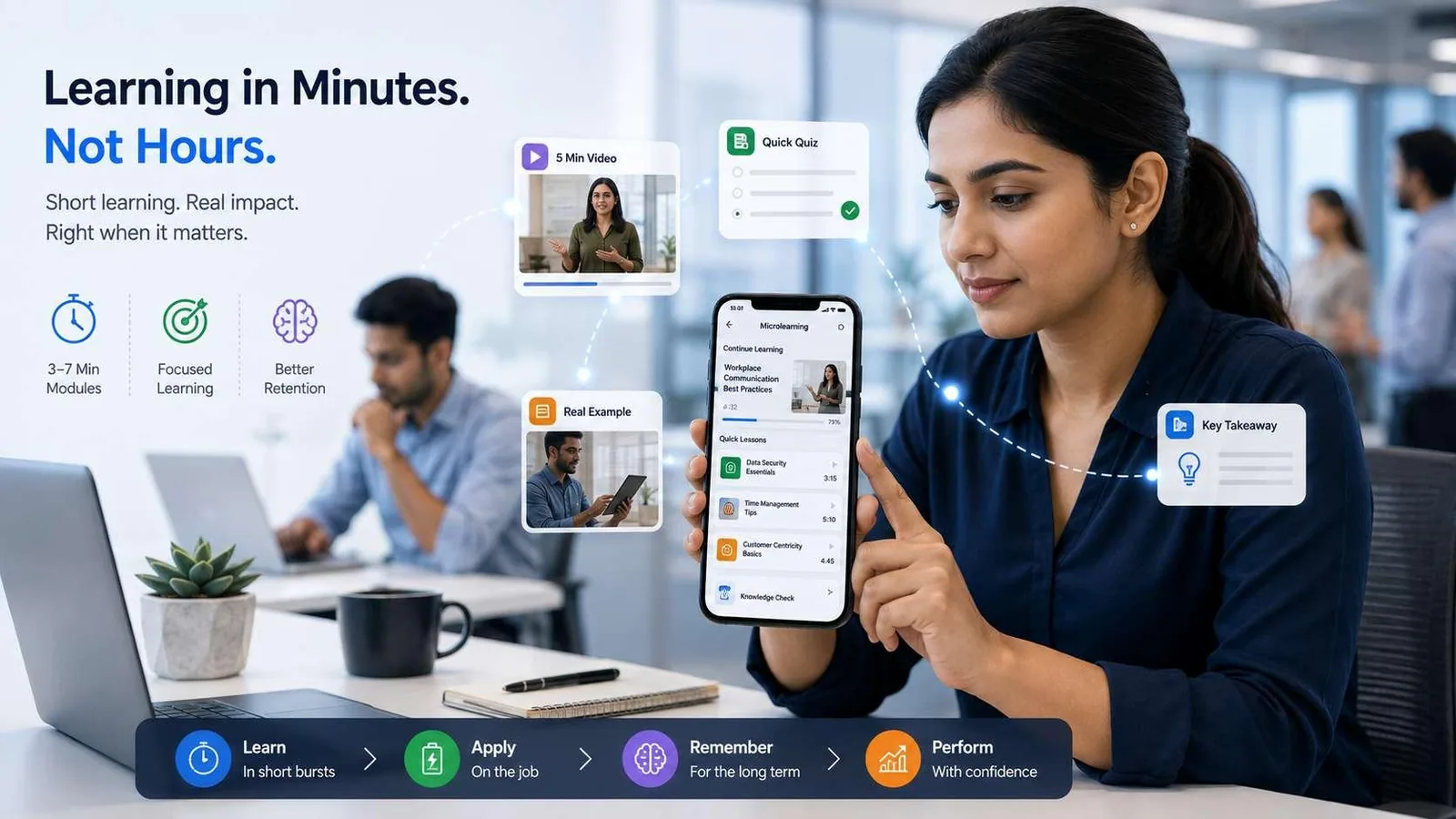
A 45-minute mandatory training module has a completion problem that most L&D teams already know about but rarely say out loud: almost nobody finishes it in one sitting, and even fewer remember its content a month later. Microlearning — short, focused training content delivered in 3-to-7-minute bursts — has moved from a "nice to have" format to the default approach for a growing share of corporate training in 2026. The reason isn't a trend; it's that microlearning matches how attention and memory actually work, and long-form e-learning largely doesn't.
The Case for Microlearning, Backed by How Learning Actually Works
It matches real attention spans, not idealized ones. Long-form e-learning assumes employees have 45 uninterrupted minutes available. Most don't — they have gaps between meetings, a few minutes at their desk, or five minutes before a shift starts. Microlearning is built for exactly those windows instead of fighting against them.
It leverages spaced repetition, a well-established memory principle. Repeated exposure to information over time builds stronger long-term recall than a single long session ever does. A microlearning series delivered across several weeks reinforces retention in a way a one-time 45-minute module structurally can't.
It's dramatically easier to keep current. A single short module covering one specific topic is far easier to update when a process or policy changes than a sprawling course where that fact is buried in module four of seven — nobody wants to re-record an hour of content to fix one outdated slide.
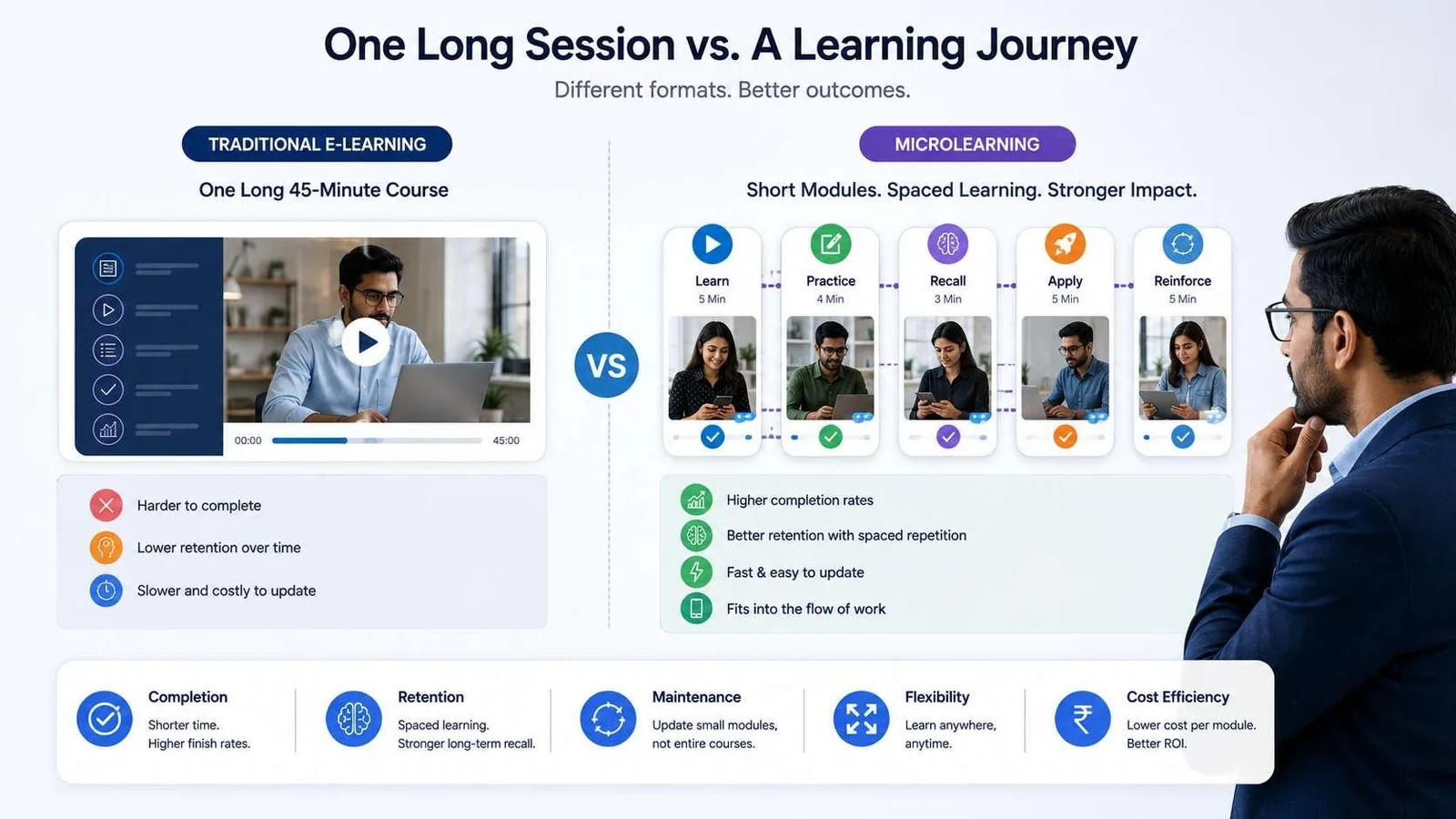
It fits learning into the actual flow of work. Employees increasingly expect to find an answer to a specific question in the moment they need it, not by relaunching an LMS and scrubbing through a long course to locate the relevant five minutes.
Microlearning vs. Traditional E-Learning: A Practical Comparison
- Completion rates: Microlearning modules consistently see meaningfully higher completion rates than long-form courses, simply because the time commitment is lower and the perceived barrier to starting is smaller.
- Retention over time: Spaced, repeated short content generally outperforms single long sessions for long-term recall, particularly for factual or procedural knowledge.
- Content maintenance: Short, modular content is faster and cheaper to update than long courses built as a single continuous unit.
- Depth of learning: Long-form content still wins for complex, judgment-heavy skills that require sustained focus and can't be meaningfully broken into 5-minute pieces.
- Production cost per module: Individual microlearning modules cost less to produce than a full course, but a complete series covering the same ground as one long course can add up to a comparable total investment.
Where Microlearning Delivers the Most Value
Compliance refreshers. Short, focused updates on policy changes work better as 5-minute modules than as a re-run of the full onboarding compliance course every employee already sat through once.
Product and sales enablement. New feature updates, competitive positioning, and objection-handling tips suit short, frequently updated modules that sales teams can consume between calls, not during a scheduled training block.
Process and tool training. "How to submit an expense report" doesn't need a full course — it needs a 3-minute walkthrough available exactly when someone hits that specific task.
Reinforcement after longer training. Microlearning works especially well as a follow-up layer after a longer onboarding or certification course, reinforcing key points over the following weeks rather than expecting a single session to make everything stick permanently.
Where Microlearning Isn't the Right Fit
Not every learning objective suits a short-form format. Complex, judgment-heavy skills — difficult conversations, safety-critical procedures, in-depth technical certifications — often need the depth that a longer format or a simulation-based approach provides. Microlearning is a format decision, not a full learning strategy on its own; it works best as one tool in a broader mix, not as the only format your L&D team uses.
A useful test: if a topic genuinely can't be explained accurately in under 7 minutes without losing critical nuance, it's probably not a good microlearning candidate on its own — though it may work well as a microlearning series building toward that depth over several sessions.
Building a Microlearning Strategy That Actually Works
Start from the learning objective, not the format. Before deciding something should be microlearning, confirm the objective genuinely fits a short, focused format. Condensing a complex regulatory topic into 4 minutes just to match the format often does more harm than good.
Design for a series, not a single module. Much of microlearning's retention benefit comes from spaced repetition — a single isolated 5-minute module rarely outperforms a well-designed longer course on its own. Plan a sequence from the outset.
Make it genuinely mobile-friendly. Much of microlearning's practical value is lost if it still requires a desktop login and a stable internet connection. Test it on the actual device your employees will use it on, not just a laptop in a conference room.
Track completion and application separately. A high completion rate on a microlearning series doesn't guarantee the skill transferred to the job. Pair completion tracking with a simple, practical check for whether behavior actually changed.

Frequently Asked Questions
Is microlearning actually more effective than traditional e-learning? For knowledge retention and completion rates, yes — particularly for factual, procedural, or reinforcement-focused content. For complex, judgment-heavy skills, longer formats or simulation-based training still tend to outperform microlearning used alone.
How long should a microlearning module be? Most effective microlearning modules run 3 to 7 minutes. Longer than that, and the format starts losing the attention and completion advantages that make microlearning valuable in the first place.
Can microlearning replace full training courses entirely? Not usually. Microlearning works best as part of a blended strategy — handling reinforcement, refreshers, and narrowly scoped topics — while more complex or judgment-heavy learning objectives still benefit from longer-format or simulation-based training.
What topics work best for microlearning? Compliance refreshers, product updates, tool and process walkthroughs, and reinforcement of previously taught concepts are strong microlearning candidates. Deep technical certifications and complex interpersonal skills generally are not, at least not as standalone single modules.
Does microlearning require a different LMS than traditional e-learning? Not necessarily, but your platform should support mobile delivery, short-form content organization, and spaced/scheduled delivery of a module series — not just hosting long-form SCORM courses.
Thinking about where microlearning fits into your broader digital learning strategy? Our Digital Learning Strategy Workbook includes a content-and-delivery-mix planner to help you decide what belongs in short-form format and what doesn't — download the planner to map it out.
About the author
4Edge Learning Design TeamLearning & Development Lead
Leads instructional design at 4Edge IT Solutions, building eLearning content, game-based learning and LMS rollouts for corporate, NGO and education clients across India and abroad.