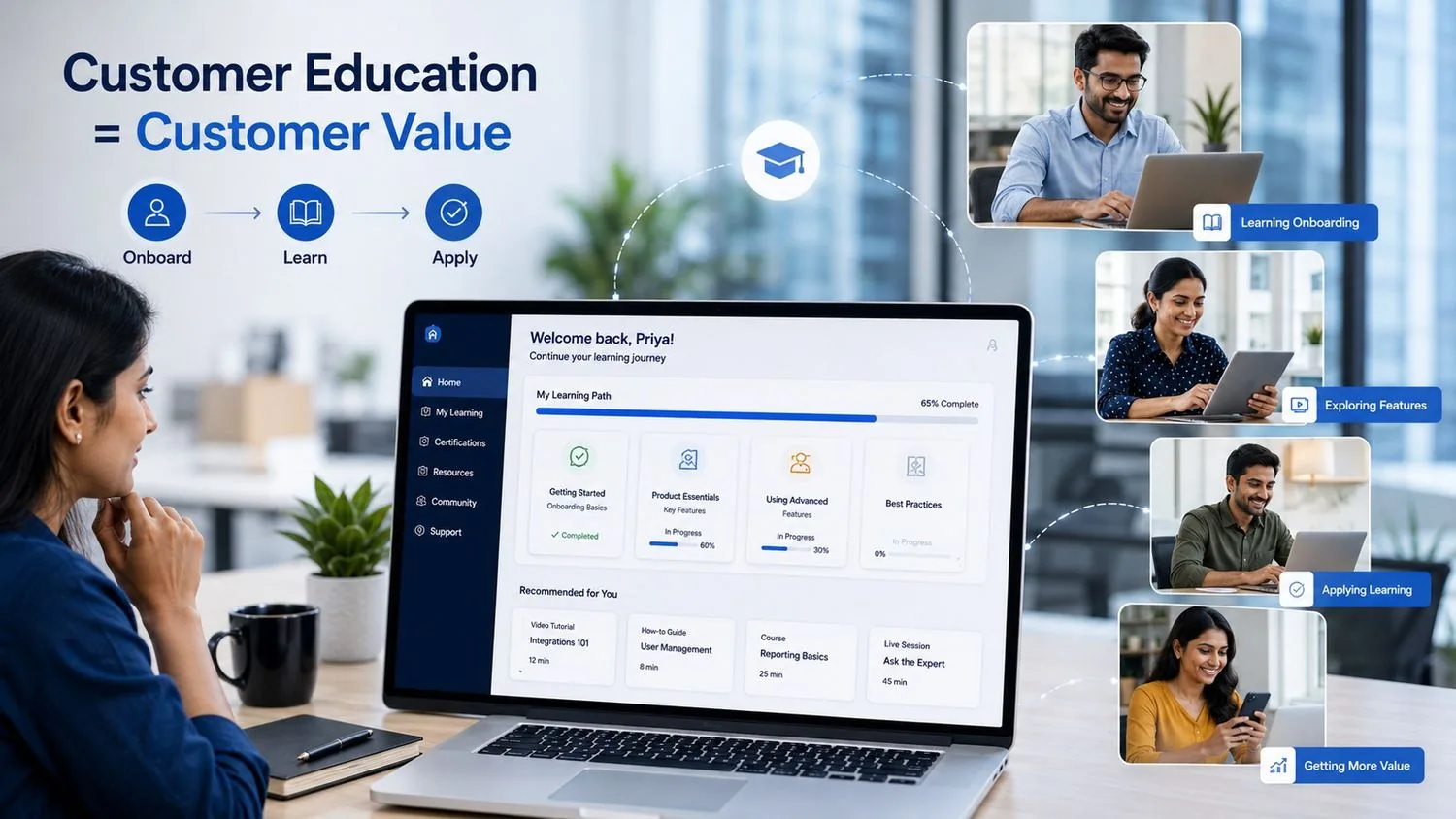
Most companies invest heavily in training their employees, and increasingly their partners. Far fewer formally train their customers — even though a customer who doesn't fully understand your product is one of the most predictable churn risks a business has. Customer education, approached deliberately, is quietly becoming one of the highest-leverage retention tools available in 2026.
Myth: Customer Education Is Just a Nice-to-Have for Enterprise Software
This assumption is outdated. Customer education used to be associated almost exclusively with complex enterprise software with steep learning curves. That's no longer where the value stops. Any product with more than a handful of features has an adoption gap between what it can do and what an average customer actually uses — and that unused value is exactly where churn risk quietly builds, regardless of company size or industry.
Why Customer Education Matters More Than It Used To
Products have gotten more complex. As software and services add features to stay competitive, the gap between what a product can do and what an average customer actually uses widens — and that gap is where churn risk concentrates.
Support costs scale with confusion, not with product complexity itself. A well-educated customer base generates fewer repetitive support tickets, because customers understand how to use the product rather than repeatedly asking the same "how do I" questions your support team has answered hundreds of times.
Expansion revenue depends on customers knowing what's possible. Customers rarely upgrade to a feature or tier they don't know exists or don't know how to use effectively. Education directly supports upsell and expansion, not just retention.
Self-service expectations have risen sharply. Customers increasingly prefer finding an answer themselves over opening a support ticket and waiting for a response — which only works if structured educational content actually exists for them to find.
What a Customer Education Program Includes
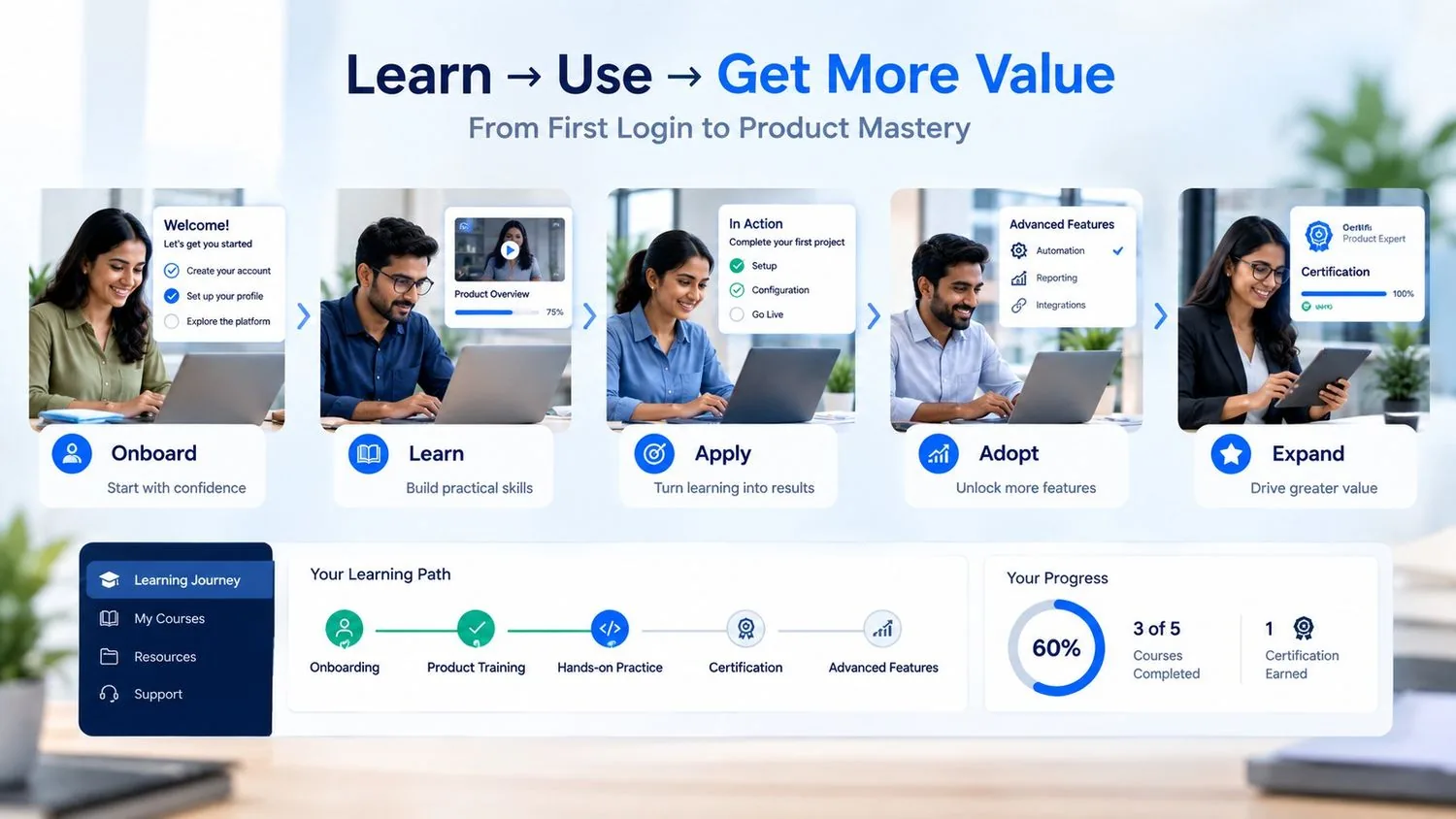
Structured onboarding for new customers. The first weeks after a purchase or signup are when a customer either builds a habit around your product or quietly drifts away. A guided onboarding curriculum — not just a welcome email sequence — directly shapes which outcome happens.
A self-service knowledge and training library. Searchable how-to content, video walkthroughs, and short courses let customers solve their own questions on their own schedule, reducing dependency on live support for routine questions.
Certification for power users or technical customers. For products with real complexity — technical platforms, enterprise software, anything with an admin role — a certification track builds deeper product expertise among your most engaged customers, who often become informal internal champions within their own organizations.
Proactive education tied to usage data. The most mature customer education programs trigger relevant training based on what a customer is actually doing — or not doing — in the product, rather than sending identical generic content to every customer regardless of where they are in their journey.
Measuring Whether It's Working
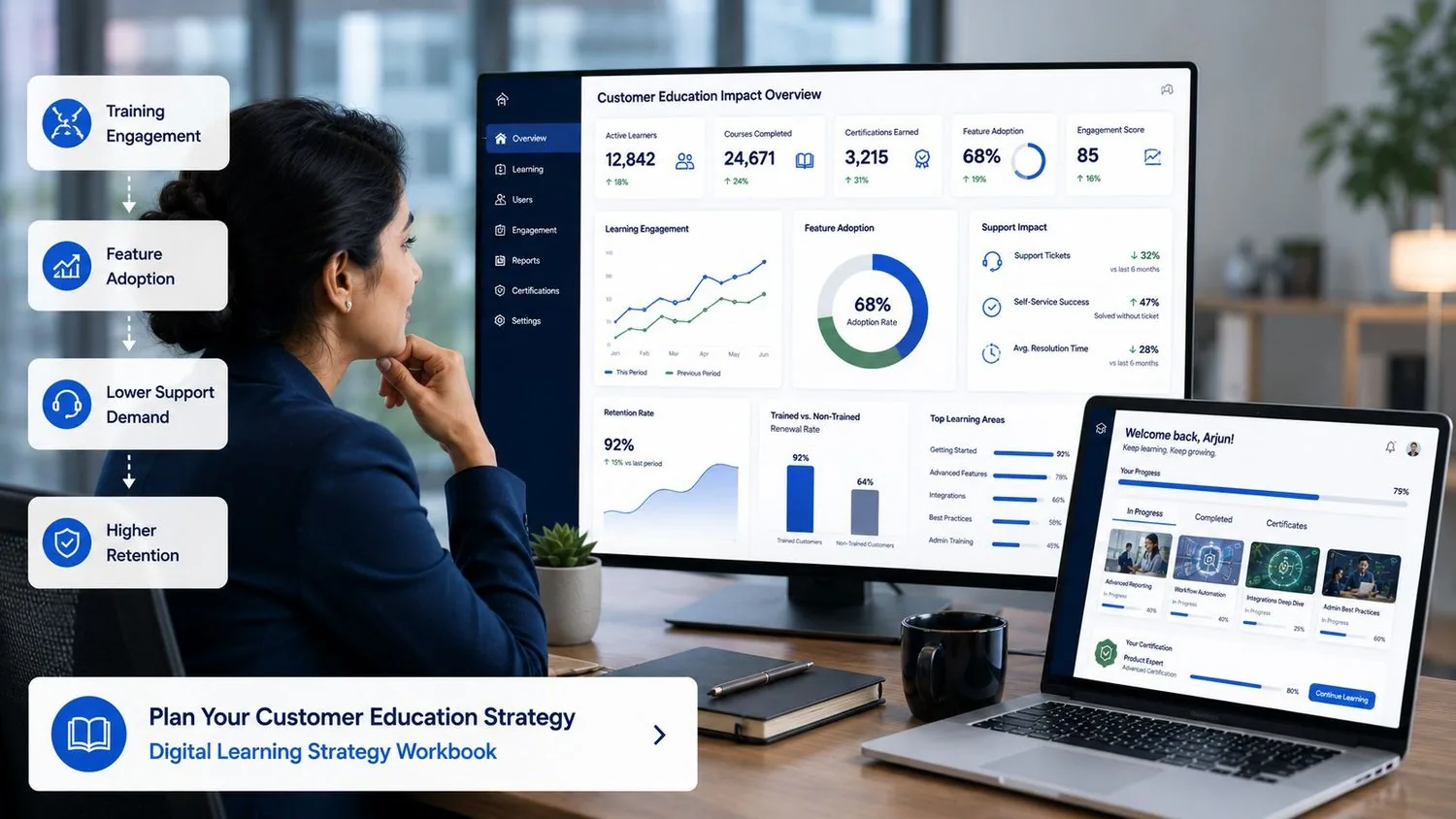
Customer education is often treated as a soft, hard-to-measure investment. It doesn't have to be. Track:
- Time-to-first-value for new customers who complete onboarding education versus those who don't
- Support ticket volume for topics already covered in self-service training content
- Feature adoption rates among customers who completed relevant training modules versus those who didn't
- Renewal and expansion rates, segmented by education engagement level
These comparisons consistently show measurable differences across most SaaS and platform businesses that track them — and they're what turns customer education from a soft cost center into a retention investment finance teams take seriously.
Common Mistakes
Treating customer education as marketing content. Product marketing sells the vision; customer education has to actually teach someone how to accomplish a specific task. Conflating the two produces content that reads well but doesn't reduce support tickets or genuinely improve retention.
Building it once and letting it go stale. Product features change constantly. Educational content that isn't actively maintained becomes actively misleading, which is arguably worse for the customer relationship than having no documentation at all.
No connection to your support and success teams. The most valuable education content usually comes directly from your support team's most frequently asked questions. A program built in isolation from that data misses the highest-impact topics from day one.
Getting Started
You don't need a fully built platform to start. Begin by identifying your three most common support questions, or your highest-churn-risk moment in the customer journey, and build focused educational content around exactly that. Expand from a working, measurable pilot rather than trying to build a comprehensive library before you've proven the approach.
Frequently Asked Questions
Does customer education actually reduce churn? Companies that track this consistently see lower churn and higher expansion revenue among customers who engage with education content versus those who don't, particularly for products with meaningful feature depth. The mechanism is straightforward — customers who understand more of what a product can do get more value from it and are less likely to leave.
What's the difference between customer education and customer support documentation? Support documentation typically answers a specific question reactively when a customer is stuck. Customer education is a structured, proactive curriculum designed to build broader product understanding over time, often including onboarding sequences and certification paths.
Do small companies need a formal customer education program? The format can be lightweight — even a well-organized help center and a short onboarding email sequence counts as a starting customer education program. The principle (helping customers understand and use more of the product) matters more than the sophistication of the platform delivering it.
What should be included in a customer onboarding curriculum? Focus on the specific actions that correlate with long-term retention for your product — often called "activation" milestones — rather than trying to teach every feature. A focused path to first value beats a comprehensive feature tour.
How do you measure ROI on a customer education program? Compare time-to-first-value, support ticket volume, feature adoption, and renewal/expansion rates between customers who engage with education content and those who don't. The gap between these groups is your clearest ROI signal.
Thinking about building a structured customer education program? Our Digital Learning Strategy Workbook includes a planning guide to help you scope this before choosing a platform — download it to map out where to start.
About the author
4Edge Learning Design TeamLearning & Development Lead
Leads instructional design at 4Edge IT Solutions, building eLearning content, game-based learning and LMS rollouts for corporate, NGO and education clients across India and abroad.