Why is game-based learning more effective than slide-based training?
Game-based learning is more effective because employees actively participate instead of passively consuming information. Interactive scenarios, simulations, challenges, and decision-making activities improve engagement, knowledge retention, confidence, and workplace performance. Organizations increasingly use game-based learning for onboarding, compliance, cybersecurity, leadership, sales enablement, and customer service training.
Employees Don’t Hate Learning. They Hate Boring Training.
Every organization invests in employee training.
Yet many employees experience training in the same way:
- A PowerPoint presentation
- A lengthy PDF
- A recorded webinar
- A mandatory quiz
They do it because they have to, not because they want to.
A week afterwards the greater part of it is forgotten.
“It’s not a training problem.
The problem is a lack of engagement.
That is why game-based learning is one of the fastest growing forms of corporate training in 2026.
Instead of having employees sit through information, it asks them to solve problems, complete missions, make decisions and experience realistic workplace scenarios.
The result is not just better engagement – but better learning outcomes.
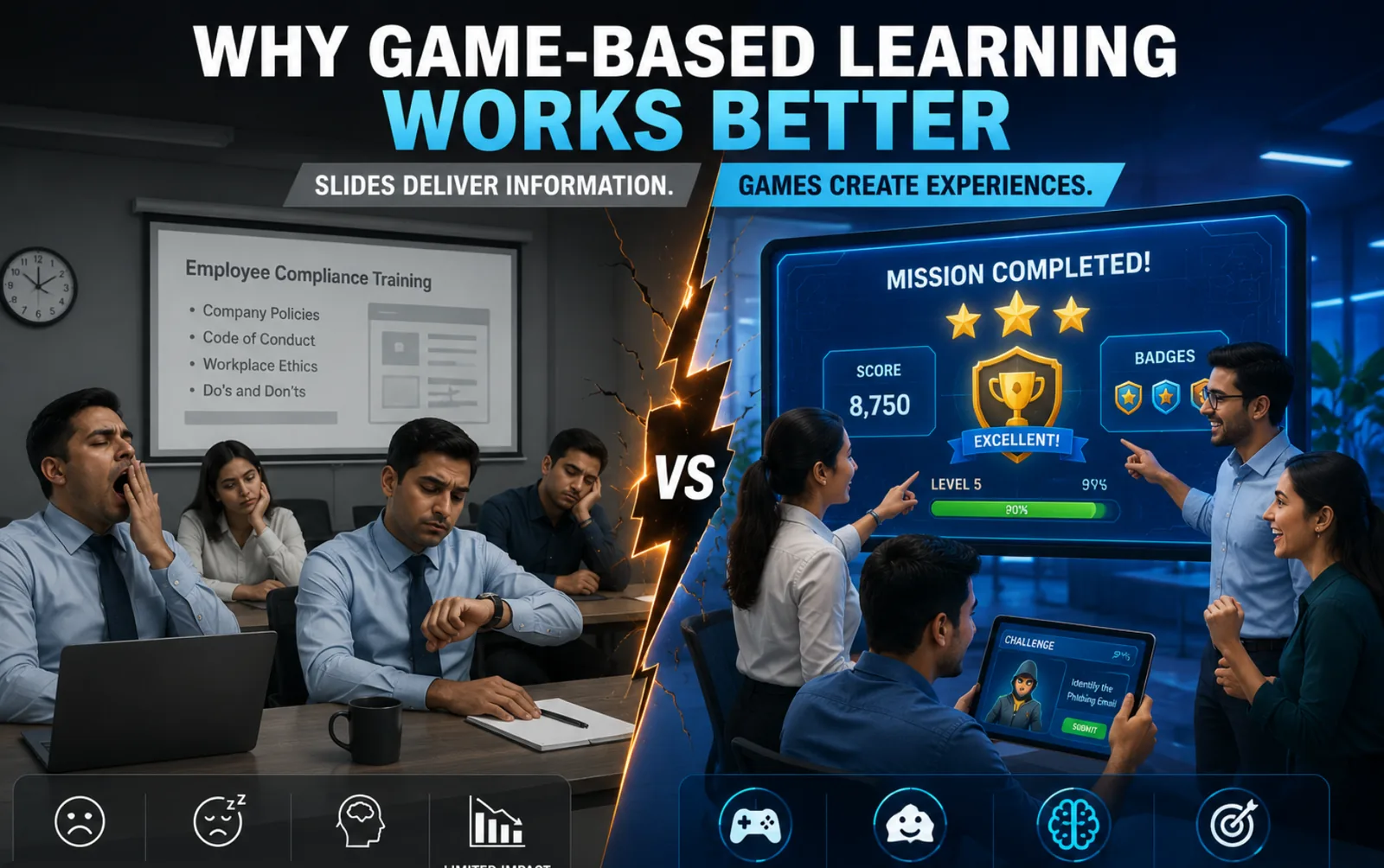
Why Traditional Slide Deck Training Falls Short
PowerPoint presentations have been a workplace staple for decades.
They're useful for sharing information.
But sharing information is not the same as creating learning.
Most slide-based training is passive.
Employees:
- Read
- Listen
- Click "Next"
- Finish the course
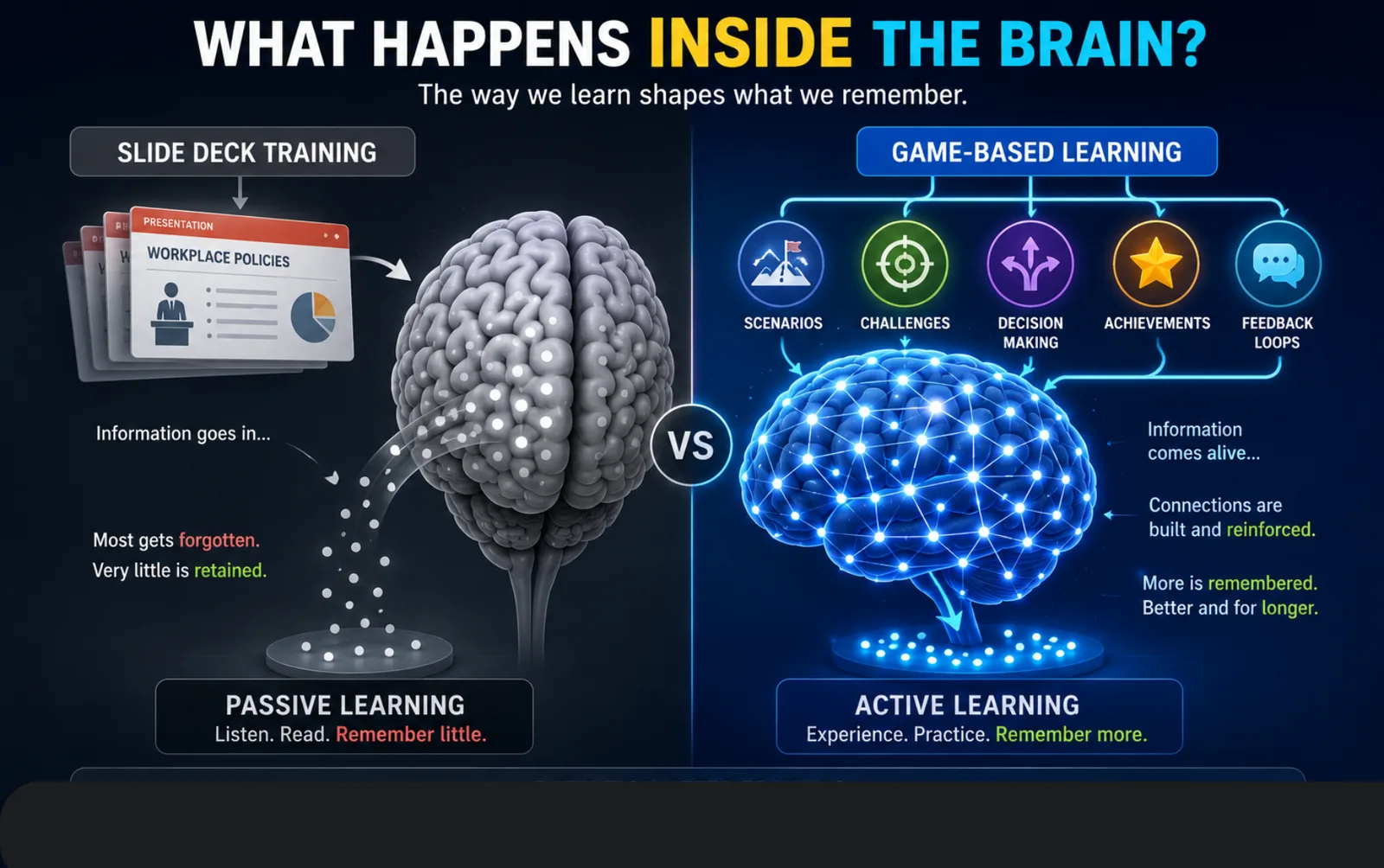
The brain, however, learns best through participation.
Without interaction, learners quickly lose attention and struggle to retain knowledge.
Common Challenges with Traditional Training
| Traditional Training | Business Impact |
|---|---|
| Passive learning | Lower engagement |
| Generic examples | Reduced relevance |
| Information overload | Poor retention |
| Limited practice | Low confidence |
| One-way communication | Minimal participation |
| Completion-focused | Limited behavior change |
Training shouldn't just inform employees.
It should prepare them to act.
What Is Game-Based Learning?
Game-based learning uses game mechanics to teach real workplace skills.
Instead of reading about a situation, learners experience it.
Examples include:
- Interactive missions
- Business simulations
- Decision-making scenarios
- Role-playing exercises
- Branching conversations
- Timed challenges
- Team competitions
- Reward systems
The objective isn't entertainment.
The objective is active learning.
Why It Works Better
1. Learning Through Experience
“We remember experiences better than lectures.
Employees develop a stronger understanding and confidence when they are engaged in problem solving.
They are practicing how to do things, not learning what to do.
2. Higher Engagement
Games naturally breed curiosity.
Employees move from being observers to being participants.
Motivators to keep learners going include progress bars, levels, achievements and challenges.
The experience becomes something they want to complete, not something they have to complete.
3. Better Knowledge Retention
Studies have shown over and over again that active participation improves long-term memory.
Game-based learning reinforces concepts through repetition, feedback and application.
Employees tend to learn lessons learned through experience more than just reading.
4. Safe Practice Environment
Many workplace situations involve risk.
Examples include:
- Customer complaints
- Cybersecurity incidents
- Safety hazards
- Leadership conversations
- Compliance decisions
Game-based learning allows employees to make mistakes safely and learn from them before facing real-world situations.
Slide Deck vs Game-Based Learning
| Factor | Slide Decks | Game-Based Learning |
|---|---|---|
| Learner Engagement | Low | Very High |
| Participation | Passive | Active |
| Knowledge Retention | Moderate | High |
| Decision-Making Practice | None | Extensive |
| Realistic Scenarios | Limited | High |
| Motivation | Completion | Achievement |
| Feedback | End of Course | Continuous |
| Business Impact | Medium | High |
The difference isn't just technology.
It's how people learn.
Where Game-Based Learning Delivers the Biggest Value
Employee Onboarding
New employees learn:
- Company culture
- Policies
- Systems
- Processes
through interactive missions instead of static presentations.
Compliance Training
Topics like:
- POSH
- Cybersecurity
- Data Privacy
- Workplace Ethics
become scenario-driven experiences where learners make decisions and understand consequences.
Leadership Development
Future leaders practice:
- Coaching conversations
- Conflict resolution
- Performance management
- Decision-making
inside realistic business simulations.
Sales Enablement
Sales teams practice:
- Discovery conversations
- Negotiation
- Objection handling
- Product positioning
before meeting actual customers.
Customer Service Training
Employees respond to simulated customer interactions and receive instant feedback based on their choices.
A Realistic Example
Imagine cybersecurity awareness training.
Traditional Approach
Employees watch a presentation explaining phishing emails.
Complete a quiz.
Receive a certificate.
Game-Based Approach
An employee receives simulated emails.
They decide whether to:
- Open attachments
- Report suspicious messages
- Ignore threats
Every decision creates consequences.
Feedback is immediate.
Learning becomes memorable because it mirrors real work.
Common Myths About Game-Based Learning
Myth 1: "Games Are Only for Young Employees."
Reality:
Adults learn through interaction just as effectively.
Game-based learning focuses on workplace scenarios—not entertainment.
Myth 2: "It's Too Expensive."
Custom game-based learning requires investment.
However, improved engagement, retention, and reduced retraining often create greater long-term value.
Myth 3: "It Doesn't Work for Compliance."
In fact, compliance training is one of the strongest use cases.
Scenario-based learning helps employees understand not only rules—but consequences.
Myth 4: "Games Replace Traditional Learning."
They don't.
Most organizations combine:
- Videos
- Microlearning
- Assessments
- Instructor-led sessions
- Game-based modules
to create blended learning experiences.
Is Game-Based Learning Right for Every Topic?
Not necessarily.
Some topics benefit from straightforward information delivery.
Others require practice and decision-making.
Best for Game-Based Learning
| Training Area | Suitability |
|---|---|
| Leadership | Excellent |
| Sales | Excellent |
| Customer Service | Excellent |
| Compliance | Excellent |
| Cybersecurity | Excellent |
| Safety | Excellent |
| Onboarding | High |
| Product Training | High |
How 4Edge Designs Game-Based Learning
At 4Edge, we believe learning should change behavior—not just deliver information.
Our game-based learning solutions combine:
- Instructional design
- Business scenarios
- Interactive storytelling
- Simulations
- Gamification
- Assessments
- LMS integration
- Analytics and reporting
Every learning experience is rooted in business objectives and employee roles and measurable outcomes.
Whether you’re training sales teams, leaders, compliance officers or frontline employees, our goal is the same:
Design learning experiences that people remember – and can use.
Game-Based Learning vs Gamification
These terms are often confused.
| Game-Based Learning | Gamification |
|---|---|
| Learning happens inside the game | Game elements are added to existing learning |
| Focus on scenarios and decisions | Focus on points, badges, and leaderboards |
| Immersive learning experience | Motivational enhancement |
| Solves workplace problems | Encourages participation |
Many organizations combine both approaches for maximum impact.
Before You Build Your Next Training Program
Ask yourself:
- Are employees actively participating?
- Are they practicing real decisions?
- Will they remember the content after a month?
- Can they confidently apply it at work?
If the answer is no, the issue may not be your learners.
It may be the learning experience.
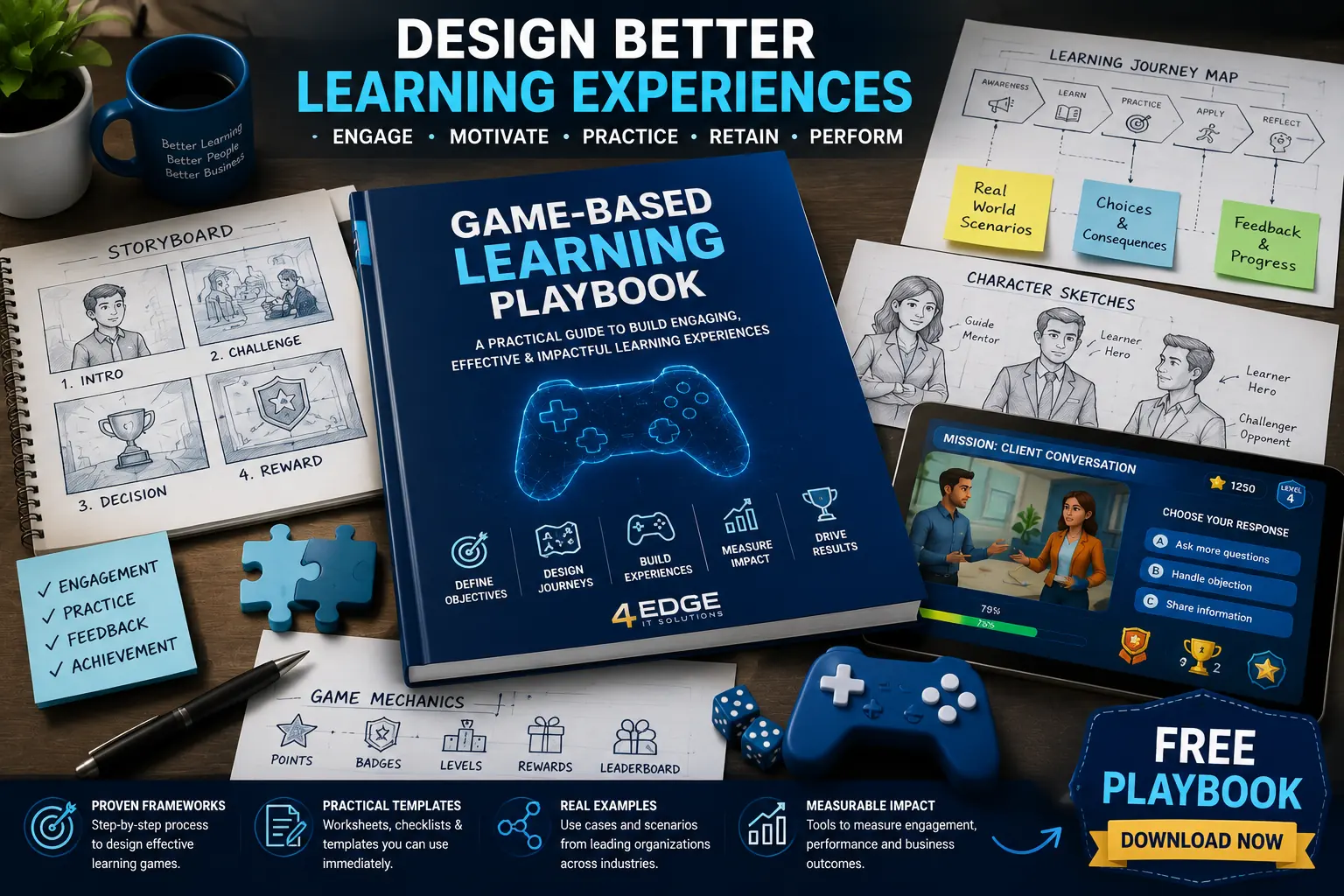
Free Resource: Game-Based Learning Playbook
Planning a gamified learning initiative?
Download our Game-Based Learning Playbook to learn how to:
- Identify suitable training topics
- Choose the right game mechanics
- Design engaging learning journeys
- Measure learning outcomes
- Build scalable programs
What's Included?
| Resource | Purpose |
|---|---|
| Game-Based Learning Readiness Checklist | Assess organizational readiness |
| Learning Journey Planner | Map learner experiences |
| Scenario Design Worksheet | Build workplace simulations |
| Gamification Framework | Select appropriate mechanics |
| ROI Measurement Guide | Track learning impact |
Build training experiences employees will actually enjoy—and remember.
Frequently Asked Questions
What is game-based learning in corporate training?
Game-based learning uses interactive scenarios, simulations, challenges, and decision-making activities to teach workplace skills through active participation rather than passive content consumption.
How is game-based learning different from gamification?
Game-based learning delivers learning through interactive gameplay, while gamification adds game elements such as badges, points, and leaderboards to existing learning experiences.
Does game-based learning improve employee engagement?
Yes. Interactive learning experiences typically increase participation, motivation, and knowledge retention by encouraging learners to actively solve problems instead of simply consuming information.
Is game-based learning suitable for compliance training?
Absolutely. Compliance topics such as POSH, cybersecurity, data privacy, workplace ethics, and safety become more effective when learners experience realistic workplace scenarios.
Can game-based learning integrate with an LMS?
Yes. Modern game-based learning modules can integrate with Learning Management Systems (LMS) using standards such as SCORM or xAPI for tracking learner progress and performance.
The future of workplace learning isn't about replacing slide decks with games.
It's about replacing passive learning with meaningful experiences.
When employees participate, decide, practice, and experience consequences, learning becomes memorable.
And memorable learning creates measurable business results.
The organizations that invest in engaging learning today will build more capable, confident, and future-ready workforces tomorrow.
About the author
4Edge Learning Design TeamLearning & Development Lead
Leads instructional design at 4Edge IT Solutions, building eLearning content, game-based learning and LMS rollouts for corporate, NGO and education clients across India and abroad.