Game-based learning can turn a compliance module, product-training course or skills program into an experience employees actually participate in.
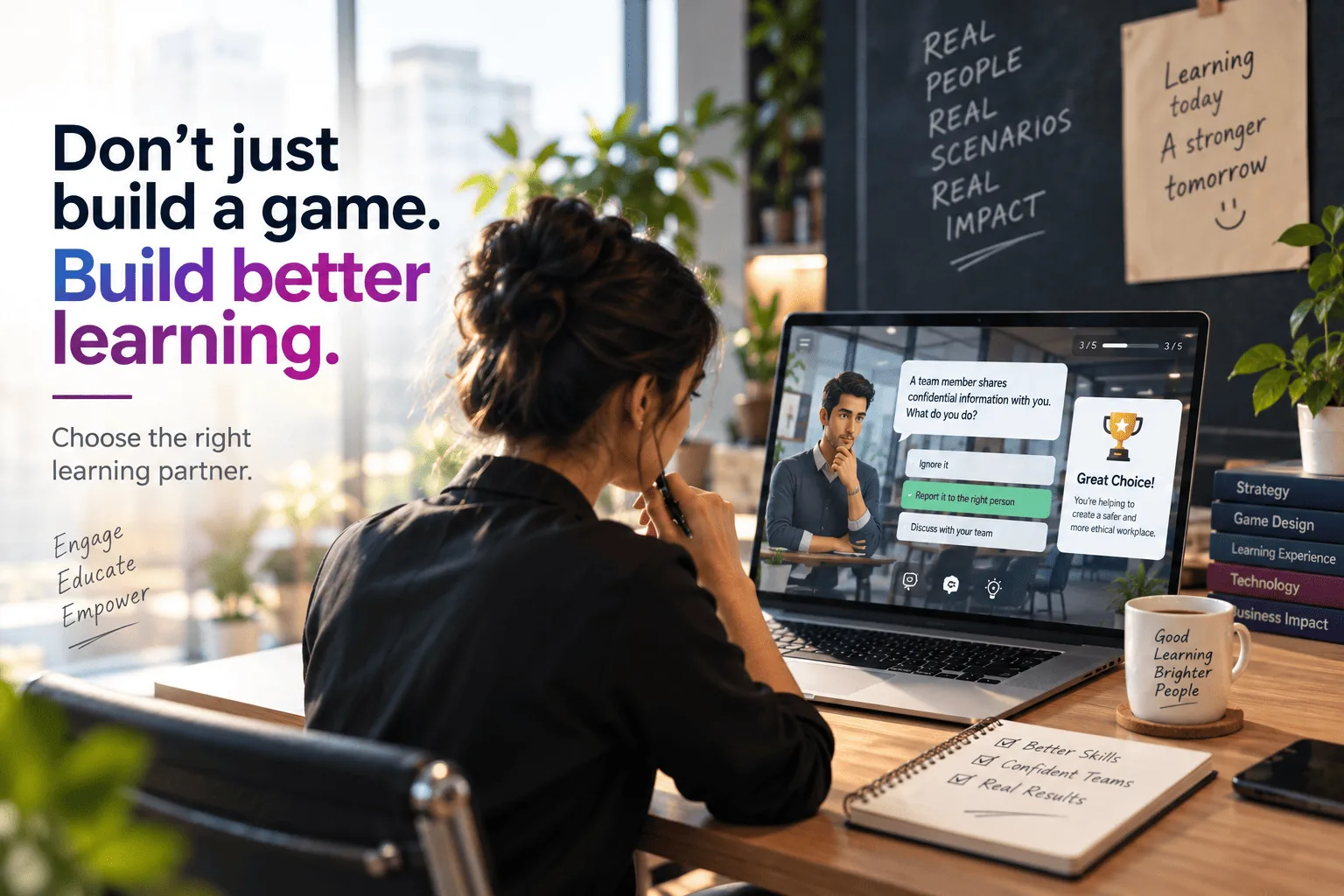
But there is an important distinction between putting points and badges into a course and actually designing a learning experience around game mechanics.
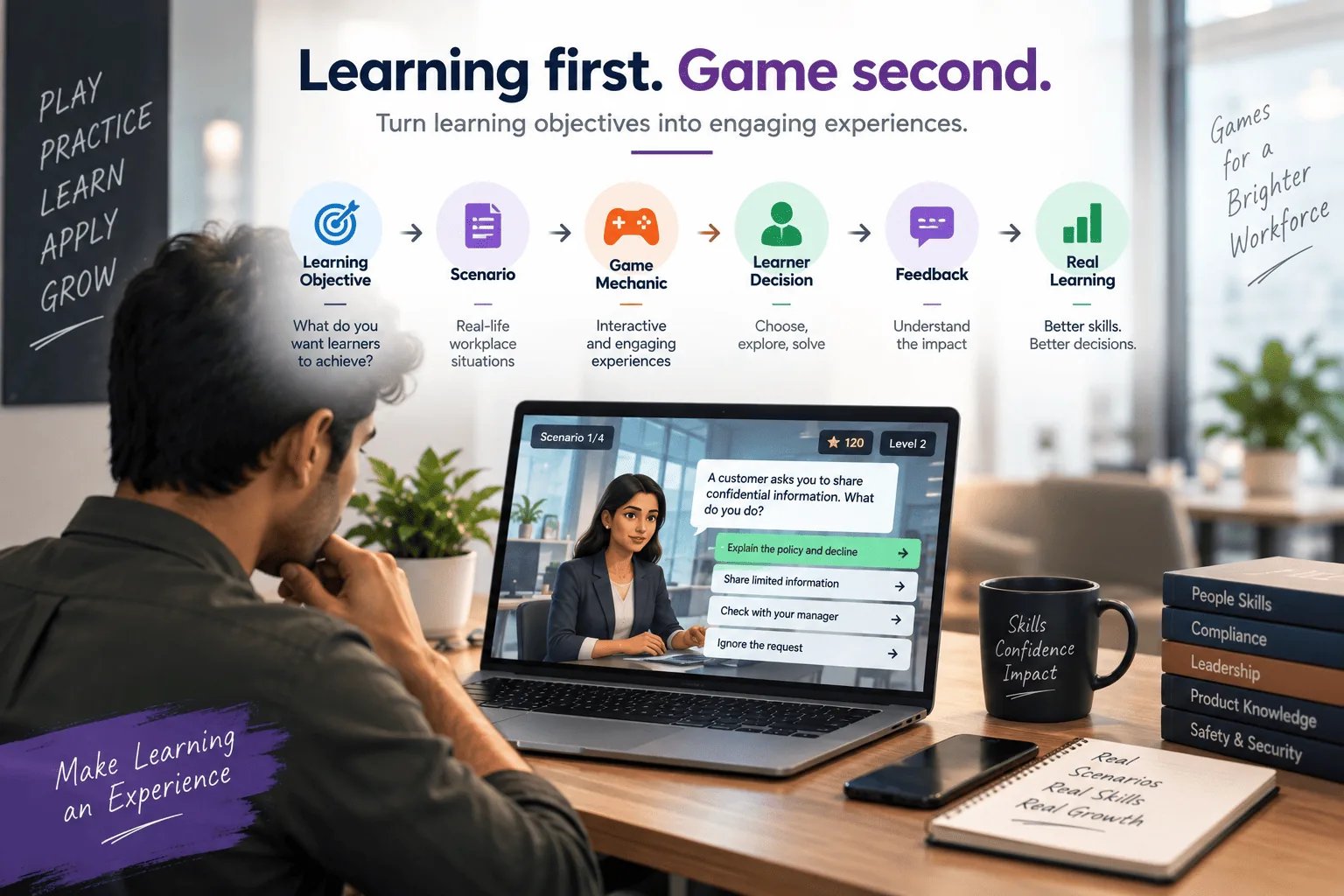
A well-designed learning game should make the learner think, decide, practise and receive feedback. The technology supports the learning objective—it shouldn't become the objective itself.
Recent research supports this distinction. A 2022 systematic review of digital game-based learning for professional upskilling found supportive evidence for its effectiveness when game design, pedagogy and learning support are deliberately addressed. It also cautioned that unnecessary game elements can interfere with learning.
For organizations considering a game-based learning project in India, the bigger question therefore isn't simply:
"Who can build us a game?"
It is:
"Who can design and build a game that actually solves our learning problem?"
Here are eight questions to ask before selecting a development partner.
Why the Development Partner Matters
A game-based learning project sits at the intersection of several disciplines:
Learning design + game design + technology + user experience + measurement
A game studio may be excellent at entertainment but have limited experience designing for workplace learning.
An e-learning company may understand instructional design but lack the technical capability to build sophisticated interactive experiences.
And a software development company may be able to build the technology without understanding how adults learn.
The strongest projects bring these capabilities together.
A 2025 review of 49 empirical studies on gamification in employee training found potential benefits across engagement, motivation, knowledge retention and performance, while also emphasizing that outcomes depend on design quality, contextual fit, learner characteristics and organizational culture.
So, before evaluating portfolios or comparing quotations, evaluate the partner's learning capability.
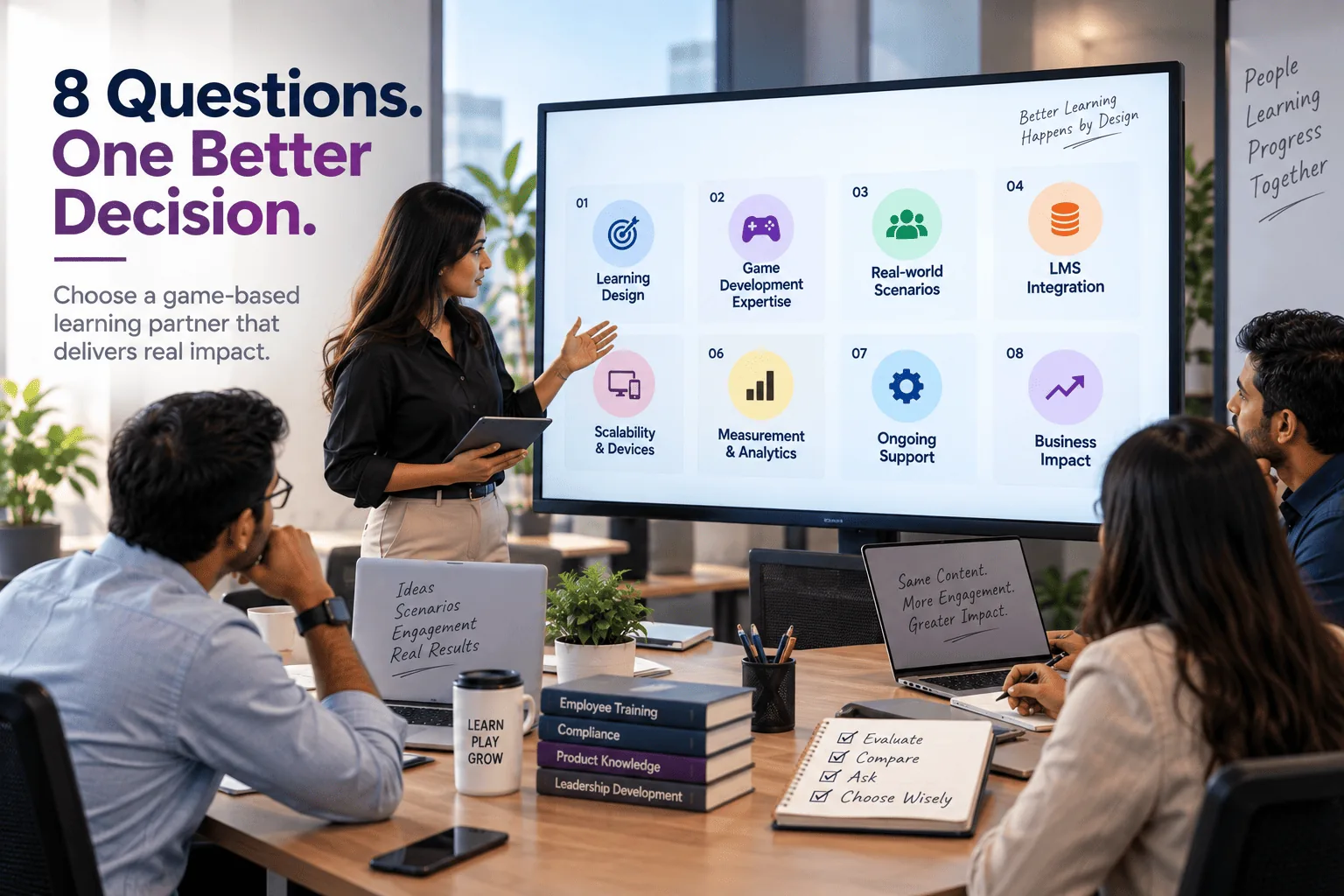
The 8 Questions to Ask a Game-Based Learning Development Company
1. Can you show us learning games—not just games?
This should be your first question.
Ask the development company to show examples of projects where the primary purpose was learning or training.
Look beyond screenshots.
Ask:
- What was the learning objective?
- Who were the learners?
- What behavior was the game designed to change?
- What decisions did learners make?
- How was learning assessed?
- How was success measured?
A visually impressive game doesn't automatically make a good learning experience.
For example, a cybersecurity game could ask employees to identify suspicious emails, decide how to respond to a security incident and see the consequences of their decisions.
That's very different from simply adding a leaderboard to a cybersecurity course.
What to look for
| Strong signal | Red flag |
|---|---|
| Learning objective comes first | Game mechanics come first |
| Realistic scenarios | Generic gameplay |
| Meaningful decisions | Clicking through animations |
| Feedback explains consequences | Points without explanation |
| Learning outcomes are measured | Engagement is the only metric |
2. How do you translate a learning objective into game mechanics?
This question separates learning design from entertainment.
A good development partner should be able to explain why a particular mechanic is being used.
For example:
| Learning Objective | Possible Game Mechanic |
|---|---|
| Decision-making | Branching scenarios |
| Problem-solving | Challenges / puzzles |
| Product knowledge | Missions / simulations |
| Process training | Interactive simulations |
| Risk awareness | Consequence-based scenarios |
| Collaboration | Team challenges |
| Knowledge reinforcement | Short challenges / quizzes |
| Skill practice | Simulated environments |
The important word is possible.
There is no universal rule that says every training program needs points, badges, levels or leaderboards.
The systematic review of digital game-based learning found that game elements should be selected purposefully because unnecessary elements can actually hinder the learning process.
Expert Insight
Don't ask, "What game can we build?"
Ask:
"What should employees be able to do differently after playing it?"
Then design the experience backwards from that outcome.
3. Do you understand adult learning and instructional design?
Your development partner doesn't necessarily need to be an academic research organization.
But they should understand that corporate learners are not playing simply for entertainment.
Employees have limited time.
They need relevance.
They need context.
And they need to understand why the experience matters to their work.
A good game-based learning experience should therefore connect:
Scenario → Decision → Consequence → Feedback → Learning
For example:
A sales employee enters a simulated customer meeting.
The customer raises an objection.
The employee chooses a response.
The customer reacts.
The learner receives feedback explaining why that response worked—or didn't.
That creates an opportunity to practise judgment rather than simply remember information.
Research into professional digital game-based learning similarly emphasizes the importance of pedagogy and instructional strategies alongside game design.
4. Can you build scenarios around our actual business?
Generic games can demonstrate technology.
Custom scenarios create relevance.
Ask whether the development partner can transform your:
- Policies
- Processes
- Products
- Customer situations
- Safety procedures
- Compliance requirements
- Sales situations
- Operational decisions
into realistic learning scenarios.
For example, instead of:
"Do you know the company's data privacy policy?"
a game could present:
A customer asks an employee to share account information with a third party. What should the employee do?
The learner makes a decision.
The scenario changes.
The consequences become visible.
The learning becomes contextual.
This is particularly useful for areas such as:
- Workplace ethics
- POSH
- Cybersecurity awareness
- Data privacy
- Product training
- Sales enablement
- Leadership development
- Safety training
- Process training
The scenarios should also reflect your industry. For example, a bank may need scenarios around:
- Customer verification
- Fraud detection
- Data privacy
- Compliance
- Difficult customer conversations
A manufacturing company might need:
- Safety decisions
- Quality checks
- Equipment handling
- Production processes
Ask:
"Can you turn our real workplace situations into interactive scenarios?"
5. Will the game integrate with our LMS and existing systems?
This is where a learning game becomes an enterprise learning asset rather than an isolated application.
Ask your development partner about:
- LMS integration
- LXP and HRMS connections
- SCORM
- xAPI
- SSO
- APIs
- User authentication
- Progress tracking
- Assessment scores
- Completion status
- Certificates
- Learning records
- Reporting dashboards
- Mobile compatibility
If your organization already has an LMS, the game should ideally fit into the existing learning ecosystem rather than creating another disconnected platform. The right integration approach depends on your existing technology architecture.
For example, 4Edge's K-Nest LMS supports content such as video, interactive video and SCORM-based content, along with assessments, user management, certification and gamification features.
Ask this before development begins
"Where will learner progress, scores and completion data live?"
If the answer is unclear, resolve it before signing off on the project.
6. Can you design for scale, devices and distributed teams?
A training game that works beautifully on one laptop in a demonstration room isn't necessarily an enterprise-ready product.
Consider your actual learner environment.
Will employees access it through:
- Desktop?
- Laptop?
- Tablet?
- Mobile?
- Corporate network?
- Home internet?
- Different browsers?
- Different screen sizes?
If your workforce is distributed, performance and accessibility become particularly important.
The World Economic Forum's Future of Jobs Report 2025 highlights the continuing importance of skills development as organizations respond to changing technology and workforce requirements. The report draws on input from more than 1,000 employers representing over 14 million workers across 55 economies.
That makes scalability more than a technical question.
It is a learning operations question.
Ask your development partner:
- How will the experience perform on mobile?
- Can thousands of users access it simultaneously?
- How is progress saved?
- What happens when connectivity drops?
- Can content be updated without rebuilding everything?
- Can new scenarios be added later?
- Is the experience accessible to all learner groups?
- Does it support multiple languages?
4Edge's game development offering specifically highlights multi-platform and multi-language capabilities.
7. How will you measure whether the game actually worked?
This may be the most important question after learning design.
Engagement isn't the same as learning.
A learner can spend 20 minutes playing a game without actually developing the intended skill.
Your measurement framework should therefore go beyond:
Users → Sessions → Time spent
Consider measuring:
Completion → Knowledge → Decisions → Application → Business outcome
Depending on the program, useful measures might include:
- Completion rate
- Assessment scores
- Scenario accuracy
- Decision quality
- Repeat attempts
- Knowledge retention
- Skill improvement
- Time to proficiency
- Reduction in common errors
- Compliance awareness
- Sales performance
- Behavioural indicators, where measurable
A 2025 review of gamification in employee training found potential benefits in engagement, motivation, knowledge retention and performance, but also emphasized that results depend heavily on implementation and context.
So don't accept:
"Employees loved the game."
as the final success metric.
Ask:
"What changed because employees played it?"
8. What happens after the game launches?
A game-based learning project shouldn't become obsolete six months after launch.
Ask about the post-launch lifecycle.
Find out:
- Who fixes bugs?
- Who updates scenarios?
- Who updates policy content?
- Can administrators add new challenges?
- How are analytics reviewed?
- Can the game be expanded?
- What happens when your LMS changes?
- What happens when a business process changes?
- Who maintains browser and device compatibility?
- What is included in ongoing support?
This matters particularly for compliance and product training.
A policy can change.
A product can change.
A process can change.
Your learning experience needs to change with it.
Game-Based Learning vs. Gamification: Don't Confuse the Two
These terms are often used interchangeably, but they aren't the same.
| Game-Based Learning | Gamification |
|---|---|
| Learning happens through a game or game-like experience | Game mechanics are added to an existing experience |
| Scenario-driven | Often course-driven |
| Decisions and consequences | Points, badges, levels |
| Can simulate real situations | Can motivate participation |
| Often requires custom design | Can be implemented within an LMS |
| Useful for practice and problem-solving | Useful for engagement and reinforcement |
For example:
Gamification: Complete a compliance course → earn 100 points → receive a badge.
Game-based learning: Enter a simulated workplace → encounter an ethical dilemma → choose an action → see the consequence → receive feedback → try again.
Both approaches can be useful.
The right choice depends on the learning objective.
What Should You Ask for During the Vendor Evaluation?
Don't evaluate vendors using only a proposal document.
Ask shortlisted companies to demonstrate a mini prototype.
Give them one small learning objective.
For example:
"Teach employees how to identify and respond to a phishing attempt."
Ask each company to explain:
- Their learning objective
- Their target learner
- Their proposed game mechanic
- The scenario
- The learner's decision
- The feedback
- How they would measure learning
- How it would integrate with your LMS
You will learn considerably more from this exercise than from a 40-slide company presentation.
A Practical Vendor Evaluation Matrix
Use this before making a decision.
| Evaluation Area | What to Look For |
|---|---|
| Learning design | Clear learning objectives |
| Game design | Mechanics serve the learning |
| Scenario quality | Realistic workplace situations |
| Technology | Scalable, responsive architecture |
| LMS integration | SCORM / xAPI / API / SSO capability |
| Analytics | Learning and performance measurement |
| Customization | Ability to reflect your business |
| Support | Post-launch maintenance |
| Accessibility | Usable across learner groups |
| Portfolio | Relevant learning-game experience |
Don't simply choose the company with the most impressive graphics.
Choose the partner whose approach makes the learning outcome easiest to explain and measure.
Why Custom Game-Based Learning Can Make Sense
Off-the-shelf learning games can be useful when the learning requirement is generic.
But custom development becomes more relevant when the organization needs:
- Industry-specific scenarios
- Proprietary processes
- Product simulations
- Complex decision-making
- Organization-specific compliance situations
- Existing LMS integration
- Custom analytics
- Multiple learner roles
- Branded learning environments
This is where a development partner with both learning and software engineering capability can add value.
4Edge IT Solutions, for example, provides education-based game development focused on concept clarity, procedural fluency, interactive quizzes and customized educational experiences.
For organizations already building a broader digital learning ecosystem, 4Edge also provides learning-platform and LMS capabilities through K-Nest.
You can also explore 4Edge's approach to gamified education when evaluating how game mechanics can support learning.
A Simple Decision Checklist
Before selecting a game-based learning development company, ask:
☐ Do they understand our learning objective?
☐ Do they have relevant corporate learning experience?
☐ Can they build realistic scenarios?
☐ Can they explain why each game mechanic is being used?
☐ Can the experience integrate with our LMS?
☐ Can it work across our actual learner devices?
☐ Can we measure learning—not just gameplay?
☐ Can the experience be updated after launch?
☐ Do they provide ongoing support?
☐ Can they scale the solution as our learning program grows?
If several of these questions don't have clear answers, the project needs more discovery before development begins.
The Right Partner Is More Than a Game Developer
The best game-based learning projects aren't created by starting with technology.
They start with a learning problem.
Then come the scenario, mechanics, experience, technology and measurement.
That sequence matters.
A strong development partner should therefore be able to move comfortably between instructional design, game mechanics, software development, LMS integration and learning analytics.
That's ultimately what you're evaluating.
Not who can build the most impressive game.
But who can build an experience that helps people learn, practise and apply something that matters to the business.
Frequently Asked Questions
What is game-based learning?
Game-based learning uses games or game-like interactive experiences as the primary environment through which learners practise knowledge, skills or decision-making. It differs from simply adding points or badges to a conventional course.
How do I choose a game-based learning development company in India?
Evaluate the company's experience in learning design, game development, corporate training, LMS integration, analytics, scalability and post-launch support. Ask for relevant case studies and consider using a small prototype exercise during vendor evaluation.
How much does custom game-based learning development cost in India?
The cost varies significantly based on the game complexity, number of scenarios, platforms, art and animation requirements, integrations, learner volume, analytics and content development. A prototype or discovery phase is useful before establishing a detailed project estimate.
Is game-based learning suitable for corporate training?
It can be particularly useful when employees need to practise decision-making, problem-solving, procedures, risk recognition or other skills that benefit from interaction and feedback. It isn't necessarily the best format for every learning objective.
What is the difference between gamification and game-based learning?
Gamification adds selected game mechanics such as points, badges, levels or leaderboards to an existing learning experience. Game-based learning uses a game or game-like experience as the learning environment itself.
Can game-based learning integrate with an LMS?
Yes, depending on how the learning experience is developed. Integration options can include SCORM, xAPI, APIs, SSO and other LMS-specific mechanisms. Integration requirements should be defined before development begins.
Conclusion
Choosing a game-based learning development company is ultimately a learning-design decision supported by technology.
Before comparing development costs or visual portfolios, ask eight questions:
- Can you show learning-game experience?
- How do you translate objectives into mechanics?
- Do you understand adult learning?
- Can you build our real scenarios?
- Can you integrate with our LMS?
- Can the solution scale?
- How will learning outcomes be measured?
- What happens after launch?
The answers will tell you far more about a development partner than a list of technologies ever will.
Planning a game-based learning project? Start with the learning objective, define the learner behavior you want to change, and then choose the technology and development partner around that requirement.
About the author
4Edge Learning Design TeamLearning & Development Lead
Leads instructional design at 4Edge IT Solutions, building eLearning content, game-based learning and LMS rollouts for corporate, NGO and education clients across India and abroad.